Every mobile line in Mexico now has to be linked to its owner’s CURP, and carriers suspend the lines that miss their deadline. The registry doesn’t record what you do online, but it ties your phone number, and the mobile data behind it, to your name.
A VPN can’t undo that link. What it protects is the data itself: bank logins, messages, and searches leave your phone encrypted, which helps on a crowded airport network where you don’t know who else is connected. For travelers, it also works in the other direction.
Your phone gets a US or Mexican IP address, so home banking apps and streaming services treat you as a local. These five handle both jobs well.
Mexico’s Top 5 VPNs at a Glance
- NordVPN: Best for speed in Mexico. Its Mexican servers kept nearly all of our connection speed.
- Proton VPN: Best for sensitive work. Secure Core and Stealth protect reporters’ traffic.
- ExpressVPN: Best for travelers. Quick to connect on hotel and airport Wi-Fi.
- Private Internet Access: Best for big families. Unlimited devices on one subscription.
- Surfshark: Best for ad-free browsing. CleanWeb comes with the cheapest plan.
Mexico VPN Comparison
| VPN | Mexican servers | Countries | Average speed loss | Obfuscation | Ads blocked (d3ward test) |
|---|---|---|---|---|---|
| NordVPN | 30+ servers | 152 | 7.8% (NordLynx) | NordWhisper, obfuscated servers | 76% (next-gen antivirus) |
| Proton VPN | 220 servers in Mexico City and Querétaro | 149 | 10.2% (WireGuard) | Stealth | 93% (NetShield) |
| ExpressVPN | Mexico City | 113 | 7.8% (Lightway) | Automatic | 71% (Advanced Protection) |
| Private Internet Access | Mexico City | 113 | 12.7% (WireGuard) | Shadowsocks proxy | 96% (MACE) |
| Surfshark | 32 servers in Querétaro | 100 | 9.6% (WireGuard) | Camouflage Mode | 79% (CleanWeb) |
Our Top 5 VPNs for Mexico: Tested and Reviewed
1. NordVPN: Best for Speed on Mexican Servers
Pros
- Fast Mexican servers
- Unblocks ViX and TV Azteca En Vivo
- NordWhisper hides VPN traffic
- Independently audited no-logs policy
- App-level kill switch
Cons
- Ad blocker misses some ads
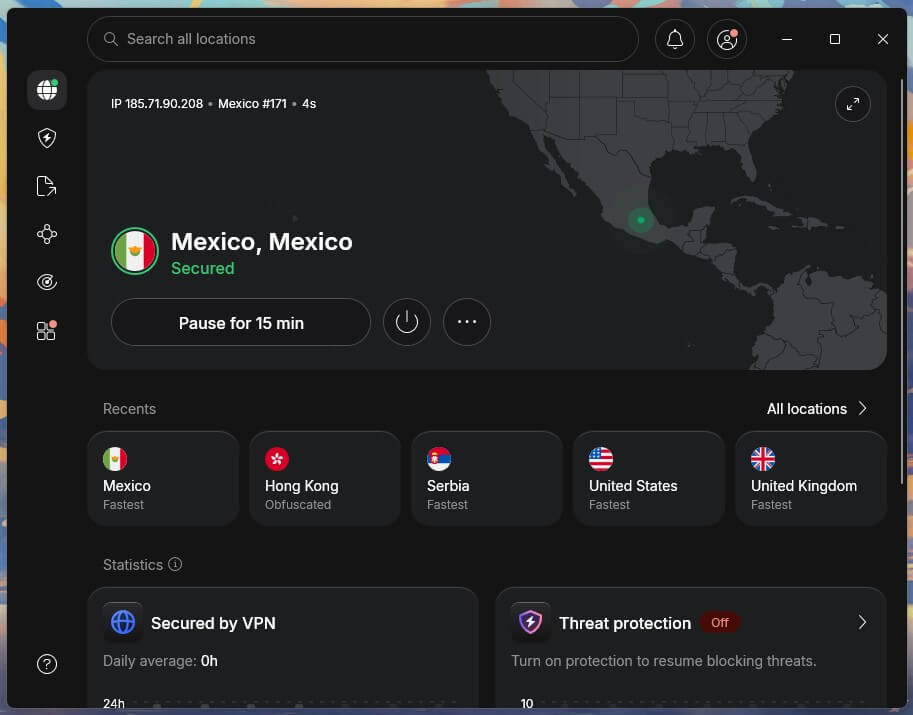
NordVPN’s Mexican server lost just 6.5% of our speed, the best result on a Mexican server we recorded. Video calls, 4K streams, and banking apps behave as they do on a normal connection, at home on Telmex or Totalplay and on a shaky hotel network alike. On those servers, NordVPN unblocked ViX and TV Azteca En Vivo.
From US and UK servers, it had no trouble with any of the 9 international streaming services in our tests. Our page on NordVPN’s Netflix results lists the libraries it unblocks. For privacy, NordVPN’s no-logs claims have gone through several independent audits, and NordWhisper disguises VPN traffic on office or hotel networks that block VPNs.
NordVPN can also close the apps you choose, such as your banking app, when the connection drops, a feature called an app-level kill switch. Next-gen antivirus was the letdown: it blocked about three-quarters of the test ads, a bit disappointing for software sold as protection.
Pair NordVPN with a browser ad blocker if pop-ups on Mexican news sites bother you.
2. Proton VPN: Best for Journalists and Activists
Pros
- Swiss privacy law
- Secure Core servers in privacy-friendly countries
- Yearly no-logs audits
- Stealth on all plans, even the free one
- NetShield blocks ads and trackers
Cons
- Slow Mexican servers
- No Smart DNS
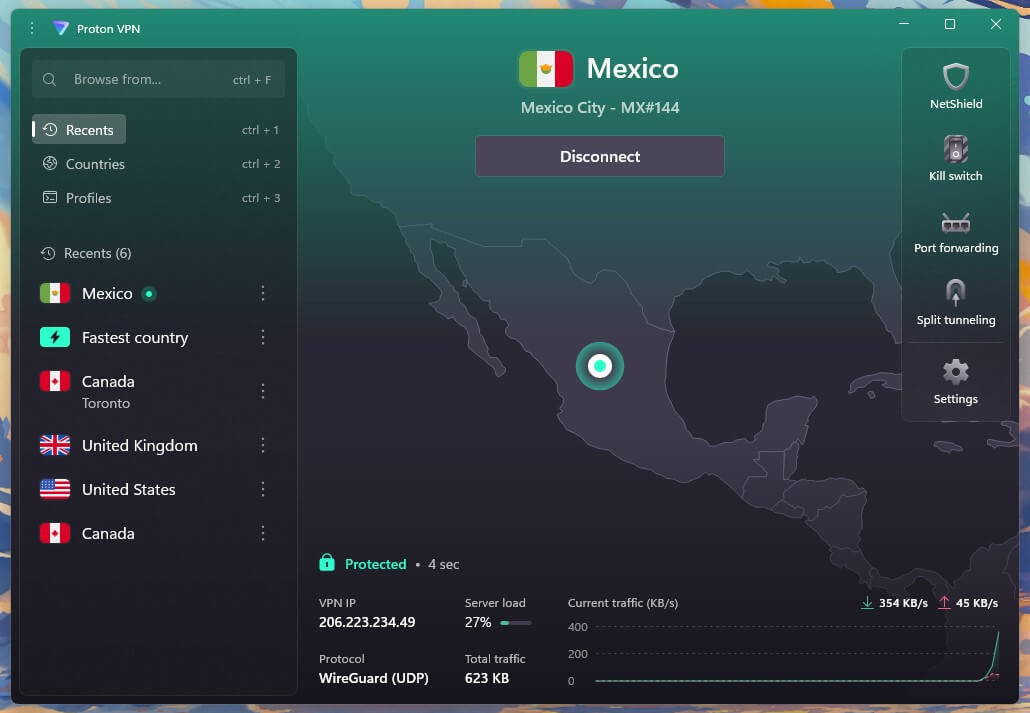
Proton VPN is the one we’d give a reporter or human rights defender in Mexico, where Pegasus spyware has been used against both. It’s based in Switzerland, and auditors check its no-logs policy every year. Secure Core adds a hardened first server in a privacy-friendly country such as Iceland.
Even someone watching the Mexican server then can’t trace the connection back to you. Its Mexican servers were the weak point, with a 59.7% speed loss, still enough for HD video but much slower than NordVPN’s. For everyday privacy, connect to one of Proton VPN’s US servers instead, which kept most of our speed.
Save the 220 Mexican servers for sites that require a Mexican IP address, since ViX and TV Azteca En Vivo gave Proton VPN no trouble there. Stealth, Proton VPN’s protocol for disguising VPN traffic, comes with every plan.
The free Proton VPN plan has unlimited data but no Mexican servers, which works for privacy but not for local sites.
3. ExpressVPN: Best for Travelers on Hotel Wi-Fi
Pros
- Connects almost instantly
- Apps available in Spanish
- Obfuscation applies automatically
- Post-quantum encryption
- Mexico City server location
Cons
- Slower Mexico City server
- Few advanced settings
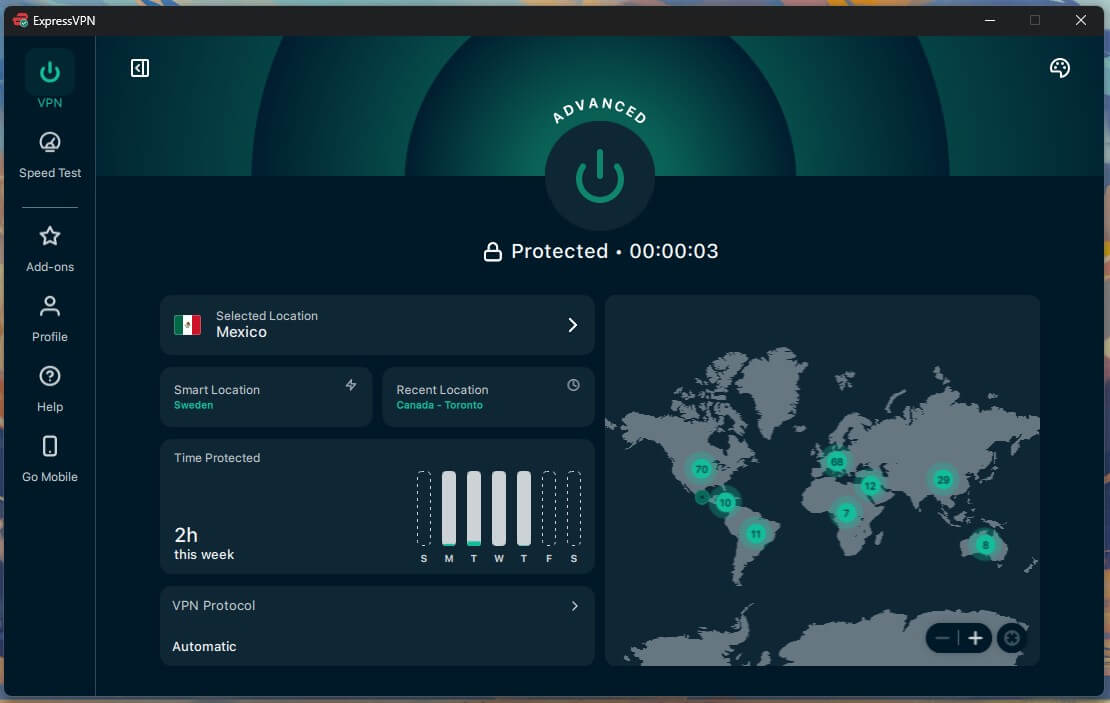
ExpressVPN is the easiest of the five to use on a trip. Its app connected in under two seconds in each of our tests, and the interface comes in Spanish. When you leave hotel Wi-Fi for mobile data, Lightway, ExpressVPN’s own protocol, restores the connection almost at once.
Obfuscation applies automatically when a network tries to block VPN traffic, so there’s nothing to configure at the airport. Its Mexico City server lost 22.5% of our speed, slower than NordVPN’s but fast enough for 4K. ExpressVPN also unblocked ViX there.
Its US servers unblocked the American streaming services we tested, and the same method works for foreign TV channels from other countries. The app has fewer settings than NordVPN’s or Proton VPN’s, with no multi-hop option and few ways to fine-tune the connection.
If you want those controls, choose one of the first two. On a two-year billing plan, ExpressVPN’s Basic plan comes to about $3 a month, with 10 devices allowed.
4. Private Internet Access: Best for Large Households
Pros
- Unlimited devices
- MACE blocks most ads and trackers
- Court-tested no-logs policy
- Mexico City server for local sites
Cons
- No automatic protocol setting
- Cluttered desktop app
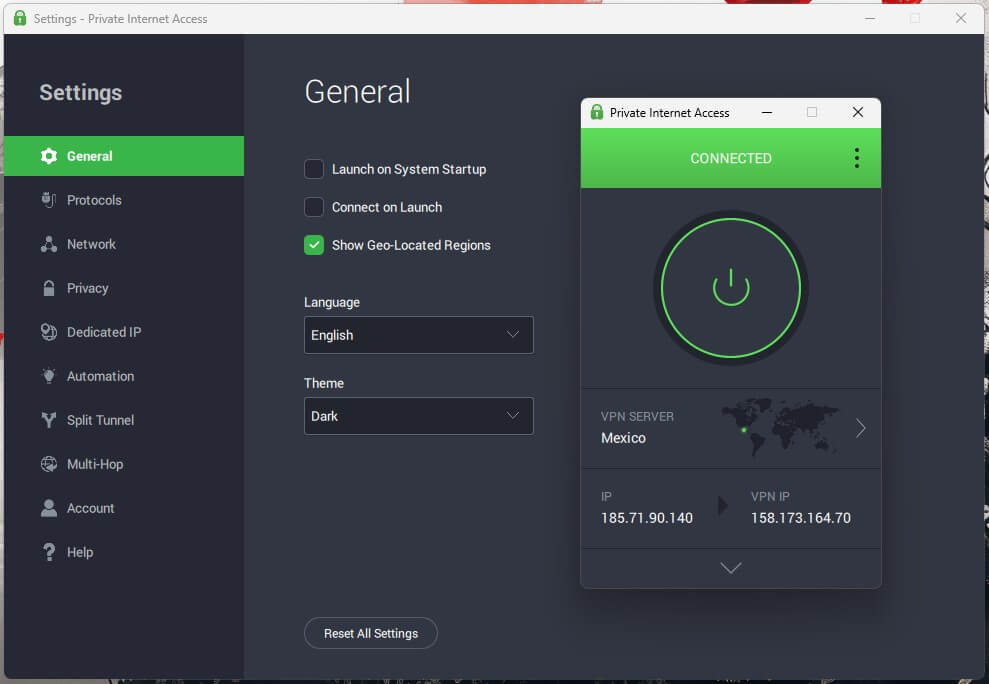
Private Internet Access covers a whole family on one subscription, since it allows unlimited devices, from phones and laptops to the smart TV in the living room. Its MACE blocker stopped 96% of the test ads and trackers, the strongest result of the five.
Subpoenas in US court cases also produced no user data from PIA, which backs up its no-logs claims. Setup takes a little more effort than on the other four. PIA’s Windows app has no automatic protocol setting and uses OpenVPN by default. Select WireGuard from its protocol menu before the rest of the family starts using it.
The desktop app also looks cluttered and dated on Windows and Mac, so expect a few minutes of finding your way around. PIA’s Mexico City server unblocked TV Azteca En Vivo and ViX, so it’s a good way to get a Mexican IP address on a budget.
Its average speed trailed the other four but remained quick enough for streaming, and prices start around $2 a month, so it’s the cheapest VPN here.
5. Surfshark: Best for Blocking Ads and Trackers
Pros
- CleanWeb on the Starter plan
- Unlimited devices
- Camouflage Mode hides VPN use
- Strong international streaming results
Cons
- Occasionally slow to connect
- Higher renewal price
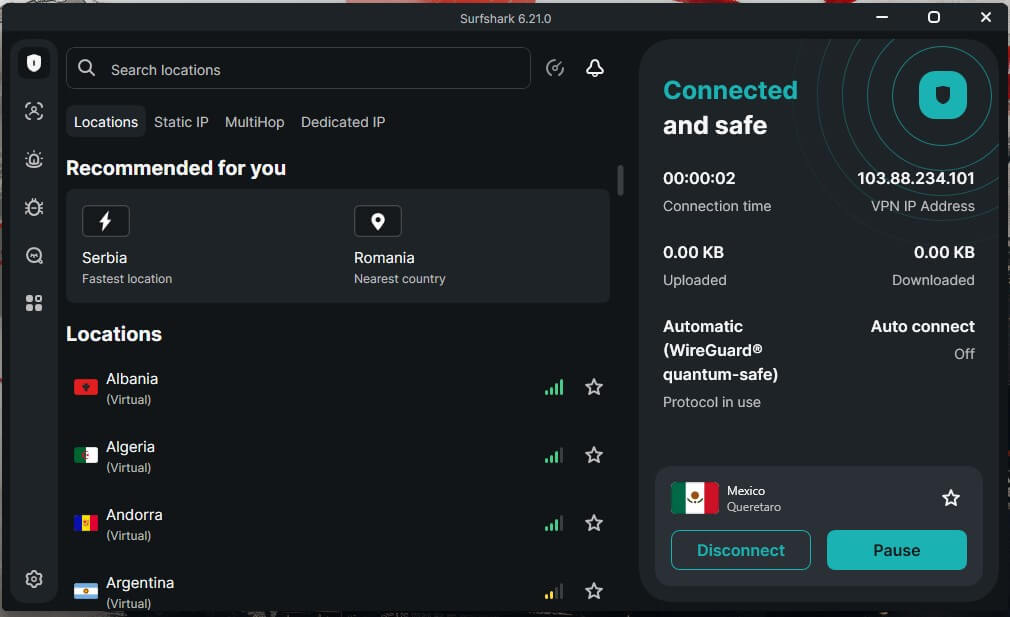
Surfshark comes with CleanWeb, its blocker for ads and trackers, even on the cheapest Starter plan. CleanWeb blocked 79% of the test ads, ahead of NordVPN and ExpressVPN, which makes ad-heavy Mexican news and sports sites easier to read on a phone. Unlimited devices mean one subscription covers the whole family.
Its Mexican servers are in Querétaro, and Camouflage Mode hides the fact that you’re using a VPN on OpenVPN connections. For streaming, Surfshark failed only on ITVX among our 9 international services, unblocking BBC iPlayer, a service with strict VPN detection, and US Netflix.
Surfshark sometimes took longer to connect than the others. If it hangs on the fastest location, choose the Querétaro server by name instead. Paying for two years brings the Starter plan to about $2.50 a month. Renewals cost more, so the longer term is the better value.
Mexico’s Telecom Rules, Surveillance, and VPN Use
Mexico doesn’t block VPNs, and nothing in its laws restricts them. Unlike China, where a VPN is often the only way to use foreign apps, the sites blocked in Mexico are mainly ones that courts find infringe copyright. The rules around those blocks changed recently.
The 2025 Telecom Law
A new telecom law took effect in July 2025 and replaced the IFT, the former regulator, with two bodies. The ATDT sets digital policy, and the CRT acts as the technical regulator. The first draft included Article 109, which would have let the authorities block digital platforms.
After criticism from rights groups, the government removed it, and the final law has no platform-blocking power. The law does keep an older duty for carriers to store connection records and phone geolocation data for authorities.
The government says access requires a court order, while critics argue the safeguards are weak. With a VPN connected, those records list the VPN server in place of the sites you visited.
Net neutrality rules also allow some traffic management, and a VPN hides which apps and services your traffic belongs to.
The Phone Registry and Spyware
Carriers are suspending unregistered lines in stages through the end of 2026, based on the last digit of each number. A VPN doesn’t affect that registry, so link your line to your CURP before your deadline.
It also can’t stop spyware. Citizen Lab confirmed Pegasus infections against Mexican journalists and human rights defenders, and court documents later showed hundreds of targets in just two months.
Pegasus attacks the phone itself, so keep your operating system updated and treat unexpected links with suspicion, with or without a VPN.
Travelers in Mexico: Banking and Streaming From Home
US and Canadian banks often treat a login from Mexico as suspicious, asking for a code or locking the session. Connecting to a server at home gives you a US IP address, so your bank sees the usual location.
Streaming works the same way. Hulu, YouTube TV, and several US channels aren’t available in Mexico, but a US server unblocks them, and watching US TV in Mexico takes only a few setup steps.
If your trip continues beyond Mexico, the method doesn’t change: connect to a US server and sign in as usual, the same way you’d access your favorite US shows abroad from any other country.
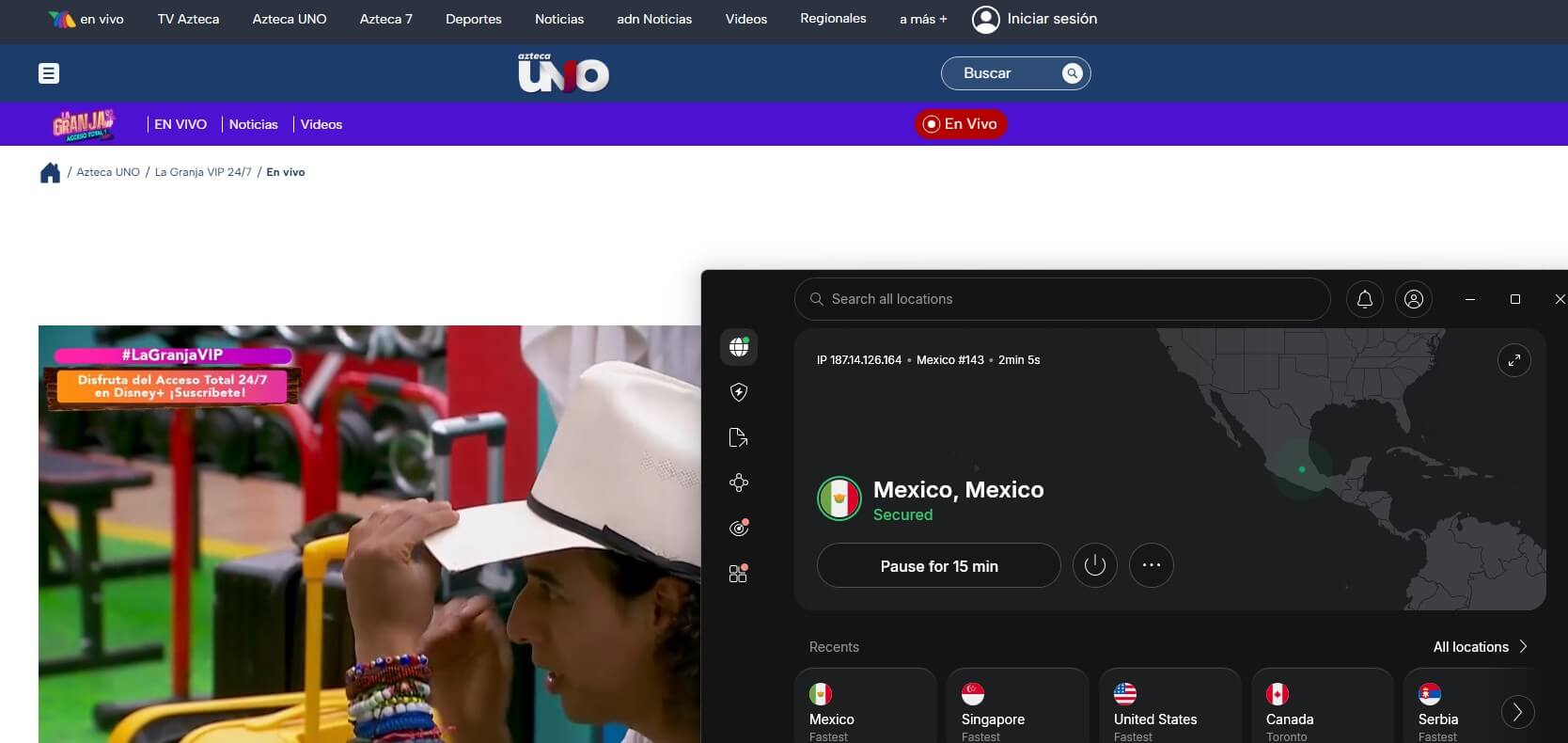
It works in reverse for Mexicans living in the US or Europe. A Mexican server unblocks ViX, TV Azteca, and Netflix Mexico, so watching Mexican TV abroad works much as it does at home.
Final Thoughts
NordVPN is the safest first choice in Mexico, mainly because its Mexican servers lost so little speed that local sites and home services behaved as usual with the VPN on. One habit makes any of the five more useful, and it’s my honest advice for you.
Set the app to connect automatically on unknown Wi-Fi networks. That way, the airport or hotel network is covered before you open your banking app, and you don’t have to remember to enable the VPN.
FAQs
Are VPNs legal in Mexico?
Yes. No Mexican law bans or restricts VPNs, so residents and visitors can use one freely. Piracy and other illegal activities remain illegal over a VPN connection.
Does a VPN hide your phone line’s CURP registration?
No. The registry links the line itself to its owner, and a VPN can’t change that. It only encrypts the internet traffic sent over the line, while the registration remains in place.
Can the Mexican government block websites?
Yes, in limited cases. Courts can order ISPs to block sites that infringe copyright. The 2025 telecom law dropped a proposal that would have let authorities block entire digital platforms.
Is there a free VPN with Mexican servers?
Yes. PrivadoVPN’s free plan includes a Mexico location with a monthly data limit. Proton VPN’s free plan offers unlimited data, but its free servers aren’t located in Mexico.
Can you use US banking apps in Mexico with a VPN?
Yes. A US server gives the phone an American IP address, so the bank sees a familiar location. Some banks still require extra verification by text message or email.