Our NordVPN vs PrivateVPN comparison explains everything you need to know about these providers. In short, both VPNs are safe to use, don’t store logs, and offer applications for all devices. However, after an in-depth assessment, we ultimately liked NordVPN more in 2026.
Despite the outcome, we think PrivateVPN is a decent low-cost option, albeit with a few caveats explained in today’s PrivateVPN vs NordVPN comparison. We performed eight tests and declared the winner at the end of each. Our results are below, so keep reading for more information.
NordVPN vs PrivateVPN: A Quick Comparison
| NordVPN 🏆 | PrivateVPN | |
| 📋 Our Current Ranking | #1 | TBD |
| 🔖 Prices | Starts at $3.09 monthly | Starts at $2.00 monthly |
| 💸 Money-Back Guarantee | 30 days for all plans | 30 days for all plans |
| 🆓 Free Version/Free Trial | No/7 days | No |
| 📓 Logging/Jurisdiction | No logging/Panama | No logging/Sweden |
| 🔐 Protocols | OpenVPN, IKEv2, NordLynx, NordWhisper | WireGuard, OpenVPN, IKEv2, PPTP, L2TP |
| 🌐 Servers | 8.100+ in 160+ locations | 200+ in 63 countries |
| 🔝 Specialty Servers | Dedicated IP, P2P, Double VPN, Onion Over VPN, Obfuscated | Dedicated IP |
| ⛔ Ad Blocking | Yes | No |
| 💾 RAM-Only Servers | Yes | No |
| 📺 Working With Netflix | Yes (25+ catalogs) | Yes (5-7 catalogs) |
| 🔽 P2P Allowance | Yes | Yes |
| 📱 Concurrent Connections | 10 | 10 |
Applications & Ease of Use
NordVPN is widely compatible with all devices, including routers, gaming consoles, Smart TVs, and even Apple TV, for which it offers a native client. PrivateVPN, despite being a lot smaller VPN, still provides excellent applications for popular and less popular systems.
We found that NordVPN’s router compatibility is superior overall; however, the difference is negligible. For those interested, both VPNs can be used with Kodi, and you can even equip your Linux computer without a GUI, alas. So what about simultaneous connections?
During our PrivateVPN vs NordVPN comparison, we found that:
- PrivateVPN supports ten simultaneous connections.
- NordVPN also supports ten simultaneous connections.
On the compatibility front, these VPNs seem to stand shoulder to shoulder.
Are They Easy to Use?
So, what about ease of use then? Is PrivateVPN better than NordVPN, or is it the opposite?
Here’s how NordVPN looks:

It’s a nice-looking app with a beautiful world map and settings on the left side. NordVPN feels snappy and premium. Click on the country you want, and it’ll connect in two seconds. The left-hand sidebar lets you access all fundamental settings and features for convenience.
The Settings menu is intuitive and lets you easily enable a kill switch, change your protocol, and tweak other options. NordVPN’s design philosophy remains consistent across all devices, so switching from a computer to your phone or tablet will always feel seamless.
Here’s PrivateVPN’s app:

It looks more “barbaric” than NordVPN, but after testing it, we must say it’s polished and smooth. Connection times are pretty short; you can always connect with a click. Menus on the left provide access to all of PrivateVPN’s features, and if you want, you can switch to a simple view, which simplifies the app.
PrivateVPN’s design transfers to mobile devices, where the app looks identical and even offers similar features. Like NordVPN, PrivateVPN feels premium and snappy enough, as it works reliably and without bugs.
Winner: NordVPN
NordVPN edges out PrivateVPN in the first round because of better-looking apps and direct support for Apple TV, which PrivateVPN lacks. It’s a minor victory, but still a victory for the Blue team.
NordVPN vs PrivateVPN Price Comparison
Our next PrivateVPN vs NordVPN comparison takes us to the pricing round.
You may be wondering how much a VPN is, and above everything, how much you’ll spend on NordVPN or PrivateVPN, depending on your decision. Let us jump right in if this is the primary factor behind your decision-making process. We’ll start with NordVPN, which costs this much:
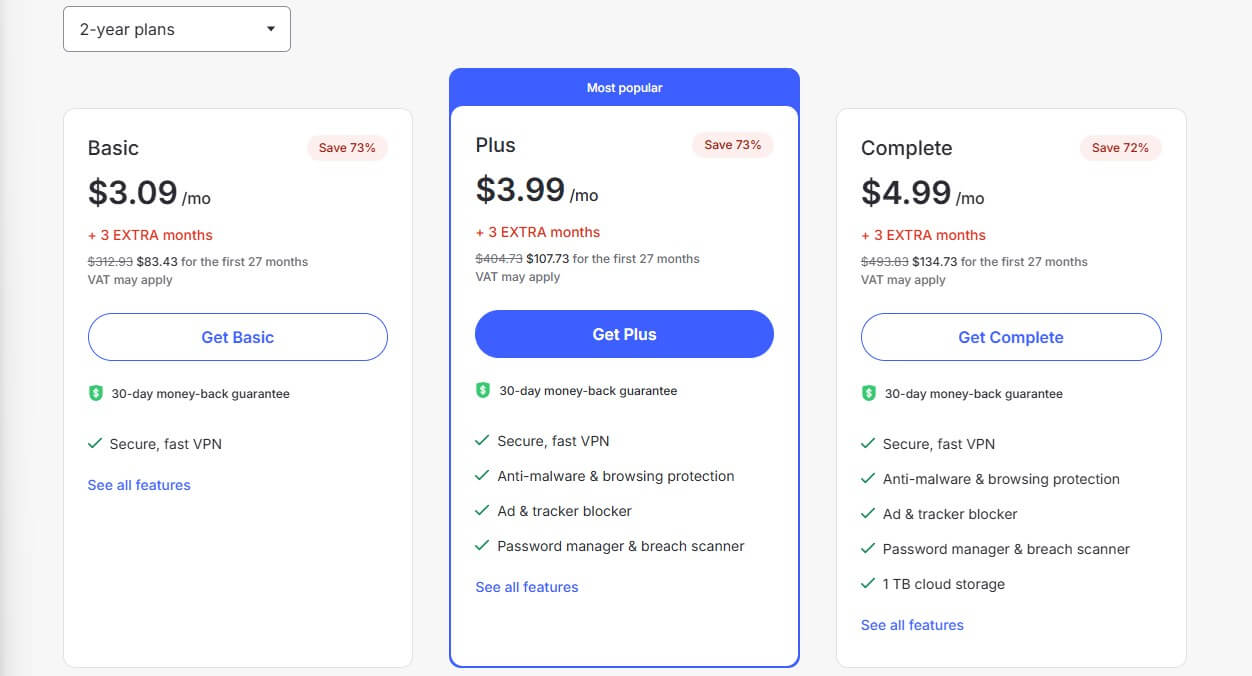
The cheapest Basic plan costs $3.00 to $3.50 monthly, depending on the current promotion. The Plus plan is roughly $4.00, and it is the most popular option. The Complete plan is about $5.00 and includes NordLocker.
Get the Best Discount on NordVPN
These are biennial plans that sometimes offer three extra months. As these are introductory prices, NordVPN’s renewal costs are higher. After the first two years, all plans are renewed annually. Speaking of annual renewals, NordVPN offers annual plans at higher prices.
You can refer to our NordVPN pricing guide for more information.
Let’s examine PrivateVPN’s prices:

PrivateVPN promotes its 36-month plan at $2.00 monthly. It’s only $72 for the first three years, making it a fantastic value. After that, it’s renewed at $72 every 12 months, which is about $6 monthly. PrivateVPN’s renewal cost is cheaper than NordVPN’s, and it offers a 30-day money-back guarantee (like NordVPN).
Winner: PrivateVPN
PrivateVPN’s three-year plan is considerably less expensive than any NordVPN plan, even the Basic one. If you’re looking to save money, PrivateVPN will suit you better. However, at a marginally higher monthly price, NordVPN is a much better VPN overall, as we’ll soon prove.
Features Analysis
This is precisely where we’ll prove it.
NordVPN is famous for delivering innovative security solutions by inventing in-house protocols and features that other providers lack. PrivateVPN… not so much. It’s more of a run-of-the-mill VPN in comparison.
Similarities
Despite that, these VPNs have a few similarities that we’d like to address in this duel:
- Bank-grade 256-bit GCM encryption
- Automatic kill switch
- OpenVPN, WireGuard, and IKEv2 protocols
- Obfuscation (obfuscated servers in NordVPN)
- IPv6 and DNS leak protection
Even these similarities can be broken down into more minor differences.
For instance, both VPNs use GCM encryption, which we prefer over AES, but PrivateVPN allows you to choose 128-bit. In theory, it should provide better performance, but this isn’t the case in practice.
Both VPNs have IKEv2 and OpenVPN protocols, but also support WireGuard.

The difference is in their implementation. NordVPN uses NordLynx, an improved version of WireGuard. Meanwhile, PrivateVPN relies on the “vanilla” version. Regarding obfuscation, PrivateVPN uses Stealth VPN, which masks your VPN traffic, ensuring it looks like a regular one.
NordVPN does the same with its obfuscated servers. In our NordVPN vs PrivateVPN test, we found that its obfuscated servers are a tad more effective. More about that later.

Finally, both providers offer advanced kill switches that can work on the system level or be applied to specific applications. We explained how a kill switch works here, but PrivateVPN and NordVPN took our definition to another level by extending their kill switch capabilities.
Differences
Many differences exist between PrivateVPN and NordVPN. Unfortunately for the former, they are reflected in NordVPN’s advanced features, which are lacking in PrivateVPN.
NordVPN offers:
- Split tunnelling, which PrivateVPN still lacks in 2026
- NordWhisper for overcoming network filtering
- Threat Protection Pro for blocking ads, trackers, and malware
- Double VPN for doubling your encryption and improving security
- Dark Web Monitor for alerts about leaked personal data or passwords
- Meshnet for file sharing, remote control, and more.
- Post-quantum encryption for protection against quantum computer attacks.
PrivateVPN offers nothing similar. Plus, its servers aren’t based on RAM like NordVPN’s, which explains its inferior performance in our speed tests below.
We should remember that PrivateVPN is much cheaper, but Surfshark, at a similar price, offers many NordVPN-like features. In a separate duel, we compared Surfshark to NordVPN and found that they’re very comparable security-wise despite the obvious price difference.
Sadly, that cannot be said about PrivateVPN.
Winner: NordVPN
NordVPN wins by a long shot. It’s the best VPN if you need extensive security features and robust encryption, paired with ad-blocking, tracker protection, obfuscation, and split tunnelling. While PrivateVPN is safe enough, the lack of some fundamentals, like split tunnelling, is unforgivable.
Do PrivateVPN and NordVPN Store Logs?
PrivateVPN is worthy of its name, as it offers impeccable privacy through its proven no-logging practices. NordVPN’s name bears no similar significance, but that doesn’t mean it’s unsafe. Our comparison between PrivateVPN and NordVPN showed the opposite: they’re both no-logging VPN services!
PrivateVPN operates from Sweden, while NordVPN is in Panama.
Inspecting their privacy policies reveals that neither stores sensitive data. By sensitive data, we refer to your IP address, browsing history, original location, connection metadata, etc. They store a minimal amount of data necessary for maintenance and server operation.

The problem with PrivateVPN is the lack of third-party audits.
On the other hand, we have NordVPN, which has a few from PwC and Deloitte. This instantly makes it more trustworthy, primarily because audits mainly focused on its no-log policy and security features.

If you’re afraid of PrivateVPN’s lack of audits, don’t be. Many “non-audited” VPNs exist (PrivadoVPN, for example) and are famous for being safe and secure. However, audits cost money, and smaller VPN companies likely can’t afford them, which explains why they lack them.
Winner: NordVPN
In the end, we’d give this one to NordVPN. It resides in a more privacy-friendly jurisdiction and has multiple third-party audits that confirm its zero-logs policy. While PrivateVPN is likely a no-log VPN, the fact that we have verified claims about NordVPN makes it more trustworthy in our eyes.
Which VPN Is Faster: NordVPN or PrivateVPN?
Should you pick NordVPN or PrivateVPN if speed is your primary concern? We’d say NordVPN, but let’s elaborate on that. Before we move on, let’s set a reference point: our non-VPN internet speed. At the time of writing, we were in Eastern Europe with these connection speed parameters:

Our test emphasised more distant servers to push the boundaries of both VPNs.
To make our test more accurate, we performed it three times a day, three days in a row, using three server locations: the UK, the USA, and Japan. We also stuck to their fastest protocols, such as NordLynx in NordVPN and WireGuard in PrivateVPN.
All tests were performed on our Windows 11 desktop computer with the latest version of network adapter drivers.
Okay, so the first table displays the speed retention rate, which is higher in NordVPN.
| NordVPN | PrivateVPN | |
| Download Speed Retention | 82% | 56% |
| Upload Speed Retention | 93% | 88% |
We used the best results to make this comparison. Speaking of the best results, we wanted to give this duel more context by displaying the actual speed test results, so here they are:
| UK (DL/UL Speed) | US (DL/UL Speed) | Japan (DL/UL Speed) | |
| NordVPN | 49.93/9.54 Mbps | 45.20/9.33 Mbps | 34.17/9.14 Mbps |
| PrivateVPN | 43.62/9.03 Mbps | 33.11/8.84 Mbps | 10.51/8.62 Mbps |
Winner: NordVPN
After measuring their speeds across all three server locations, NordVPN consistently beat PrivateVPN. It has high download and upload speed retention, lower latency, and superior reliability on nearby and distant servers.
Streaming & Torrenting Comparison
Our detailed NordVPN review highlighted its streaming prowess as one of its key aspects. Torrenting was also included because of its special P2P servers. It’s clear that PrivateVPN has to fight an uphill battle, but let’s see how well it holds up against its foe in 2026.
Streaming: NordVPN
We won’t lie: NordVPN was better for streaming.
We tested over twenty Netflix libraries, including the most popular, and NordVPN unblocks them all without a hitch. Interestingly, the VPN has an exciting browser extension with location spoofing, which aids streaming through Firefox, Chrome, Brave, and other supported browsers.
Moreover, including Smart DNS helps unblock US-based streaming services on various devices.
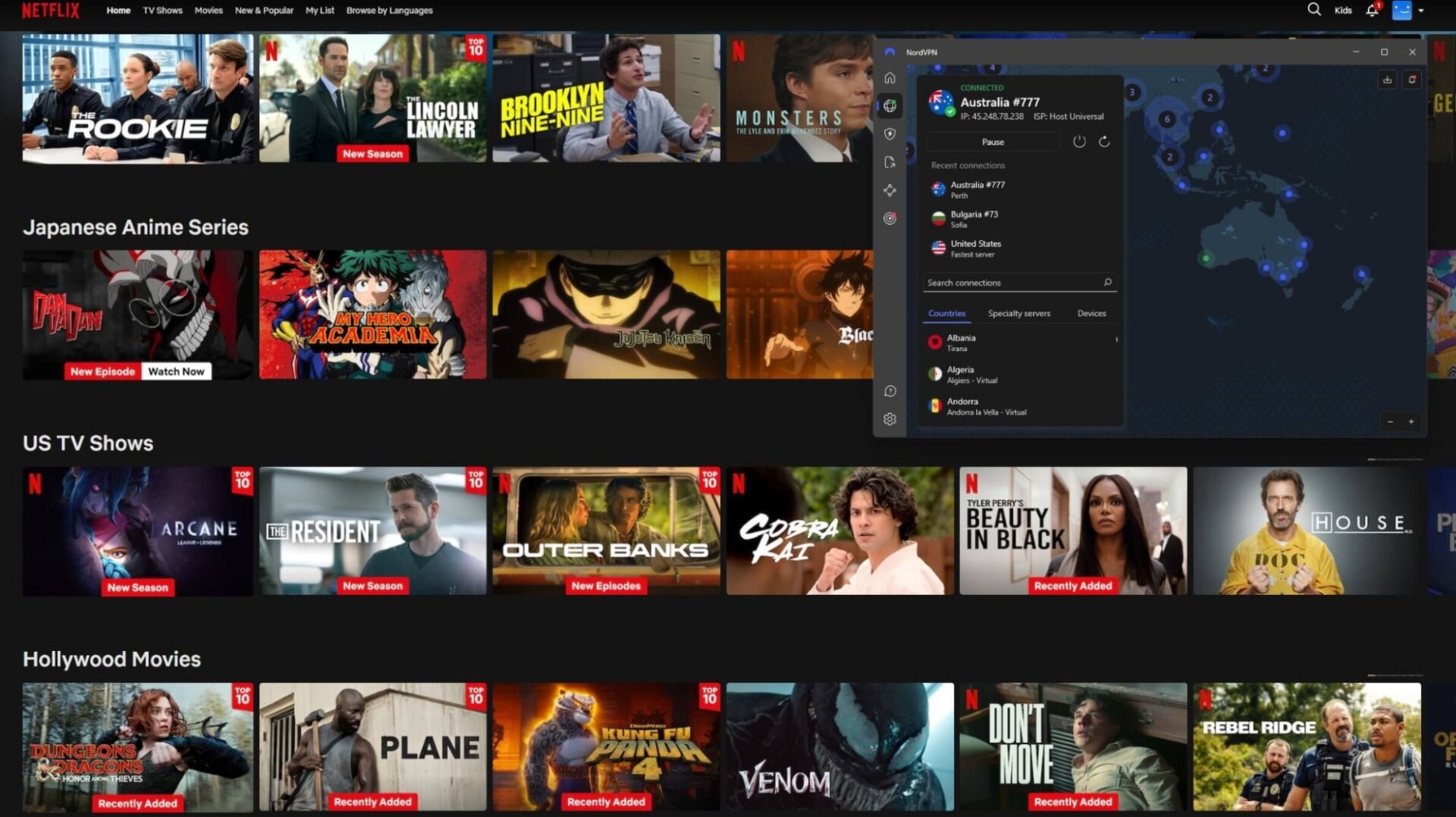
NordVPN’s streaming prowess goes far beyond Netflix. You can also enjoy Hotstar, Max, Prime Video, foreign TV channels, and more. There’s pretty much no insurmountable obstacle for this VPN.
Meanwhile, PrivateVPN is a solid pick for Netflix if you stick to the most popular libraries. Experiment a bit and you’ll find cracks in its “story”. PrivateVPN works with BBC iPlayer, but simultaneously fails to unblock more “demanding” platforms like ESPN Plus, which worked with NordVPN in our tests.

Due to occasionally slower speeds, longer buffering times are typical, but they don’t always break the immersion. NordVPN’s superior performance and unblocking abilities result in an exceptional overall experience.
Torrenting: Tie
These VPNs support P2P on all servers, while NordVPN offers specialised torrenting servers. We noticed no difference between these and “regular” servers.
As you can see below, NordVPN works well for torrenting:

If you choose PrivateVPN, you’ll get the same results:

PrivateVPN offers port forwarding, which may slightly aid torrenting performance. In our tests, however, we haven’t noticed any difference. NordVPN supports SOCKS5, which you can set up in your torrent client.
However, we recommend sticking only to the VPN connection to maximise privacy and performance.
Overall Winner: NordVPN
NordVPN and PrivateVPN are on par torrenting-wise, but the former takes advantage in the streaming portion. Because of its more impressive streaming performance, NordVPN ultimately takes this fundamental round.
Server Locations: PrivateVPN vs NordVPN
The benefits of a larger server network are usually reflected in performance and the IP address pool.
If the network is large enough, finding an uncrowded server that provides the best speed is easier. Meanwhile, a more constrained network inevitably leads to overcrowding and usually results in less convincing performance.
So, how large are their server parks?
- NordVPN offers over 8,100 servers in 160+ locations
- PrivateVPN has around 200 servers in 63+ locations
NordVPN’s server count is roughly 40 times larger. The location count is about 3.5 times larger, so things are straightforward. Additionally, NordVPN has many speciality servers, such as Onion over VPN, Double VPN, and P2P. It also offers inexpensive dedicated IP addresses.
You’ll say PrivateVPN also has dedicated IPs: you’d be right!
However, it uses so-called dynamic IP addresses, which means you get a unique IP with each connection, but not the same one. These IP addresses are free, but aren’t better than NordVPN’s traditional dedicated IP addresses.
Lastly, we’ll repeat that NordVPN’s servers are RAM-based, while PrivateVPN has yet to migrate to RAM.
Winner: NordVPN
You don’t have to look twice to conclude that NordVPN is a much larger VPN with a richer server park, RAM-based servers, and better server distribution. PrivateVPN is too small for 2026, especially when similarly-priced options offer thousands of servers.
Bypassing Censorship: Which VPN Does It Better?
Can you use NordVPN and PrivateVPN in China?
Yes, you can, but they behave differently. PrivateVPN’s StealthVPN struggles to connect, but the connection speed is drastically slower when it does. NordVPN’s obfuscated servers do a slightly better job and maintain the speed, with minimal occasional losses.
To be clear, the Great Firewall successfully fights off VPNs, and most won’t work as well as they used to. Therefore, expect connection issues on both sides, but less with NordVPN.
We tested PrivateVPN and NordVPN in Turkey, the UAE, and Qatar. These censored regions are known for occasional VPN blocking, but luckily, both providers were up to the task. In some instances, we didn’t need to use obfuscation, but relied on regular servers without issues.
NordVPN offers NordWhisper, which also helps overcome network filtering. This makes it a great VPN to use in school or any other environment where proper internet access is restricted.
Winner: NordVPN
The ultimate winner is NordVPN, thanks to superior performance in China and the proprietary NordWhisper protocol for overcoming network filtering. PrivateVPN is a surprisingly decent pick, but it’s still not better than NordVPN.
The Final Verdict
Our extensive tests brought us back to our initial conclusion: NordVPN is a better VPN overall.
PrivateVPN took one out of eight rounds, and the rest easily went to NordVPN. The extension is a sub-round in which we compared their torrenting prowess, and PrivateVPN was on par. However, you’d be crazy not to see how superior NordVPN is in every aspect.
Now, we must address the pricing aspect.
NordVPN isn’t an expensive VPN, as the Basic plan starts at just over three quid. PrivateVPN costs 55% less for three years, but as you saw, it offers very little compared to NordVPN. We advise against picking PrivateVPN and saving money because you’ll likely be disappointed.
Instead, we advise exceeding your budget (if possible) and spending that extra dollar or so on NordVPN. Given the negligible price difference, NordVPN is an unbelievably better option.
This concludes our NordVPN vs. PrivateVPN comparison. We hope you’ve picked your favorite by now.