
Switzerland’s best-known privacy company spent the past year moving much of its server hardware to Germany and Norway. The reason was a government plan to extend surveillance duties from phone and internet companies to VPNs and encrypted apps. That plan stalled after heavy criticism.
However, the rules already in force still require Swiss ISPs and mobile carriers to keep months of connection records on every customer. So in Switzerland, a VPN mostly protects what those records can show, and it changes where websites think you are. That second part works in two directions.
People in Zurich or Geneva want foreign streaming catalogs, while Swiss residents traveling abroad want their banking and TV to treat them as if they were home. These five VPNs handled both directions in our tests.
Top VPNs for Switzerland Summarized
- NordVPN: Best Overall. Zurich servers, top speeds, and a clean sweep in our streaming tests.
- Proton VPN: Best Swiss-Based VPN. Run from Geneva, with the widest choice of Swiss servers.
- ExpressVPN: Best for Simple Setup. A plain app that looks the same on phones, laptops, and TVs.
- Surfshark: Best for Ad-Free Streaming. Strong streaming results and a built-in ad blocker at a low price.
- Private Internet Access: Best for Large Households. No device limit and open-source apps.
How the Five Swiss VPNs Compare
| VPN | Swiss servers | Company based in | Average speed loss | Streaming services unblocked | Ad blocking |
|---|---|---|---|---|---|
| NordVPN | Zurich, 120+ servers | Panama | 7.8% | 14 of 14 | Complete plan and up |
| Proton VPN | 800+ servers | Switzerland | 10.2% | 11 of 14 | Paid plans |
| ExpressVPN | 2 Swiss locations | British Virgin Islands | 7.8% | 14 of 14 | Every plan |
| Surfshark | Zurich | Netherlands | 9.6% | 14 of 14 | Every plan |
| Private Internet Access | Zurich | United States | 12.7% | 9 of 14 | Every plan |
Best VPNs for Switzerland in 2026
The five VPNs we ranked have servers in Switzerland and large networks abroad. As a result, the order came from our speed and streaming tests and from what each one does for privacy under Swiss law.
1. NordVPN: Best Overall VPN for Switzerland
Pros
- Tied for the fastest speeds we tested
- Unblocked every streaming service in our tests
- Over 120 servers in Zurich
- Blocks malware and phishing sites
- Double VPN for a second layer of encryption
Cons
- Steep price jump at renewal
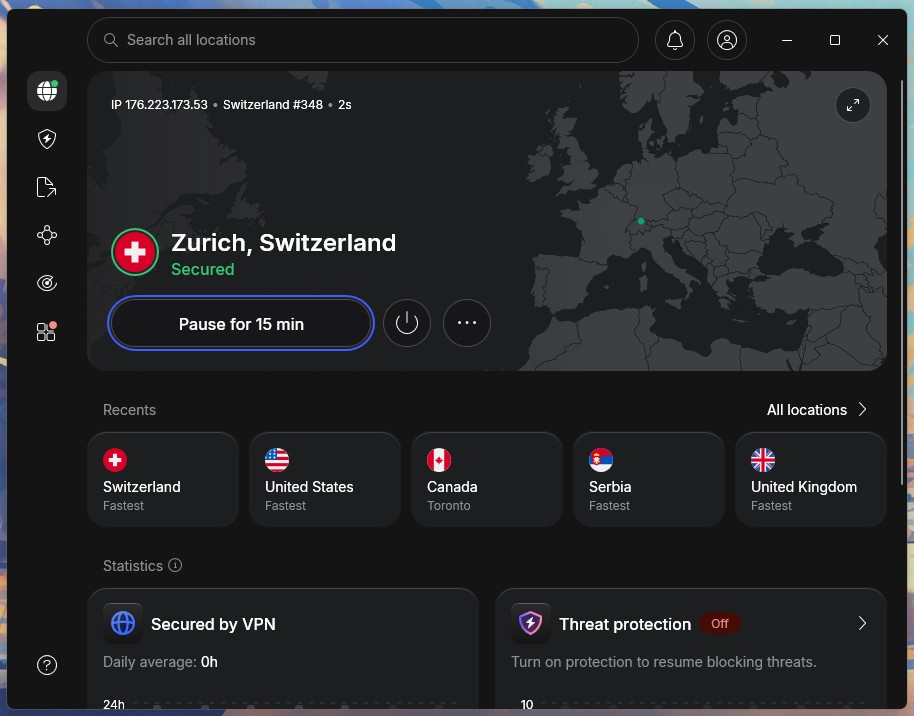
NordVPN tied with ExpressVPN for the fastest results in our tests, with a 7.8% average speed loss. On top of that, it unblocked every one of the 14 streaming services we tested. That combination is why it ranks first: US Netflix and BBC iPlayer from outside the UK worked on the first server we chose, so an evening in Zurich doesn’t start with a server hunt.
Its Swiss network, meanwhile, covers the opposite case. NordVPN has more than 120 servers in Zurich, and in our tests they unblocked Play SRF and Zattoo. For instance, a Swiss resident on vacation can keep SRF’s coverage running, including the Formula 1 races SRF streams for free.
As for privacy, NordVPN keeps no logs, which independent auditors have verified, and its servers use RAM only, so a reboot wipes them. The Complete plan adds next-gen antivirus, which blocks malware and phishing pages before you enter a password.
Prices start at about $3.50 a month on the two-year plan, but the renewal price is much higher, so choose the longest term at checkout to keep the low rate the longest.
2. Proton VPN: Best Swiss-Based VPN for Privacy
Pros
- Swiss company protected by Swiss privacy law
- More than 800 servers in Switzerland
- Traffic can pass through hardened privacy servers first
- Open-source apps anyone can inspect
- Disguises VPN traffic on restricted networks
Cons
- Couldn’t unblock Hulu or Pluto TV
- No post-quantum encryption yet
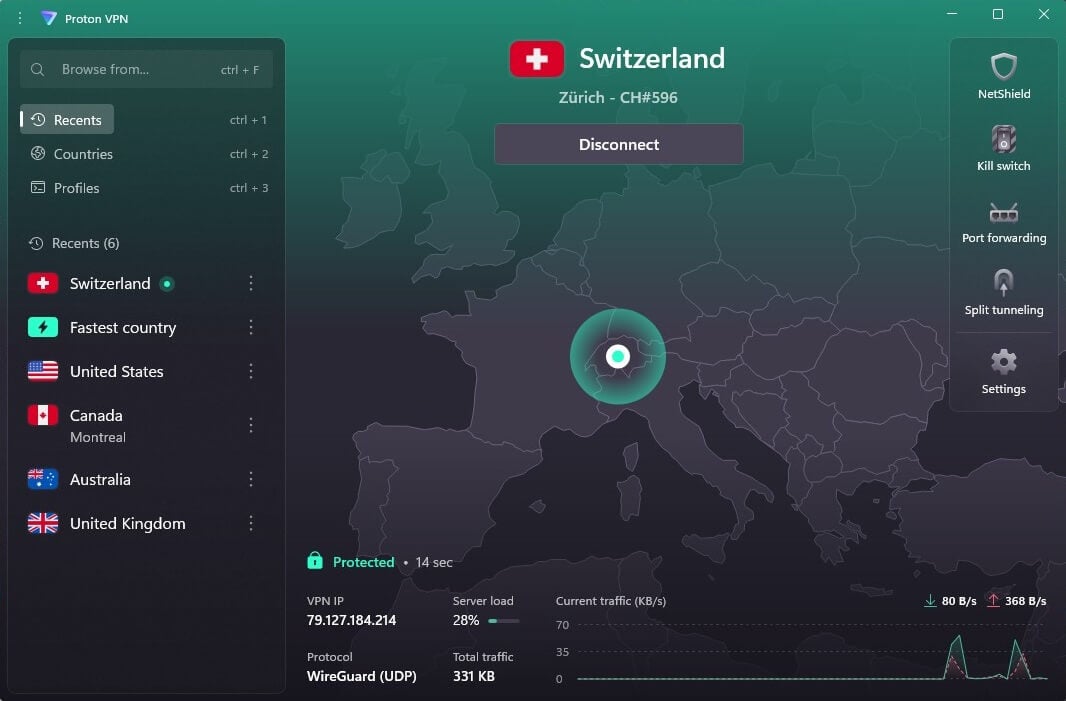
Proton VPN is the only VPN in this ranking run from Switzerland, with its headquarters in Geneva and more than 800 servers that assign a Swiss IP address. When the surveillance plan went to consultation, Proton VPN’s parent company moved much of its hardware to Germany and Norway, and it has said it would go further if the plan returns unchanged.
For anyone choosing a VPN on privacy grounds, that’s a company willing to act on its promises. Beyond its base, its privacy tools are the strongest of the five. Secure Core sends your connection through a hardened server in Switzerland, Iceland, or Sweden first, so someone watching the second server can’t trace you back.
Meanwhile, the Stealth protocol disguises VPN traffic as ordinary web traffic, and auditors check the no-logs policy every year. Streaming, however, is weaker. In our tests, Proton VPN unblocked 11 of the 14 services, and its average speed loss was 10.2%. It couldn’t unblock Hulu or Pluto TV.
On price, the VPN Plus plan is close to NordVPN at about $3 a month on the two-year term, so if either service is on your list, NordVPN is the better buy.
3. ExpressVPN: Best for Simple Setup on Every Device
Pros
- Same simple app on phones, computers, and TVs
- Ad and tracker blocking on every plan
- Post-quantum encryption
- Unblocked all 14 streaming services we tested
- Quick connections
Cons
- Few settings for advanced users
- No multi-hop servers
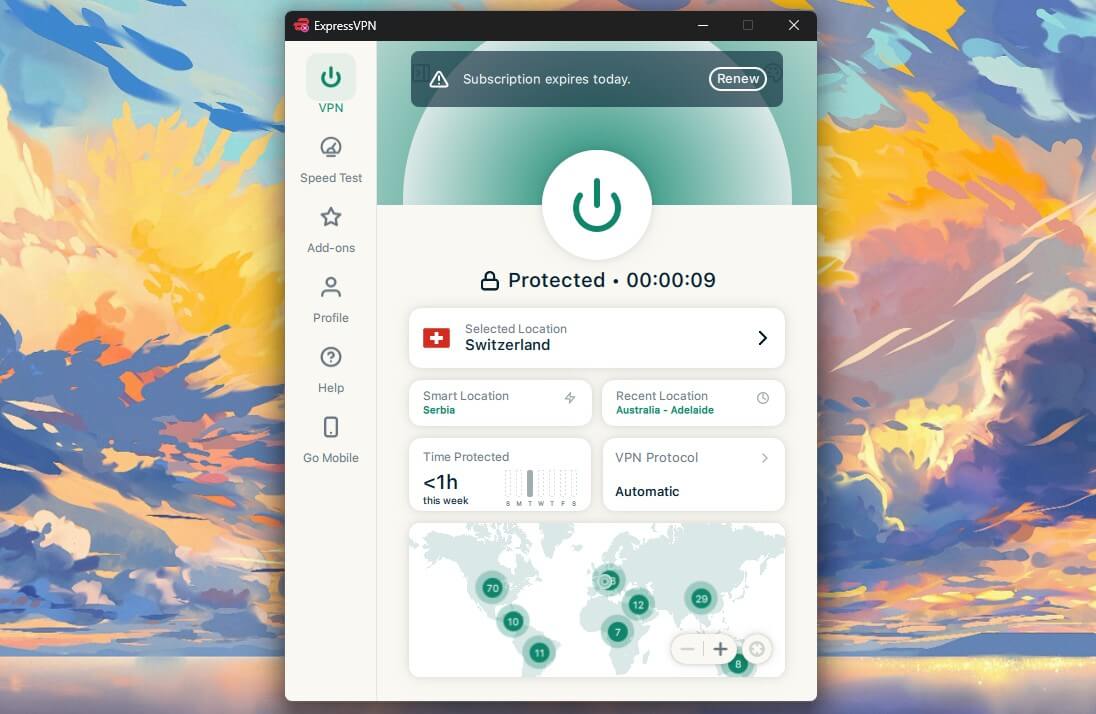
ExpressVPN matched NordVPN with a 7.8% average speed loss and unblocked the same 14 streaming services. However, simplicity is its strongest point. The app looks the same on a phone, a laptop, and a smart TV, and it connected in a second or two in our tests, which suits anyone setting up a VPN for the first time.
On the Swiss side, ExpressVPN has two Swiss locations, and Play SRF and Zattoo worked on them in our tests. Going the other way, its US servers make it a solid option to watch US TV channels from abroad, including from Zurich.
Every plan also includes Advanced Protection, which blocks ads and trackers, and ExpressVPN has added post-quantum encryption against future attacks on today’s recorded traffic. The trade-off is control. ExpressVPN has fewer settings than NordVPN or Proton VPN and no multi-hop servers.
So, privacy-minded users will find less to adjust. For everyone else, the simplicity costs little: the Basic plan is about $3 a month on the two-year term, with 10 devices covered.
4. Surfshark: Best for Ad-Free Streaming
Pros
- Blocks ads and trackers on every plan
- Unblocked Netflix US and BBC iPlayer
- Low long-term price
- No limit on connected devices
- Masked email addresses for sign-ups
Cons
- Connections sometimes take a while
- Price rises after the first term
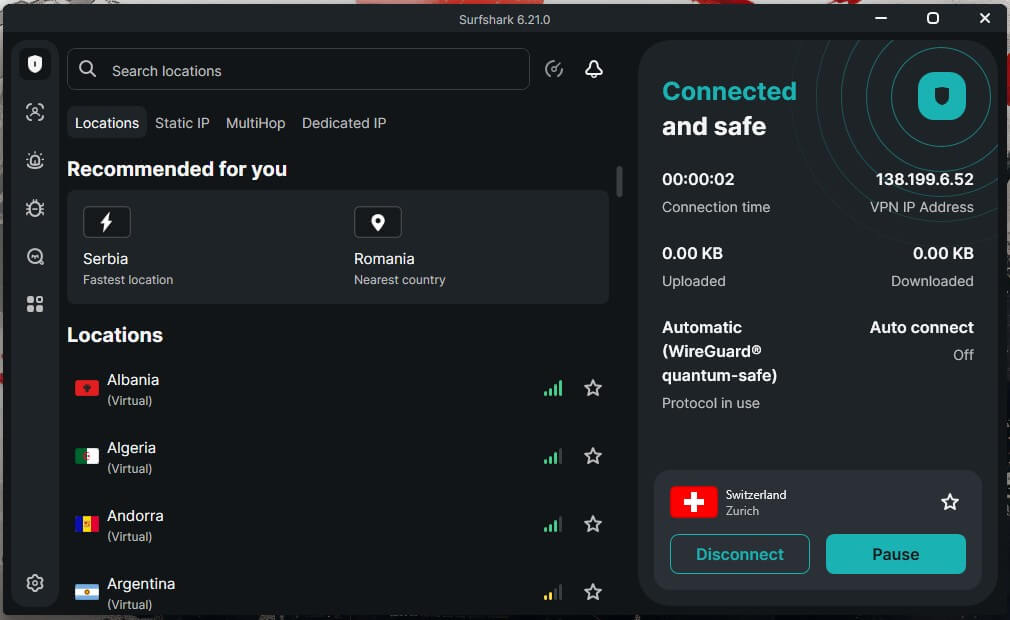
Surfshark unblocked all 14 streaming services we tested, including ITVX and Hulu, and its average speed loss was 9.6%. In other words, it matches the top two for streaming while costing less, at about $2.50 a month on the two-year Starter plan.
The renewal price is higher, however, so the two-year term keeps the low rate the longest. Beyond streaming, Surfshark’s CleanWeb blocks ads, trackers, and known malware sites on every plan. That helps on free streaming sites and news pages loaded with pop-ups.
Alternative ID also creates a masked email address and persona for sign-ups, so retailers and forums never see your own inbox. As for coverage, Surfshark’s Swiss servers are in Zurich, and one account covers every device in the home. On the other hand, connecting sometimes took several seconds in our tests.
If that happens, choose a nearby server and the connection usually comes back faster.
5. Private Internet Access: Best for Large Households
Pros
- Unlimited simultaneous connections
- Open-source apps
- Lowest long-term price of the five
- Browser extensions for Chrome, Firefox, and Opera
- Swiss location optimized for streaming
Cons
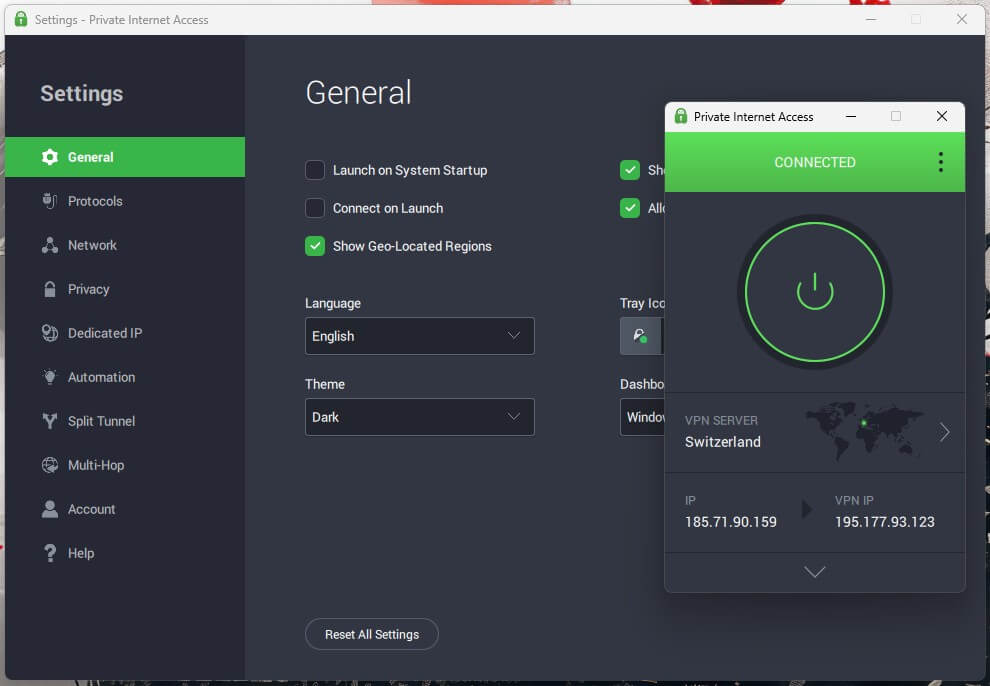
- Dated, cluttered desktop app
- Couldn’t unblock Prime Video or HBO Max
Private Internet Access costs around $2 a month on its long plan, and one subscription covers an unlimited number of devices. For a family with phones, laptops, and a smart TV each, that’s the cheapest way to cover everyone. PIA also lists its Swiss servers in Zurich as streaming-optimized, and PIA’s open-source apps let anyone check what they do.
Speed is where it falls behind. Its average speed loss was 12.7%, the largest of the five, though still enough for HD streaming. PIA also unblocked 9 of the 14 services we tested, failing on Prime Video and HBO Max. So if streaming is the main reason you’re subscribing, the four VPNs ranked above it are safer choices.
Then there’s the desktop app, which looks dated and hides settings in crowded menus. If that bothers you, PIA’s Chrome extension covers browsing with fewer controls. For most households, the low price outweighs that.
Why Use a VPN in Switzerland?
Switzerland doesn’t block social media or news sites, and using a VPN is legal. Even so, three parts of Swiss law shape what a VPN does for you there: data retention, copyright, and gambling rules.
Connection Records and Public Wi-Fi
ISPs and mobile carriers record each customer’s connection data and keep it for six months, as Swiss surveillance law requires. That covers who you contacted, when, and from which IP address, though not the content itself. With a VPN on, your ISP still logs that you connected.
But it only sees an encrypted connection to a VPN server, not the sites and services you used. The 2025 plan would have gone much further. Its draft required VPNs, email services, and messaging apps with many Swiss users to identify customers and keep similar records.
After the consultation drew heavy criticism, the Federal Council ordered a rework and promised a second consultation, and parliament backed motions demanding a fundamental rethink. For now, nothing has changed for VPN users.
On top of that, public Wi-Fi is an everyday risk. Train stations, airports, and hotels in Switzerland offer free networks, and a VPN encrypts your logins and banking sessions before they leave your phone.
What Swiss Law Allows: Torrenting and Gambling
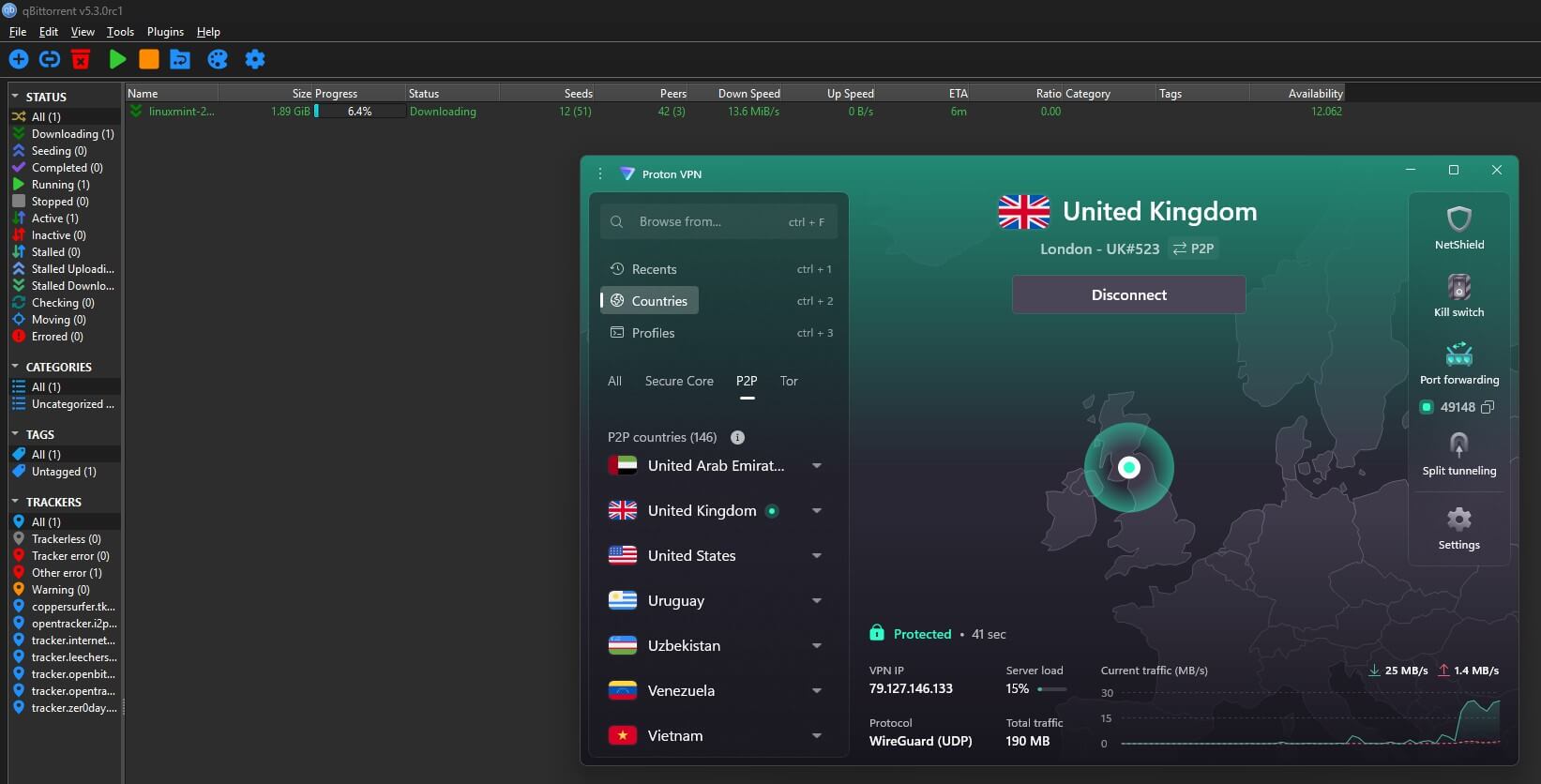
Swiss copyright law lets you download films, music, and series for private use, even from unofficial sources. Software and games are the exception. Uploading is illegal, and torrent clients upload pieces of a file while you download it, so seeding counts as sharing.
A VPN hides your IP address from other users in a swarm, and a kill switch, which cuts your internet if the VPN drops, keeps it hidden. Still, it doesn’t make uploading legal, so read up on how to torrent privately and within the rules.
Gambling rules, by contrast, are stricter. Since the Gambling Act took effect, only Swiss-licensed casinos and betting operators can offer online games, and ISPs block unlicensed foreign sites through DNS filters.
Using a VPN to get around that breaks the operator’s terms and can break Swiss law, one of the legal risks of betting through a VPN.
Foreign Streaming Catalogs
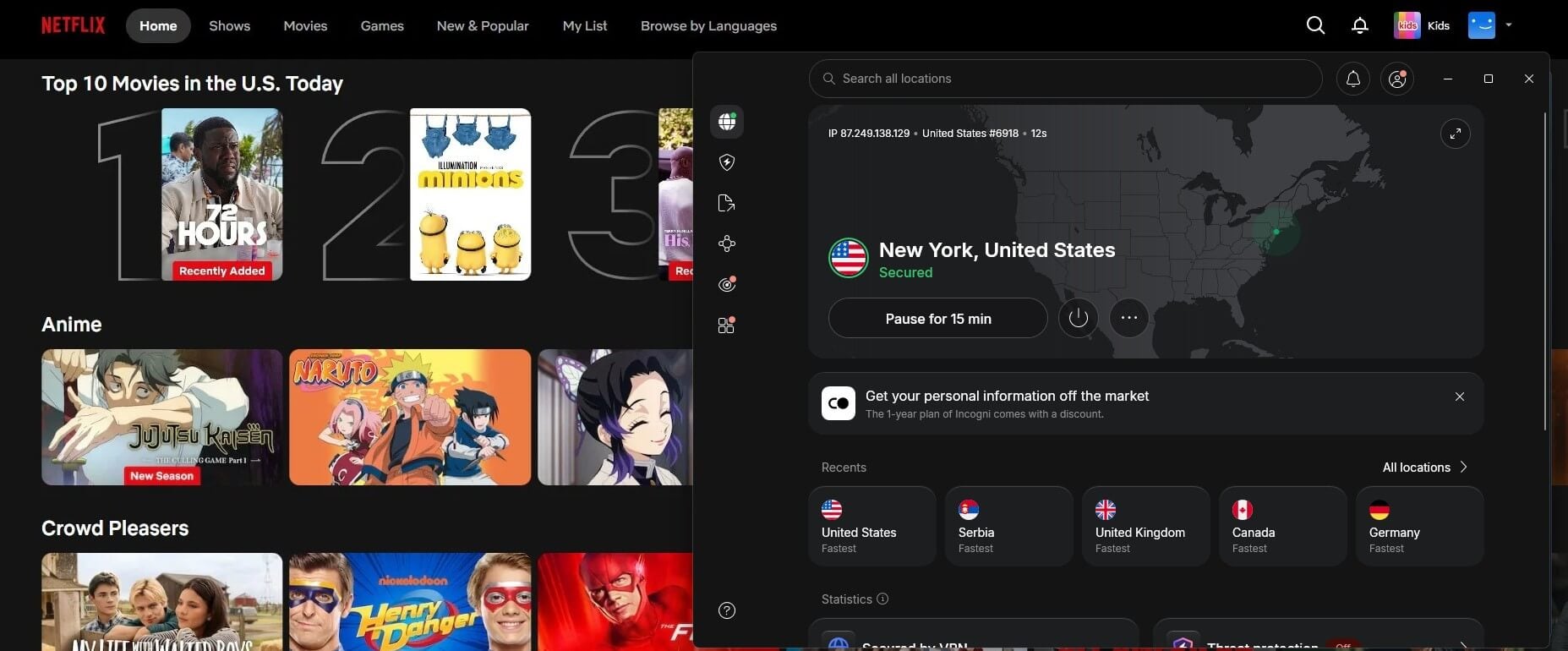
Netflix, Prime Video, and other services operate in Switzerland, but with Swiss catalogs. A US or UK server shows the library of that country instead, and it’s the simplest way to change your country on Netflix without a new account. BBC iPlayer, Hulu, and other services that don’t operate in Switzerland also unblock this way.
Meanwhile, viewers abroad face the reverse. Outside the country, Play SRF, RTS, and Zattoo show a region message on most live streams, and our guide to watching Swiss TV from another country covers each service and which VPNs unblock it.
Free VPNs and Swiss Servers
A free VPN can encrypt public Wi-Fi, but few free plans include Switzerland. Windscribe’s free plan does, while Proton VPN’s free plan assigns a server automatically and never offered us a Swiss one. Free plans also limit data or speed, so they can’t replace a paid VPN for streaming.
For the free options that do offer Swiss locations, see our best free VPNs for Switzerland. Otherwise, premium VPNs like NordVPN come with a 30-day money-back guarantee, so you can test one without risk.
Final Thoughts
Swiss record-keeping rules currently apply to ISPs and mobile carriers, so for most people the right VPN is simply the fastest one that unblocks foreign catalogs.
In our tests, that was NordVPN. The exception is anyone following the surveillance debate. If that’s you, choose Proton VPN, the only Swiss company here and the one with the most at stake if the plan returns.
FAQs
Which VPN is based in Switzerland?
Proton VPN is the best-known Swiss VPN, run by Proton AG from Geneva. Its headquarters remain there, although the company has moved much of its server hardware to Germany and Norway.
Does NordVPN have servers in Switzerland?
Yes, NordVPN has servers in Zurich. They assign a Swiss IP address, so Swiss banking and streaming services work abroad, and they support NordVPN's usual encryption and malware protection.
Is torrenting legal in Switzerland?
Yes, for downloading. Swiss copyright law allows downloading movies, songs, and TV shows for private use, but not software or games. Uploading is illegal, and seeding a torrent counts as uploading.
Is Switzerland part of the 14 Eyes alliance?
No, Switzerland isn't a member of the Five, Nine, or 14 Eyes intelligence-sharing alliances. Swiss authorities can still request data from Swiss companies through domestic courts and international legal assistance.
Can you watch US Netflix in Switzerland?
Yes, with a VPN server in the US. Netflix then shows its American catalog instead of the Swiss one, using the same account and subscription. Reliable unblocking varies by VPN and server.