Mullvad never requires an email address. You sign up with a random account number and can pay with cash sent in an envelope. ExpressVPN takes the familiar approach instead: an email, a card, and apps for nearly every screen in the house.
The two VPNs are built for different people, so the better one depends on whether you value anonymity or convenience. I tested both on the same connection to see what each choice costs you.
ExpressVPN or Mullvad: My Recommendation
I recommend ExpressVPN for most people. It was faster in my tests, unblocks far more streaming services, and covers more devices, from Apple TV to routers.
Choose ExpressVPN if:
- You stream, travel, or want one subscription for every device at home.
- You want obfuscation that works without changing any settings.
Choose Mullvad if:
- You want maximum anonymity, since it requires no email and accepts cash.
- You want multihop and DAITA, which hides your traffic patterns from observers.
ExpressVPN vs Mullvad: Quick Comparison
| Mullvad VPN | ExpressVPN | |
| Our Current Ranking | #10 | #3 |
| Prices | Flat €5 a month | About $3 a month on the two-year plan |
| Money-Back Guarantee | 14 days (not for cash or crypto) | 30 days |
| Free Version/Free Trial | No | No/3 days on Android |
| Logging/Jurisdiction | No logs, no email required/Sweden | No logs/British Virgin Islands |
| Third-Party Audits | Apps, servers, and WireGuard code, plus a police search | Apps, Lightway, and the no-logs policy |
| Protocols | WireGuard only | Lightway, WireGuard, OpenVPN (Lightway Turbo on Windows) |
| Post-Quantum Encryption | Yes | Yes |
| Servers | 570 in 50 countries | 113 countries |
| Specialty Servers | Multi-hop, DAITA | Dedicated IP (add-on) |
| Ad Blocking | Yes, DNS-level filtering | Yes, Advanced Protection |
| RAM-Only Servers | Yes, all servers | Yes, all servers |
| Working With Netflix | Netflix US, little else | Yes, all major libraries |
| P2P Allowance | Yes, no port forwarding | Yes, all servers |
| Concurrent Connections | 5 | 10-14 |
Privacy and Logging: Mullvad Knows Less About You
Neither VPN keeps records of the sites you visit, your IP address, DNS lookups, or session times. Both store a small amount of operational data, such as how many devices are connected, which is how they enforce device limits. The difference lies in what each company knows about you to begin with.
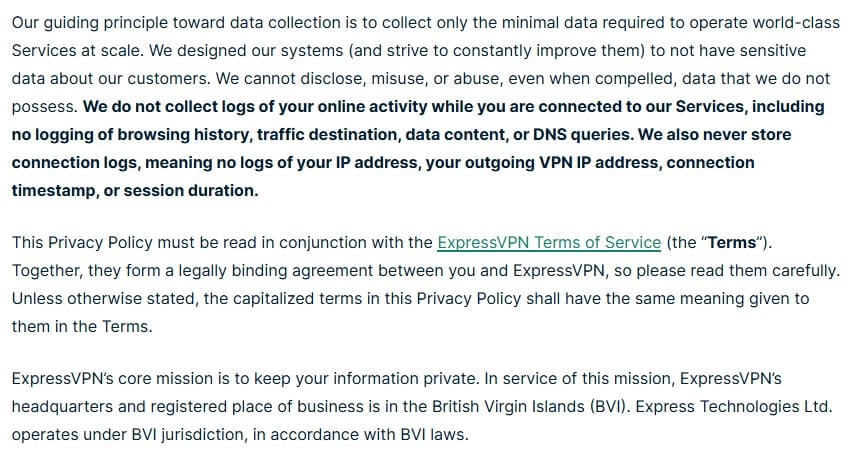
ExpressVPN’s case rests on audits and evidence. KPMG has audited its no-logs policy, and every server operates from RAM, so data is wiped on each restart. When Turkish investigators seized one of its servers in 2017, they found no logs to use.

On top of that, the British Virgin Islands impose no data retention duty. Mullvad starts from the other end: it never learns who you are. Sign-up requires no email address, only a randomly generated 16-digit account number, and you can pay in cash.
Its apps are open source, and independent firms, including Cure53 and Assured, have audited its apps and servers. In 2023, Swedish police arrived with a search warrant and left without any customer data, because Mullvad had none to hand over.
Winner: Mullvad. ExpressVPN’s audits and the 2017 seizure are strong evidence. Still, Mullvad goes a step further by never collecting your identity, so there’s nothing to request. For anonymity, I’d choose Mullvad.
Security Features: Mullvad Has More Privacy Tools
Beyond logging, the two VPNs start from a similar security base, and the differences come from a few tools only one of them offers.
Shared Features
Both include strong encryption, a kill switch that cuts your internet if the VPN drops, split tunneling for sending only chosen apps through the VPN, RAM-only servers, private DNS, and IPv6 and DNS leak protection.
They also block ads, trackers, and malicious domains: ExpressVPN through Advanced Protection and Mullvad through its DNS filtering. Either one can block adult sites too, which works as a simple parental control.
Post-quantum protection is on by default in both, so traffic recorded today remains protected against future quantum computers. ExpressVPN builds it into Lightway, while Mullvad applies it on every server.
Unique Features
Protocols are the first difference. In January 2026, Mullvad removed OpenVPN and kept only WireGuard, whose much smaller codebase is easier to audit, as our WireGuard and OpenVPN comparison explains.

It now uses GotaTun, its own WireGuard implementation written in Rust, which was independently audited in 2026. ExpressVPN took the opposite approach. It offers its own audited Lightway protocol, plus WireGuard and OpenVPN.
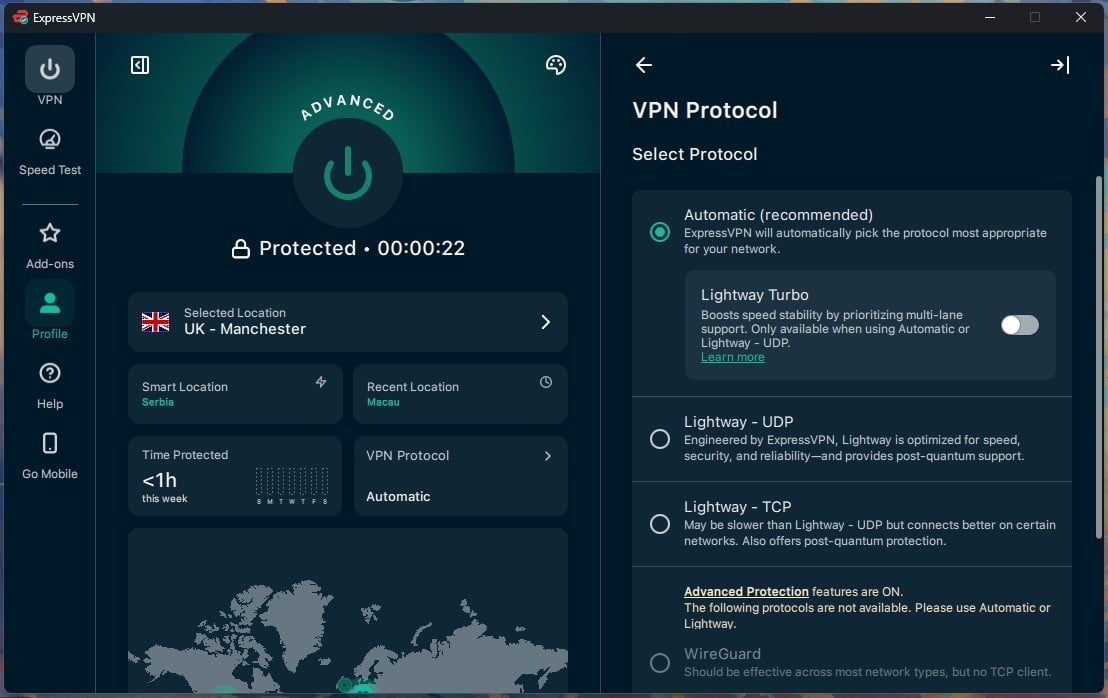
On Windows, a Lightway Turbo toggle sends data through several tunnels at once, but it made no measurable difference on my connection. DAITA is Mullvad’s other exclusive.
Short for Defense Against AI-guided Traffic Analysis, it pads packets to one size and adds dummy packets, so an observer at the ISP level can’t infer what you’re doing from the shape of your traffic. That extra traffic slows the connection, so it’s a feature to enable when privacy outweighs speed.
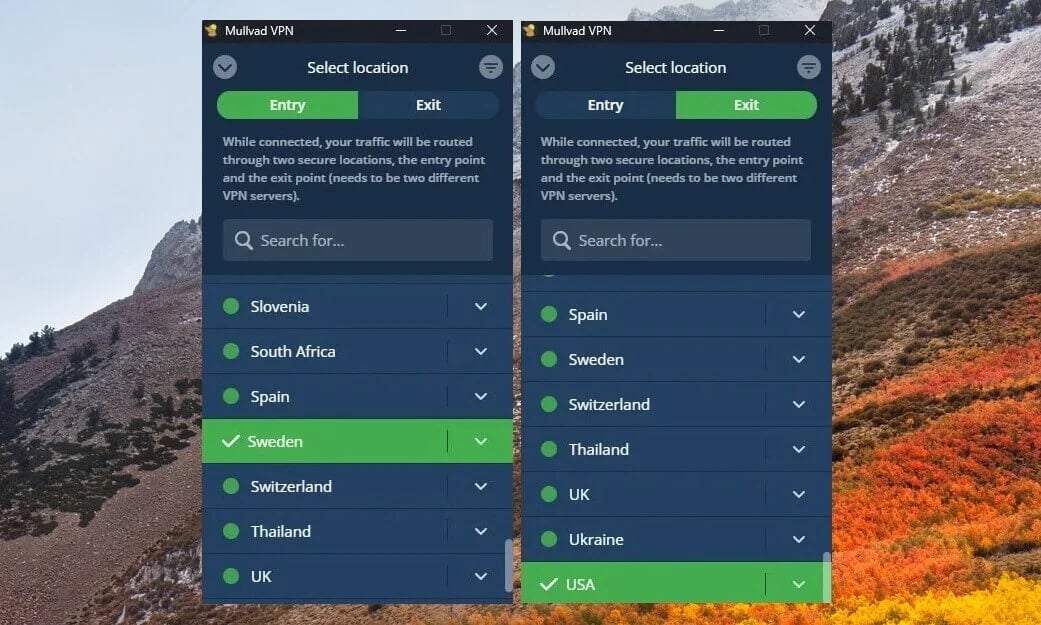
Multihop is the second difference. Mullvad sends your traffic through two servers you choose, and ExpressVPN has no equivalent. In return, ExpressVPN offers dedicated IP addresses and MediaStreamer, its Smart DNS feature for consoles and smart TVs.
Winner: Mullvad. DAITA has no counterpart at ExpressVPN, and multihop is a feature ExpressVPN still lacks. ExpressVPN’s extras are aimed at streaming and remote access instead.
Speed Tests: ExpressVPN Is Faster on Distant Servers
Speed is where the result flips. I tested both VPNs on the same connection, three times a day for three days, on UK, US, and Japanese servers.
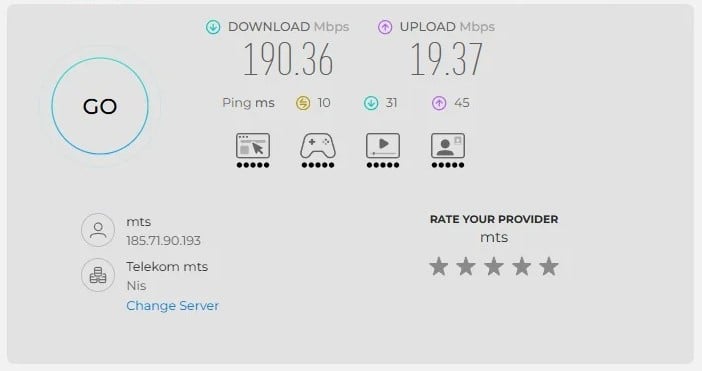
Mullvad used WireGuard, its only protocol, and ExpressVPN used Lightway.
| Average Download Speed Loss | Average Upload Speed Loss | |
| Mullvad | 16.2% | 9.6% |
| ExpressVPN | 7.8% | 8.9% |
On the UK server, the two were within three percentage points of each other. Distance changed that, because on the Japanese server Mullvad’s speed loss was more than twice ExpressVPN’s. Upload speeds remained close everywhere, so they won’t change the choice for most people.
Ping showed a similar pattern. A lower ping means less delay in online games and video calls, and on the US server, ExpressVPN recorded 125 ms against Mullvad’s 220 ms.
| UK (Download/Upload) | US (Download/Upload) | Japan (Download/Upload) | |
| Mullvad | 180.40/18.21 Mbps | 172.53/18.00 Mbps | 125.61/16.33 Mbps |
| ExpressVPN | 185.74/18.02 Mbps | 177.03/17.74 Mbps | 163.94/17.15 Mbps |
Winner: ExpressVPN. It lost less download speed on every server, and the difference grew with distance. Its 7.8% average loss ties with NordVPN’s for the lowest among the fastest VPNs I tested.
Streaming and Torrenting: ExpressVPN Unblocks More
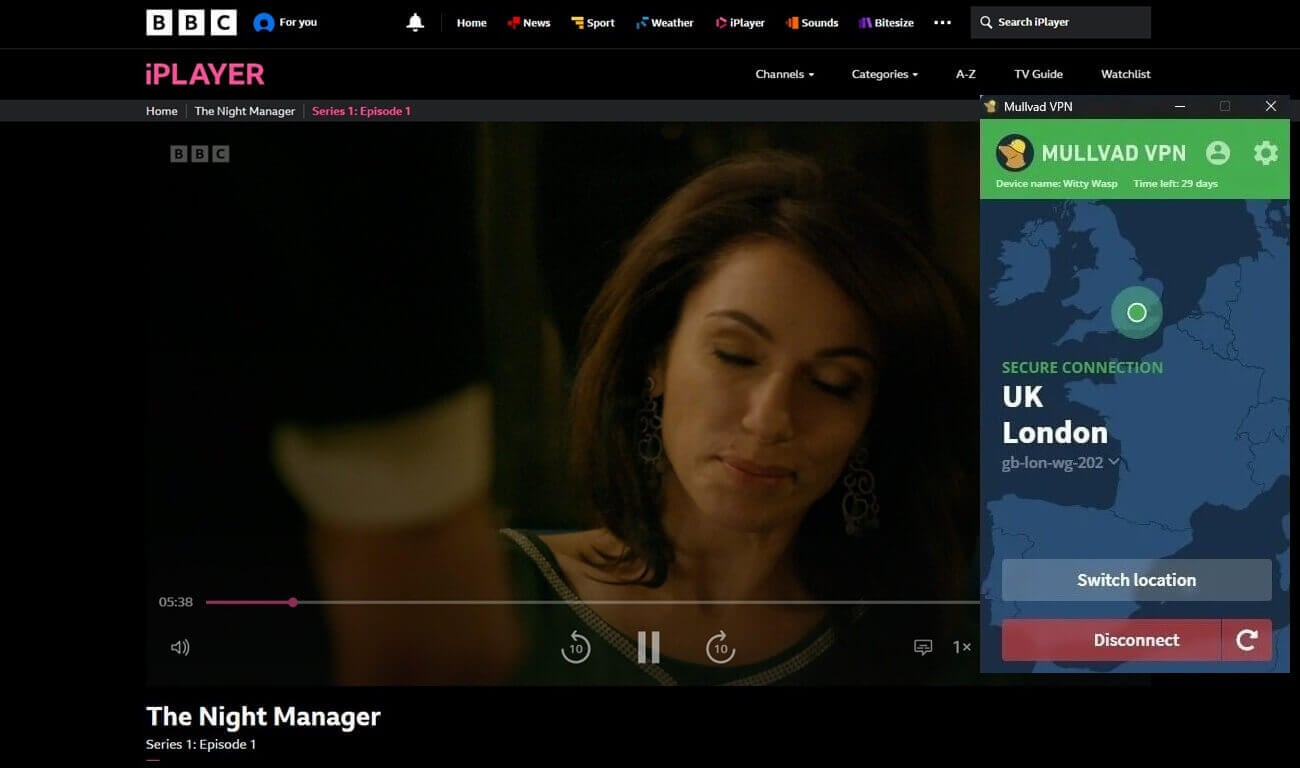
Streaming has never been Mullvad’s purpose. It unblocked Netflix US and usually BBC iPlayer, but it couldn’t unblock services with stricter VPN detection.
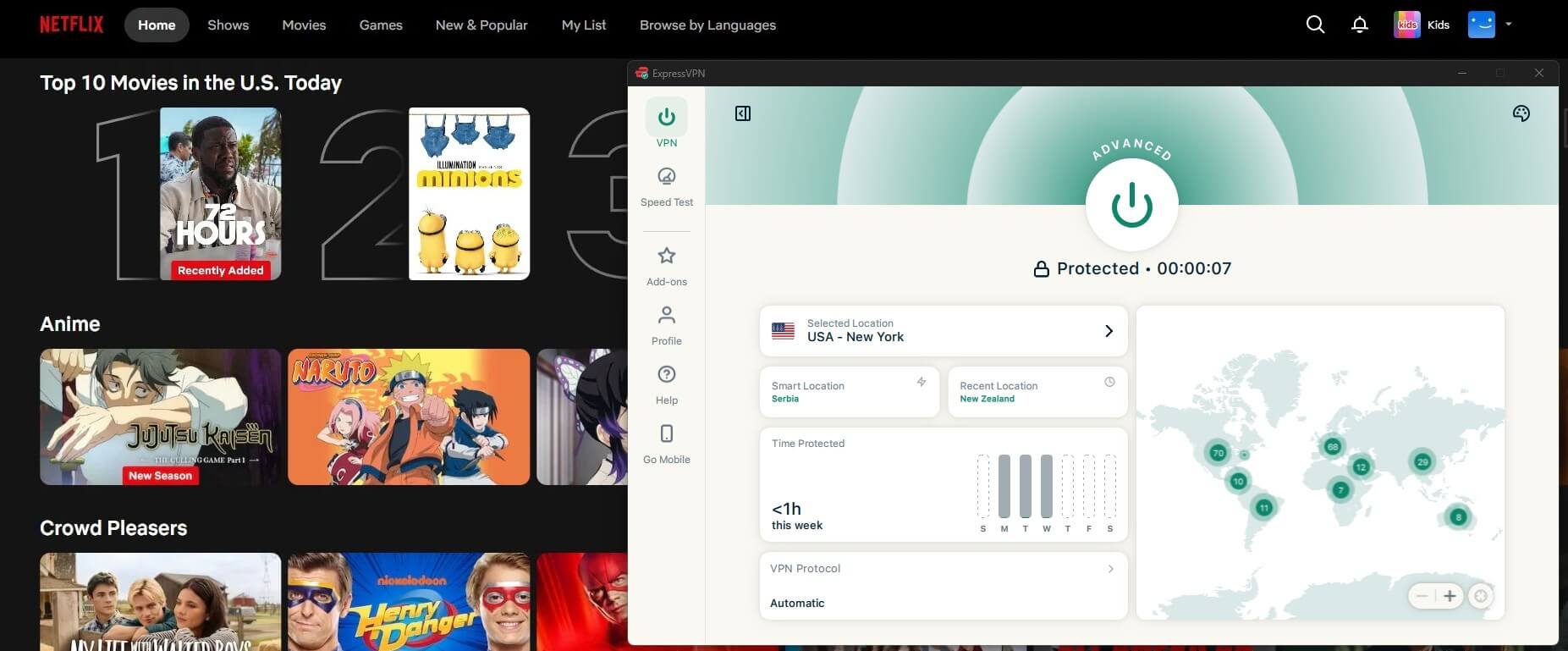
When a stream does start, playback is smooth, since speed isn’t the problem. ExpressVPN, by contrast, unblocked every major Netflix library I tested.
That includes libraries from the US and the UK to Japan, along with BBC iPlayer, Channel 4, ITV, Prime Video, and HBO Max. ITV and Prime Video detected it now and then, and its browser extension, which spoofs your location for sites that check it a second way, solved that.

Torrenting is much closer. Neither VPN limits P2P to special servers, and neither leaked my IP address or DNS requests in testing.
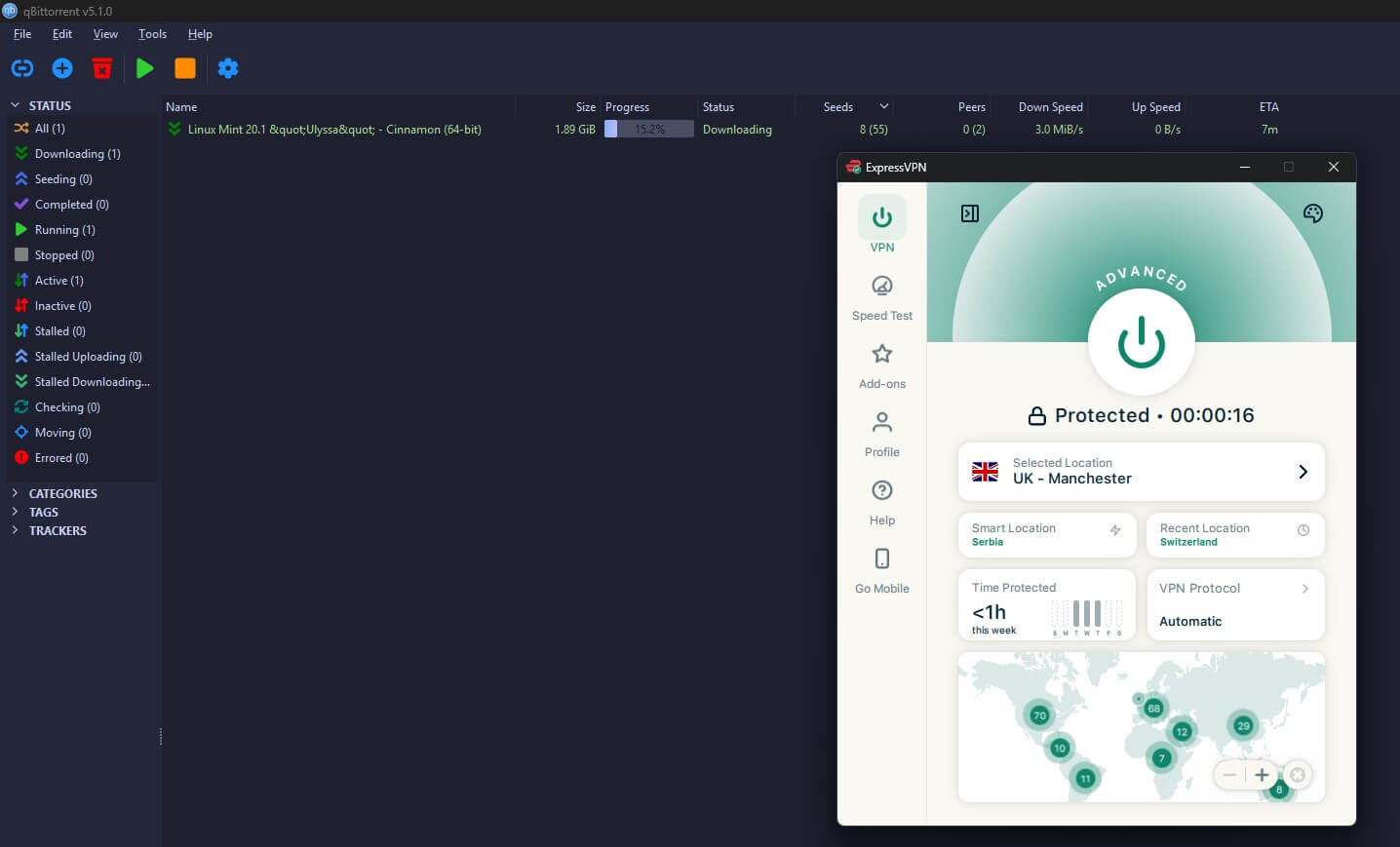
Mullvad removed port forwarding in 2023, and ExpressVPN has never offered it, so seeding on private trackers is equally limited on both.
Winner: ExpressVPN. It unblocks far more streaming services. For torrenting, the features match, and ExpressVPN’s distant servers transfer files faster.
Price Comparison: Cheaper at Different Times
Mullvad has charged the same flat €5 a month since 2009, with no discounts for longer terms. ExpressVPN costs less during its first term, but its price increases on renewal, so Mullvad becomes the cheaper VPN from then on.
| Mullvad | ExpressVPN | |
| Price | €5 a month (under $6) | About $3 a month on the two-year Basic plan |
| Plans | One plan, any length | Basic, Advanced, and Pro |
| After the First Term | Same €5 a month | Increases above €5 a month |
| Money-Back Guarantee | 14 days (not for cash or crypto) | 30 days on any payment method |
| Free Trial | No | 3 days on Android |
| Payment Methods | Card, PayPal, bank transfer, cash, crypto | Card, PayPal, crypto |
Mullvad also accepts cash, a payment option few cheap VPNs offer, though paying in cash or crypto rules out a refund.
Verdict: a draw. ExpressVPN suits a two-year commitment with a longer refund window. Mullvad suits anyone keeping a VPN for years or paying without leaving a name.
Apps and Devices: ExpressVPN Covers More Screens
Both keep their interfaces spare and mirror the desktop layout on mobile, so there’s no relearning. ExpressVPN connected in one to two seconds in my tests, and its app is easy to use, with most choices made for you. The trade-off is fewer advanced settings for people who like to fine-tune their connection.
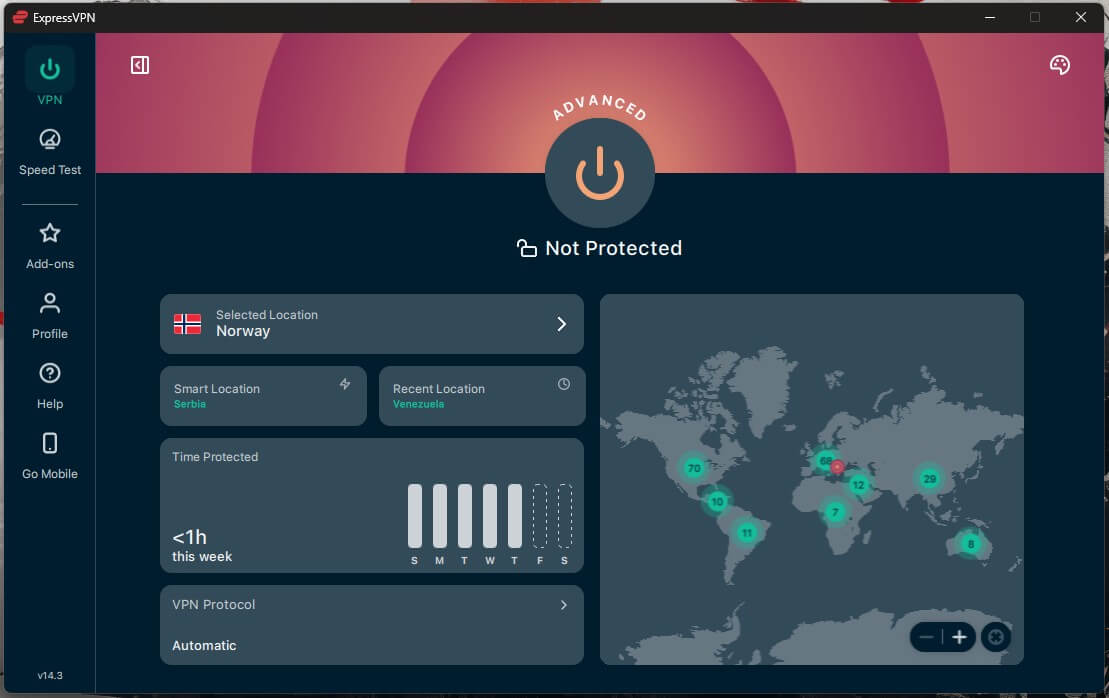
ExpressVPN also supports far more devices, with apps for Windows, macOS, Linux, iOS, Android, Apple TV, Fire TV, and routers, plus MediaStreamer for consoles.
Mullvad covers Windows, macOS, Linux, iOS, and Android, and its Android app also works on Android TV and Fire TV, where you install it from Mullvad’s site. It has no Apple TV app and nothing for consoles.
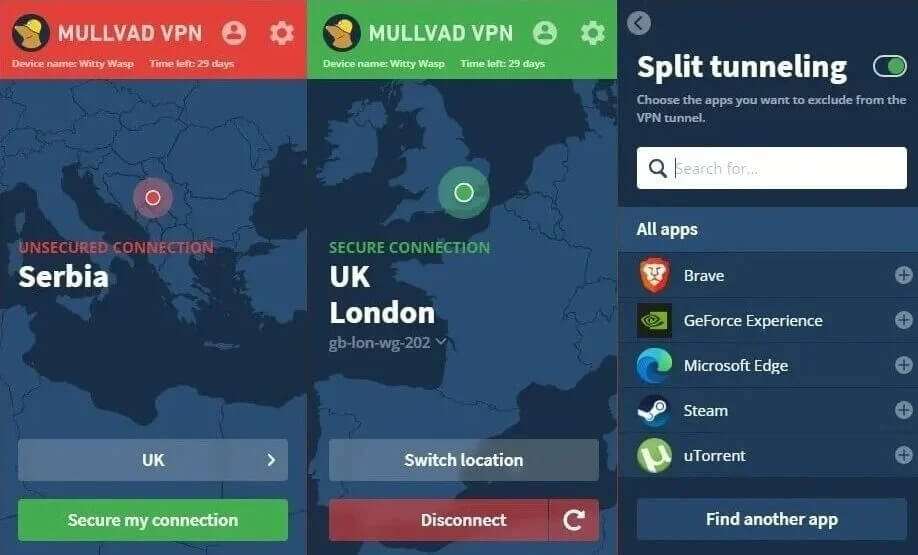
In my Mullvad review, I rated its apps highly, but some settings took longer to find than they should. Device limits differ sharply too: Mullvad allows 5 connections, ExpressVPN 10 to 14 depending on the plan. Support follows the same split, with email only at Mullvad and 24/7 live chat at ExpressVPN.
Winner: ExpressVPN. Twice the devices and much wider hardware support win ExpressVPN this round. Mullvad’s apps work well, but they cover fewer screens.
Server Network: ExpressVPN Has More Locations
ExpressVPN has servers in 113 countries, connected through 10 Gbps ports, and dedicated IP addresses are available as an add-on.
Mullvad operates about 570 servers in 50 countries, and it owns some of that hardware instead of renting it. Owning servers is a genuine privacy argument, since no hosting company controls them.
Even so, the network is small, 63 countries short of ExpressVPN’s, and it offers no dedicated IP addresses.
Winner: ExpressVPN. More than twice the countries means a closer server for more people and a better chance of finding the location you want.
Bypassing Censorship: ExpressVPN Requires Less Setup
Dropping OpenVPN also removed Mullvad’s bridge mode. It now disguises WireGuard with four obfuscation methods, including QUIC, which makes VPN traffic resemble ordinary web traffic. Its Automatic setting enables obfuscation when a plain connection fails.
DAITA, on the other hand, changes traffic patterns and leaves the protocol visible, so it doesn’t help against VPN blocking. ExpressVPN disguises traffic on every server with nothing to enable.
That also helps on school and office networks that block VPN traffic, a common obstacle when you try to unblock websites at school or work.
Winner: ExpressVPN. Mullvad offers more obfuscation methods, but you have to know which one suits the network. ExpressVPN disguises traffic from the first connection, which is the simpler option on a filtered network.
Summary
For most people, ExpressVPN is the better VPN. The deciding point is breadth: one subscription handles streaming, travel, and the TV in the living room, and a filtered network requires no settings. Mullvad is narrower by design, and that’s its strength.
If you want to remain anonymous even from your VPN company, choose Mullvad and accept the smaller network and weaker streaming. Everyone else is better served by ExpressVPN.
Frequently Asked Questions
Is Mullvad better than ExpressVPN?
No, not for most people. Mullvad is better for anonymity, since it requires no email and accepts cash. ExpressVPN is better for streaming, speed, and device coverage, including TVs and routers.
Is Mullvad faster than ExpressVPN?
No. ExpressVPN is generally faster, and the difference grows on distant servers. Mullvad's WireGuard connections perform well on nearby servers but slow down more over long distances.
Does Mullvad work with Netflix?
Yes, but only partly. Mullvad unblocks Netflix US, while most other Netflix libraries and stricter streaming services detect it, since Mullvad doesn't design its servers for streaming.
Can you use Mullvad without an email?
Yes. Mullvad creates a random account number at sign-up and requires no email, name, or password. Payment can also be made in cash or cryptocurrency for extra anonymity.
Does ExpressVPN keep logs?
No. ExpressVPN keeps no activity or connection logs, and independent auditors have verified its no-logs policy. Its servers operate from RAM only, so stored data is wiped on every restart.
Does Mullvad have a free trial?
No. Mullvad has no free trial, but it offers a money-back guarantee on card and PayPal payments. Payments made in cash or cryptocurrency aren't refundable.