
Philippine ISPs now block websites on orders from several regulators, from unlicensed crypto exchanges such as Binance to piracy streaming sites flagged by the Intellectual Property Office. Add the cybercrime law that makes libel posted online a crime, and it’s clear the government takes an active interest in what happens online.
A VPN changes your IP address, and that helps in both directions. At home, a server abroad unblocks foreign Netflix catalogs, while overseas, a Philippine server brings back local banking and streaming services. The five VPNs below have Philippine servers and passed our speed and privacy tests.
The Best Philippines VPNs at a Glance
- NordVPN: Best overall. Top US speeds in our tests and a Philippine server for a local IP address.
- Proton VPN: Best for privacy. Swiss law and a no-logs policy audited every year.
- ExpressVPN: Best for long-distance speed. The strongest results on our Japanese servers.
- Private Internet Access: Best budget VPN. A low long-term price with no device limit.
- Surfshark: Best for phones. GPS spoofing on Android and unlimited devices.
Comparing VPNs for the Philippines
These figures come from the tests behind our ranking of top VPN services. The average covers servers in the UK, the US, and Japan. Since Japan is the closest of those locations to the Philippines, its column shows how each VPN handles a long connection to Asia.
| VPN | Average speed loss | Speed loss on Japanese servers | Countries | Devices | Price (long-term plan) |
|---|---|---|---|---|---|
| NordVPN | 7.8% | 15.7% | 152 | 10 | About $3.50/mo |
| Proton VPN | 10.2% | 16.0% | 149 | 10 | About $3/mo |
| ExpressVPN | 7.8% | 13.9% | 113 | 10-14 | About $3/mo |
| Private Internet Access | 12.7% | 25.6% | 113 | Unlimited | About $2/mo |
| Surfshark | 9.6% | 16.6% | 100 | Unlimited | About $2.50/mo |
Top VPNs for the Philippines in 2026
1. NordVPN: Top VPN for the Philippines
Pros
- Fastest US speeds in our tests
- Unblocked Netflix Philippines
- Kill switch that closes chosen apps
- Servers in 152 countries
- Independently audited no-logs policy
Cons
- Server categories can confuse beginners
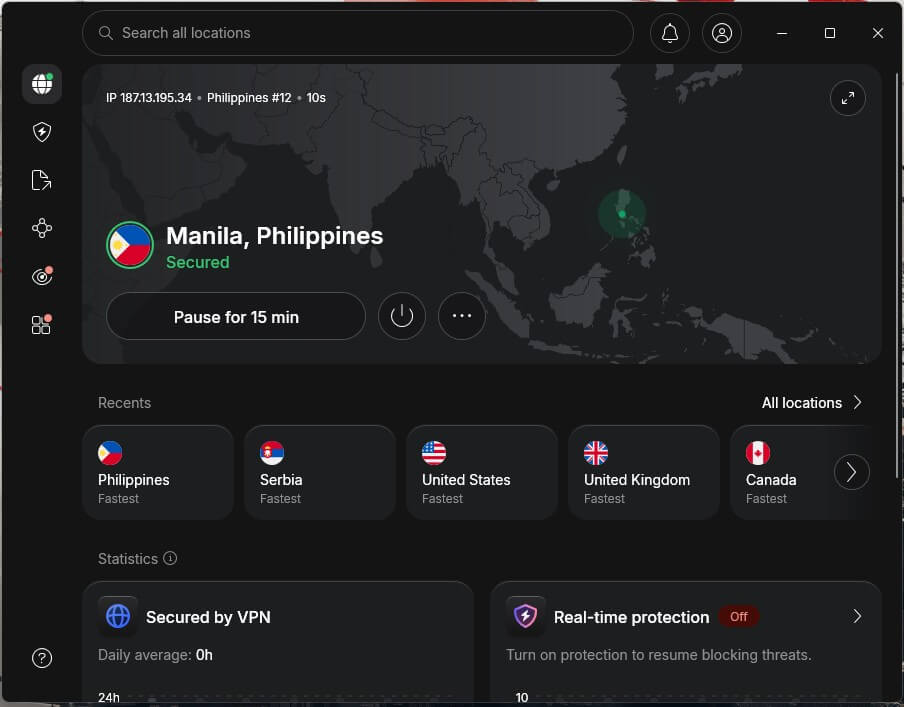
NordVPN takes the top spot because it’s fast on the connections people in the Philippines use most. In our tests, it lost the least speed on US servers, and its 7.8% average loss places it among the fastest VPNs we’ve tested. On top of that, its app-level kill switch is a useful extra on unstable mobile connections.
Most kill switches cut all internet access when the VPN drops, while NordVPN’s can close only the apps you name until the connection returns. The NordVPN review explains its other privacy tools, including the audited no-logs policy. Pricing starts at about $3.50 a month for the Basic plan on a two-year term.
Still, there’s one drawback for beginners: the long list of server categories, from Double VPN to obfuscated servers, which can look confusing at first. Fortunately, Quick Connect avoids all of it by connecting you to the fastest available server in one tap.
2. Proton VPN: Most Private VPN for the Philippines
Pros
- Unblocked Netflix Philippines
- No-logs policy audited every year
- Extra privacy servers in Switzerland, Iceland, and Sweden
- Feature that speeds up distant connections
Cons
- No Smart DNS for smart TVs
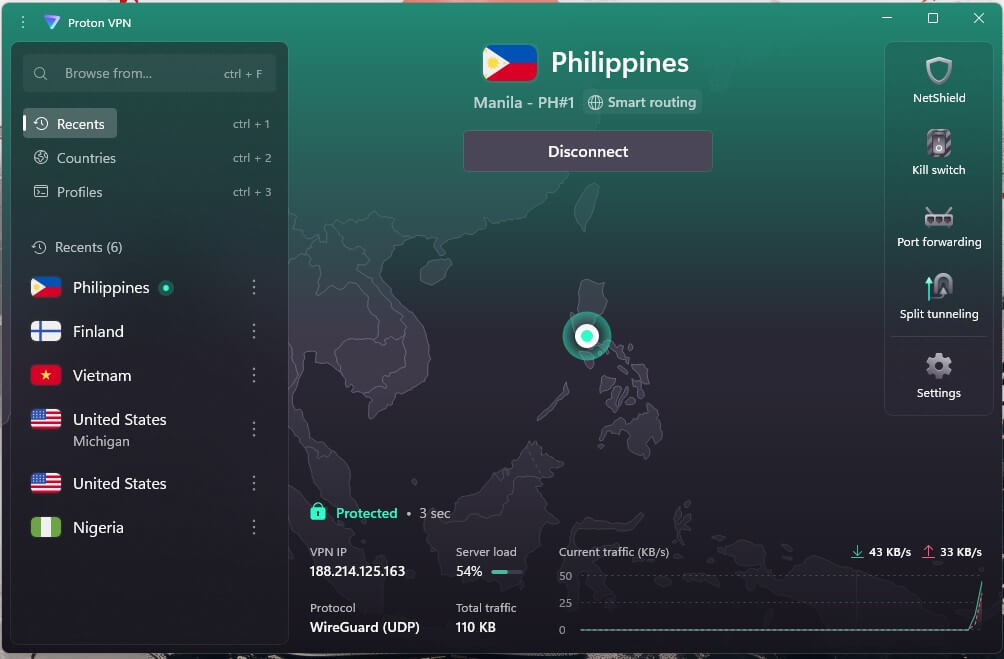
Proton VPN is the one we’d recommend to journalists, activists, and others who post political commentary in the Philippines. That’s because Proton AG answers to Swiss courts, publishes the code of its apps, and has its no-logs policy audited by an outside firm each year.
In addition, Secure Core on VPN Plus adds a first stop in Switzerland, Iceland, or Sweden for extra protection. As for speed, it’s close behind the leaders, with a 10.2% average loss. On top of that, its VPN Accelerator feature also helps on long connections: switching it off cost about 5% of our download speed on a US server.
Over two years, the VPN Plus plan averages about $3 a month and covers 10 devices, including a Chromebook through its Android app. What it lacks is Smart DNS, so a smart TV without a VPN app requires a router setup or a connection shared from your computer.
3. ExpressVPN: Best for Long-Distance Speed
Pros
- Strongest speeds on Japanese servers
- Unblocked Netflix Philippines
- Native Apple TV app
- Simple apps with few menus
Cons
- Weaker ad blocking
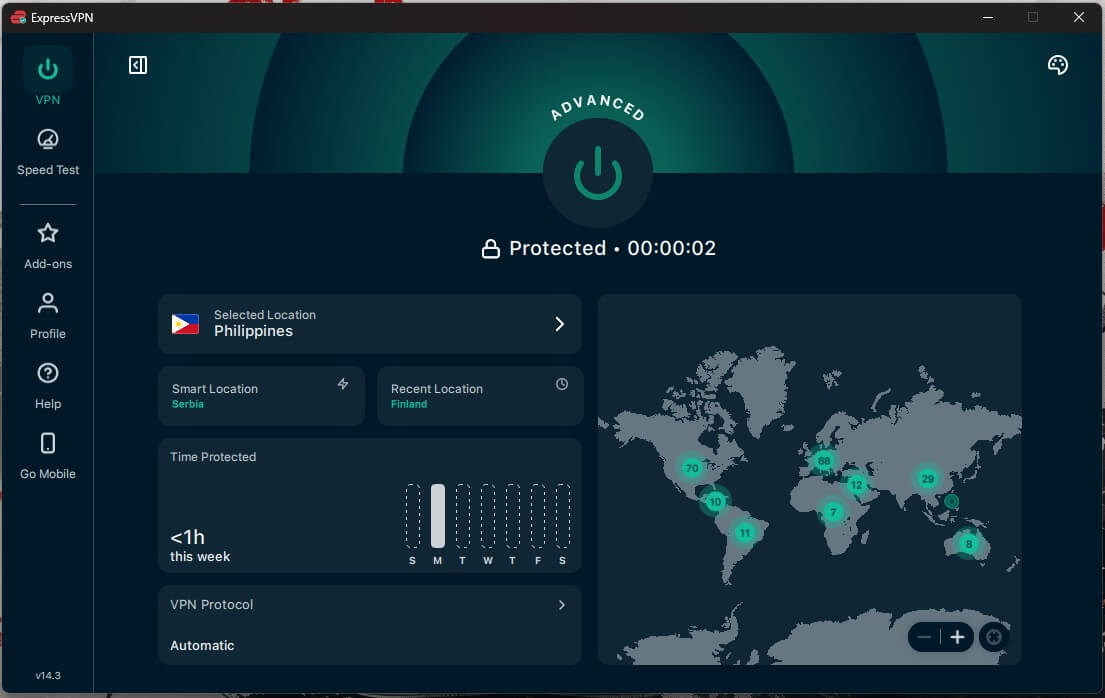
ExpressVPN handled distance better than the other four. On Japanese servers, for example, it lost 13.9% of its speed, the smallest drop we recorded there, so it’s a strong fit for users who connect across Asia or to services hosted far away. Its apps are also the simplest of the five.
You choose a country, press one button, and the Lightway protocol connects almost instantly. It also has a native app for Apple TV, so a TV in the living room doesn’t require a router setup. ExpressVPN’s two-year Basic plan comes in at about $3 a month for 10 devices.
Ad blocking, on the other hand, is its weaker side. Advanced Protection blocked 71% of the ads and trackers on our test page, below the scores of PIA and Proton VPN. If a cleaner browser is part of what you want from a VPN, PIA or Proton VPN does that job better.
4. Private Internet Access: Best Budget VPN for the Philippines
Pros
- No limit on devices
- Budget-friendly long-term plan
- Strong ad and tracker blocking
- Independently audited no-logs policy
Cons
- Bigger speed loss on distant servers
- Based in the US
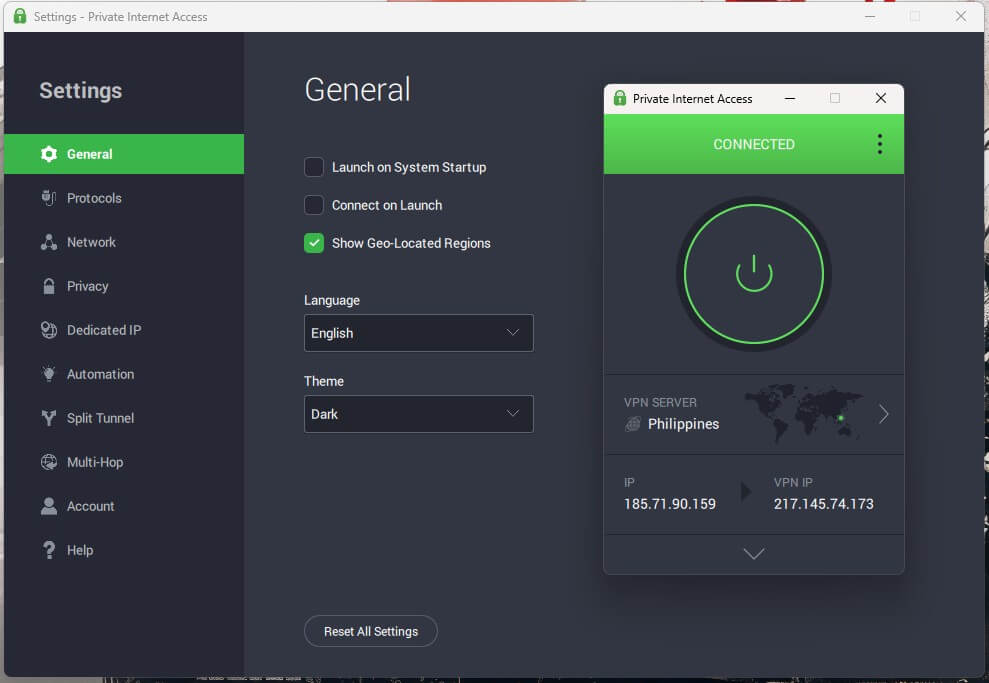
Private Internet Access makes sense when price comes first. At about $2 a month on its long-term plan, it’s among the cheapest VPNs with an audited no-logs policy, and one account protects the whole household’s devices. Distance, however, is its weak point.
PIA lost 25.6% of our speed on Japanese servers, far more than the other four, so streams from Asian or American servers can take longer to buffer. For browsing and HD video, that’s still enough, but if you stream across long distances every day, NordVPN or ExpressVPN keeps more of your speed.
On the plus side, MACE stopped 96% of the ad and tracking requests in our blocking test, the highest score we’ve recorded. PIA is based in the US, which concerns some privacy-focused users. Even so, its no-logs policy has been independently audited, so there’s little user data for authorities to request.
5. Surfshark: Best for Phones
Pros
- GPS location spoofing on Android
- Unlimited devices
- Unblocked Prime Video and BBC iPlayer
- Masked email on every plan
Cons
- Some connections take several seconds
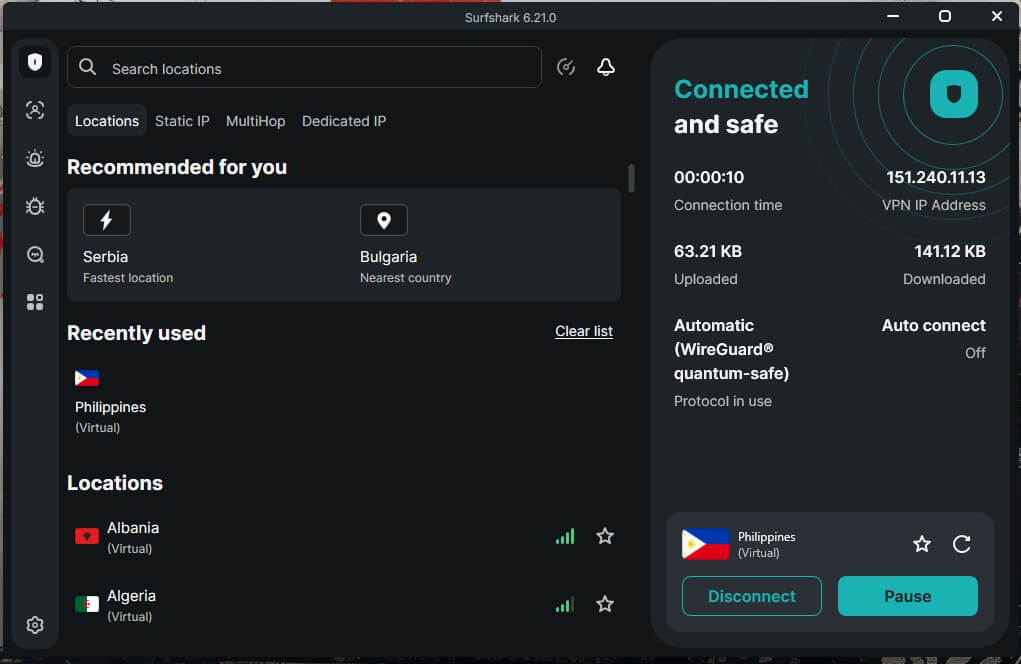
Surfshark is built around phones, which suits a country where most people go online through mobile data. For example, its Android app includes GPS override, which helps you spoof your location for apps that read GPS instead of your IP address. On top of that, there’s no device limit. Beyond phones, streaming is another strength.
Surfshark unblocked every service we tested except ITVX, and it kept enough speed for 4K, with a 9.6% average loss. As a result, it ranks among the best VPNs for streaming foreign catalogs. On a two-year term, Surfshark Starter costs about $2.50 a month.
Next to NordVPN, as our Surfshark vs NordVPN comparison shows, it costs less and allows unlimited devices, but it’s slower on US servers. Its connections also took several seconds to start now and then in our tests, so give it a moment before you assume a server isn’t responding.
Philippine Servers and Streaming From Abroad
NordVPN, Proton VPN, ExpressVPN, PIA, and Surfshark offer Philippine locations, so any of them can switch you to a Philippine IP address in a few seconds.
- Philippine services abroad: For Filipinos working or studying overseas, a Philippine server brings back local banking sites, news, and streaming apps.
- Netflix Philippines: In our tests, NordVPN, Proton VPN, and ExpressVPN unblocked it, and Full HD and 4K streams were smooth. The process is the same as changing your Netflix region to any other country: connect first, then open Netflix.
- Speed from far away: Loading is slower from Europe or North America than from elsewhere in Asia, because of the distance. For frequent flyers and overseas workers, the best VPNs for travel cover what else to look for on the road.
- US TV at home: By contrast, in the Philippines the most common use works the other way, with a US server for American channels and streaming services. US TV in the Philippines has its own setup guide covering free channels and paid services.
VPN Laws and Website Blocking in the Philippines
- VPNs are legal: No Philippine law bans them, and banks and companies use them every day.
- The law still applies online: The Cybercrime Prevention Act of 2012 treats online libel as a crime, and a VPN doesn’t change what counts as legal.
- ISPs follow blocking orders: For example, the National Telecommunications Commission has told ISPs to block unlicensed gambling sites and crypto platforms, and the Intellectual Property Office now sends piracy sites for blocking as well. A VPN keeps your ISP from seeing which sites you visit, but using one to access an illegal service doesn’t make it legal.
- Everyday privacy: For most users, however, privacy on mobile data and public Wi-Fi in malls, airports, and coffee shops is the main reason to use a VPN in the Philippines, along with access to foreign catalogs.
Summary
Most of what people in the Philippines stream comes from the US, Japan, or Europe. As a result, how a VPN copes with long connections decides how fast it feels day to day. NordVPN keeps the most speed on the US servers behind much of that streaming, so it’s the VPN we’d recommend to most Filipinos, at home or abroad.
If your posts could attract legal attention, Proton VPN’s Secure Core servers are the better match. On a tight budget, Private Internet Access (or even Surfshark) covers every device in the house for less (both under $2.5 per month).
Frequently Asked Questions
Is it legal to use a VPN in the Philippines?
Yes. VPNs are legal in the Philippines, and businesses and individuals use them openly. Activity that breaks the law, such as posting libel or sharing pirated films, remains illegal with a VPN on.
What is the best VPN for the Philippines?
The best VPN for the Philippines is NordVPN, thanks to its Philippine servers, strong speeds to the US and Asia, and audited privacy. Proton VPN is the leading privacy-focused alternative.
Which VPNs have servers in the Philippines?
NordVPN, Proton VPN, ExpressVPN, Private Internet Access, and Surfshark offer Philippine server locations. Any of them assigns a Philippine IP address for local banking, news, and Netflix Philippines.
Is there a free VPN with a Philippines server?
No reputable free VPN offers one. Proton VPN, Windscribe, PrivadoVPN, and Hide.me leave the Philippines off their free plans, so a paid VPN with a money-back guarantee is safer.
Can you use a VPN on mobile data in the Philippines?
Yes. VPN apps work on Globe, Smart, and DITO mobile data the same way they do on Wi-Fi, encrypting traffic before it leaves the phone, with a small increase in data use.