
Hawaii is a long way from the mainland, and most US websites and streaming apps are hosted on servers in California or farther east. A VPN can only be as quick as the mainland server behind it. Visitors have a second problem: hotel and condo Wi-Fi shared with dozens of other guests. Then there are the problems specific to the islands.
Hawaii counts as home territory for several California sports teams, and their games are blacked out on the streaming packages mainland fans use. Outside the US, one Honolulu TV station blocks its livestream. A VPN for Hawaii helps with most of this, and a few can even make you appear to be in Honolulu. Here’s what worked for us.
Top VPNs for Hawaii at a Glance
- NordVPN: Best overall, with a Honolulu location and fast US servers
- Proton VPN: Best for privacy on shared hotel and condo Wi-Fi
- ExpressVPN: Best for US server coverage
- Private Internet Access: Best budget VPN with a Honolulu location
Hawaii VPNs Side by Side
| VPN | Hawaii location | US download speed | Devices | Long-term price |
| NordVPN | Honolulu | 181.50 Mbps | 10 | $3.49 a month |
| Proton VPN | None, nearest in California | 173.68 Mbps | 10 | $2.99 a month |
| ExpressVPN | Honolulu | 177.03 Mbps | 10 | $2.99 a month |
| Private Internet Access | Honolulu | 175.68 Mbps | Unlimited | $2.19 a month |
Four VPNs We Recommend for Hawaii
We tested every VPN in October on a Windows 11 PC in Europe, against a 190.36 Mbps baseline, and checked each Honolulu location with an IP lookup. Speeds on the islands depend on your local connection, so treat the figures as a comparison of each VPN’s US network.
1. NordVPN: Best for a Fast Hawaiian IP Address
Pros
- Fast US servers, including Los Angeles
- Smart DNS for game consoles
- Obfuscated servers for strict networks
- Meshnet for connecting to devices back home
Cons
- Malware filter not included on the Basic plan
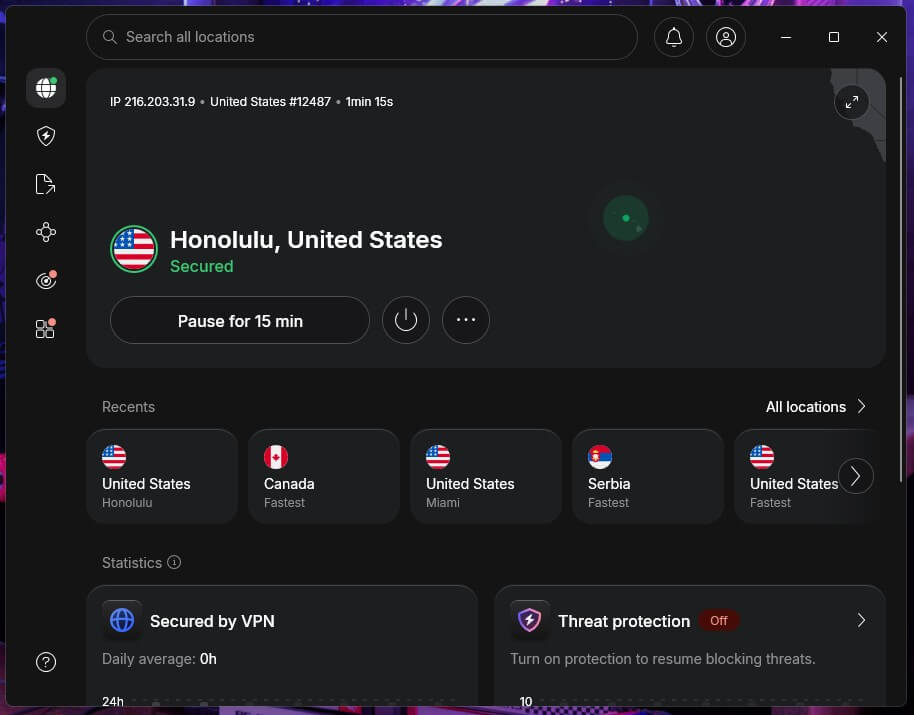
NordVPN combines a Hawaiian IP address with the fastest US servers we tested. When I connected to its Honolulu location, an IP lookup placed me in Honolulu, Hawaii, and KHON2’s livestream, which is blocked from abroad, played normally. On its standard US server, it lost only 4.7% of our speed, and its Los Angeles server was almost as quick.
For shared hotel Wi-Fi, its kill switch blocks traffic if the VPN drops, and it passed our PC-restart test. NordVPN has servers in 152 countries and allows 10 devices on one account. NordVPN’s Basic plan is $3.49 a month and covers the VPN alone, which is enough for streaming and a Hawaiian IP address.
Next-gen antivirus, its filter for malicious sites and downloads, comes with the Complete plan, at $4.49 a month. Our NordVPN review explains what each plan adds.
2. Proton VPN: Best for Privacy on Shared Wi-Fi
Pros
- NetShield blocks ads and trackers
- Advanced kill switch for public networks
- Servers in California and Washington state
- Logging policy audited each year
Cons
- No Honolulu location
- Slow Los Angeles server in our test
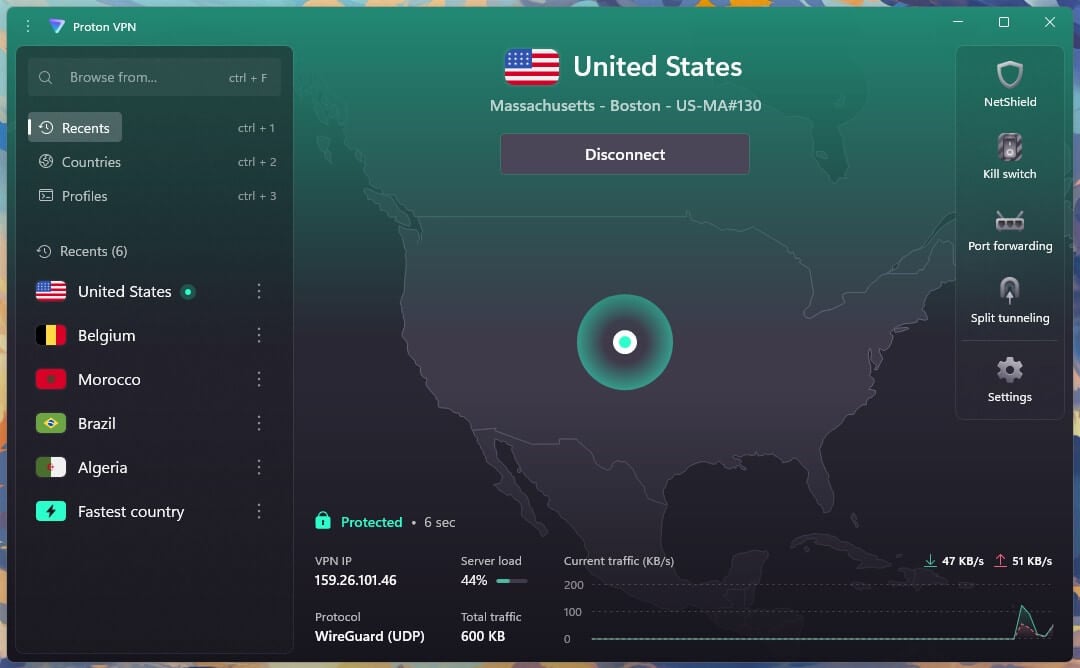
Proton VPN has no Hawaiian location. It’s for people who want protection on the islands and can do without a Honolulu IP address. Its NetShield feature filtered out 93% of ad and tracker requests in d3ward’s ad-block test, and the advanced kill switch kept traffic blocked through a PC restart. These help on resort and condo networks you don’t control.
Its US servers cover 18 states and Washington, D.C., with California and Washington state the closest to Hawaii. Its standard US server was close to the others, but the Los Angeles server dropped to 75.03 Mbps in our test. If Los Angeles is slow for you, try Seattle, which came in at 140.02 Mbps.
For KHON2, any US server is enough: its livestream played on a New York server. The VPN Plus plan starts at $2.99 a month with two years paid up front. Proton VPN operates under Swiss law, and an outside auditor checks its no-logs policy each year.
3. ExpressVPN: Best for US Server Coverage
Pros
- Dozens of US cities, including Honolulu
- Router app covers a whole vacation rental
- Strict kill switch for public Wi-Fi
- Connects almost instantly
Cons
- Average ad and tracker blocking
- Few customization settings
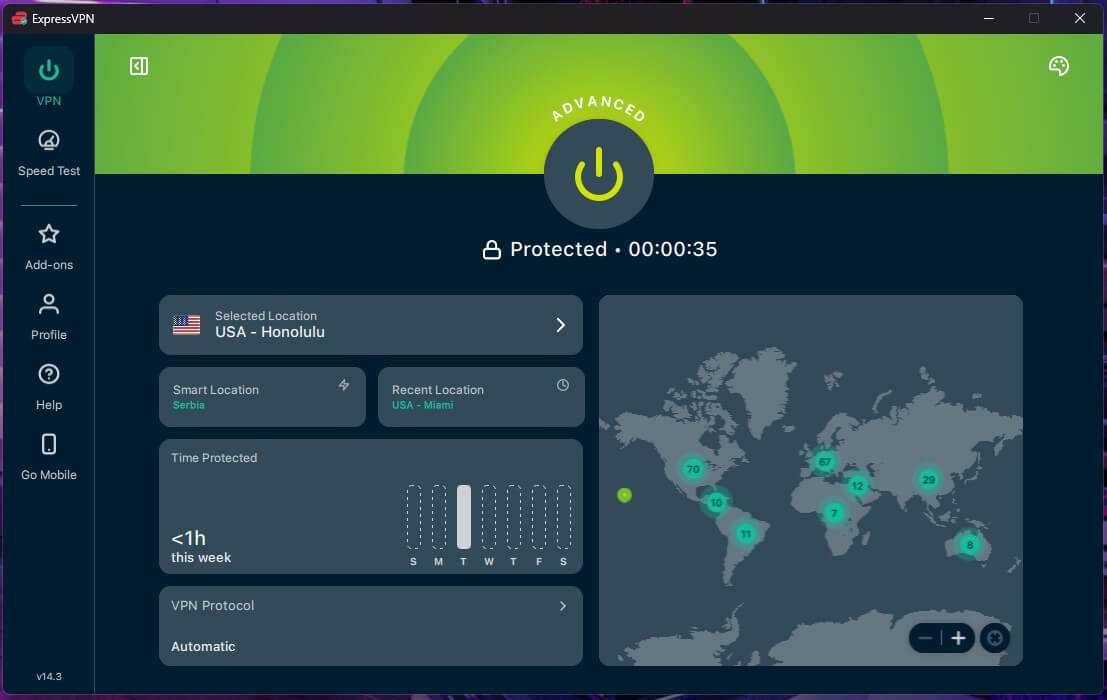
ExpressVPN lists 63 US locations, the most of these four VPNs, so finding a nearby West Coast server is easy. Its Honolulu location passed the same checks: an IP lookup showed Honolulu, and KHON2’s stream played. Its standard US server lost 7.0% of our speed. You won’t notice that while streaming.
Its router app protects a whole vacation rental at once, and the Apple TV app means you can use a VPN on Apple TV without extra setup. Our ExpressVPN vs NordVPN comparison looks at the two in detail. Advanced Protection, its ad and tracker blocker, caught only 71% on the same d3ward test, so keep your browser’s own blocker enabled on public Wi-Fi.
Its apps also have few customization settings, and PIA offers far more control over protocols and encryption. ExpressVPN’s Basic plan is $2.99 a month over 28 months and covers 10 devices.
4. Private Internet Access: Best Budget VPN With a Honolulu Location
Pros
- US servers in every state
- No device limit
- MACE ad and malware blocker
- Low two-year price
Cons
- Cluttered, dated desktop app
- WireGuard must be selected by hand
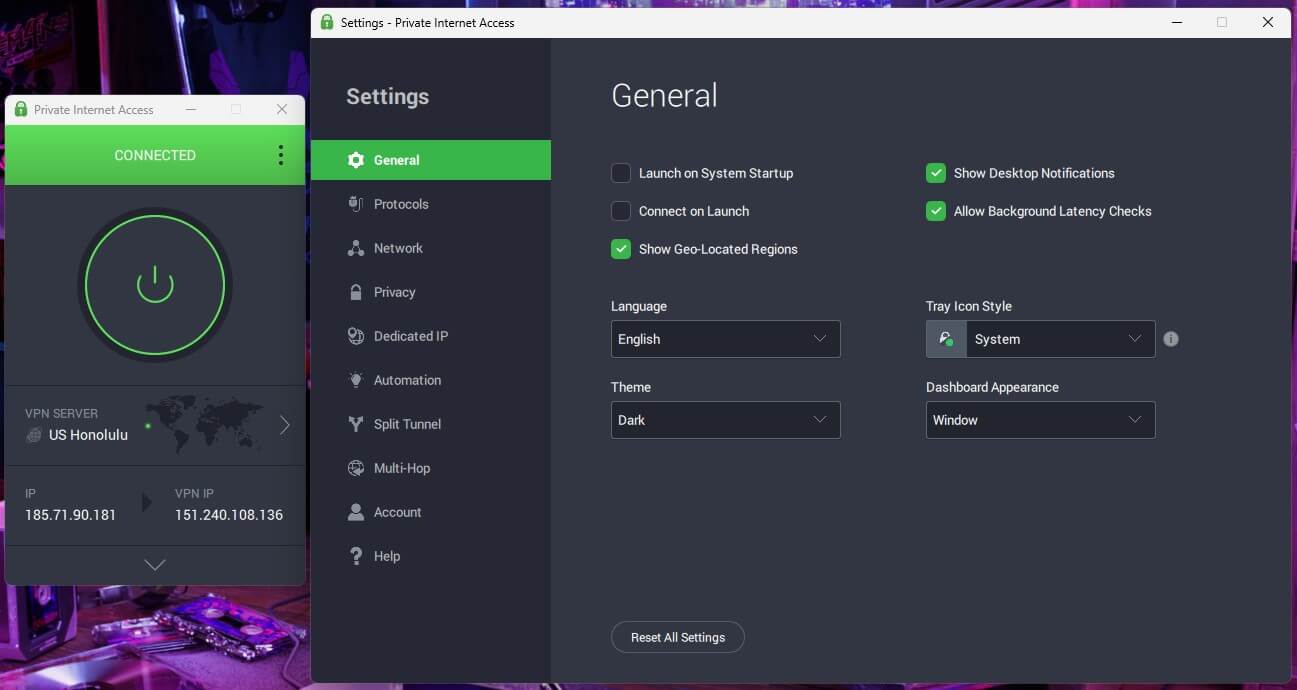
Private Internet Access is the least expensive way to obtain a Hawaiian IP address. On its Honolulu location, whatismyipaddress.com placed me in Honolulu, and KHON2’s livestream played. It has servers in all 50 states, and mainland visitors can connect to their home state too.
Its US speed was close to ExpressVPN’s, and MACE, its ad blocker, caught 96% on d3ward’s test, the best result of these four VPNs. There’s no device limit, and apps cover Windows, macOS, iOS, Android, and Linux. The Windows app looks dated and defaults to OpenVPN.
Choose WireGuard in the settings for better speed. The two-year plan is $2.19 a month, including two extra months, and PIA appears on our list of the best cheap VPNs.
Which VPNs Offer a Honolulu Location?
Four of the VPNs we checked offer a Honolulu location. Connect to it, and websites and apps see a Hawaiian IP address.
- Honolulu location: NordVPN, ExpressVPN, PIA, and Windscribe (Pro plan only).
- No Honolulu location: Proton VPN, Surfshark, CyberGhost, IPVanish, and Hide.me.
On the islands, the Honolulu location doesn’t make your connection faster. For streaming and downloads, connect to a West Coast server, such as Los Angeles, San Francisco, or Seattle. Save the Honolulu location for Hawaiian sites that check where you are.
How to Use a Hawaiian IP Address Away From Home
When you’re on the mainland or abroad, a few local sites require a Hawaiian IP address. Here’s how to connect:
- Subscribe to NordVPN, ExpressVPN, or PIA, the VPNs with a Honolulu location.
- Search for Honolulu in the app’s server list and connect.
- Visit whatismyipaddress.com and check that it shows Honolulu, Hawaii.
- Clear your browser’s cookies, then open the Hawaiian site or app.
For local TV, a US IP address is enough. From Europe, Hawaii News Now and KITV played their livestreams without a VPN. KHON2 blocked us, but its livestream played on the Honolulu locations of NordVPN, ExpressVPN, and PIA, and on Proton VPN’s New York server too.
Sports Blackouts in Hawaii
Hawaii is part of the home territory of all five California baseball teams: the Dodgers, Giants, Angels, Padres, and Athletics. Their games are blacked out on MLB.TV in Hawaii. For 2026, MLB says each of these teams sells an in-market streaming subscription. It removes the local blackout within the team’s home territory, and that’s the legal way to watch from the islands.
Our guide to the best VPNs for MLB.TV covers the package itself. Basketball is similar. NBA.com lists Hawaii within the Lakers’ local broadcast area, so Lakers games stream through Spectrum SportsNet+ in Hawaii, and League Pass doesn’t show them live. For other teams, the NBA checks eligibility by ZIP code.
MLB and the NBA don’t allow VPNs for avoiding blackouts, and their apps can also check your device’s location. Before a trip, check your service’s travel rules: Spectrum SportsNet+, for example, allows up to 30 days of travel within the US.
Home TV for Visitors to Hawaii
Visitors from Japan, Canada, South Korea, and Australia lose their home streaming services in Hawaii, because those apps only play in their own countries. A server back home solves it, and NordVPN, Proton VPN, and ExpressVPN worked with each of these in our tests:
- Japan: TVer, Abema, U-NEXT, and NHK+ played on Japanese servers. More in our guide to Japanese TV abroad.
- Canada: CBC Gem and ICI TOU.TV streamed on Canadian servers, as our Canadian TV abroad guide explains.
- South Korea: KBS, MBC, Wavve, and Coupang Play worked on Seoul servers. Setup steps are in our Korean TV abroad guide.
- Australia: 9Now, 7plus, and Kayo played on Australian servers. Our page on Australian TV abroad covers sign-up.
Netflix and Prime Video also change their catalogs by country, and our list of the best VPNs for Prime Video explains how to switch regions. Visitors from the mainland US can use their usual services without a VPN, though one still protects hotel Wi-Fi.
Free VPNs in Hawaii
None of the free VPNs offer a Honolulu location. Windscribe keeps Honolulu for its paid Pro plan, and Proton VPN’s free plan connects you automatically to one of ten countries, so you can’t choose the US. Windscribe and PrivadoVPN include free US servers, where ABC and CBS played in our tests, but their 10 GB monthly limit is used up after a few hours of HD.
On hotel and café Wi-Fi, Windscribe or PrivadoVPN is fine for browsing and banking. Pay for a VPN if you stream, use a Hawaiian IP address, or keep a VPN on your phone all day. For more free VPNs, see our best free VPN rankings.
Conclusion
Hawaii’s distance from the mainland shapes how a VPN behaves there. On the islands, use a server in Los Angeles or Seattle for streaming and downloads. Away from Hawaii, connect to Honolulu when a local site checks your location. NordVPN is the best overall. Its US servers were the fastest we tested, and its Honolulu location unblocked KHON2.
Proton VPN is the better fit if you mainly want privacy on shared Wi-Fi and a Hawaiian IP address isn’t on your list. For the lowest price with a Honolulu location, choose Private Internet Access. If you follow a California MLB team, its in-market streaming subscription removes Hawaii’s blackout for that team’s games.
Frequently Asked Questions
Which VPNs offer a Hawaiian IP address?
NordVPN, ExpressVPN, and Private Internet Access offer Honolulu locations that provide a Hawaiian IP address. Windscribe also offers a Honolulu location on its paid Pro plan.
Can a VPN unblock Hawaiian TV from abroad?
Yes. KHON2 blocks viewers outside the US, and a US server is enough to unblock it. KITV and Hawaii News Now stream without a VPN.
Is there a free VPN with a Hawaii server?
No. Windscribe's Honolulu servers require its Pro subscription, and the free versions of Proton VPN and Hide.me have no Hawaiian location. Free US servers are the closest alternative.
Is a VPN legal in Hawaii?
Yes. VPNs are legal throughout the US, including Hawaii. Using one to avoid a streaming service's blackout or region rules can break that service's terms, though.
Can a VPN get around MLB blackouts in Hawaii?
No, not within MLB's rules, which prohibit VPNs for avoiding blackouts. MLB.TV can also check device location, and Hawaii fans can subscribe to their team's in-market stream instead.
Does a VPN make the internet faster in Hawaii?
No. A VPN usually adds a little delay, which a server in California or Seattle keeps small. Choosing Honolulu over those cities doesn't speed things up.