You’ve come to this Hola VPN review 2026, wondering if it’s safe, fast, and good. We’ll burst your bubble: it’s not, despite its popularity. While Hola VPN has a few good qualities, ultimately, it’s not a VPN I would advise for privacy enthusiasts or those wanting more online security. Hola VPN was founded in 2007 as a community-powered VPN, promising fast and unrestricted internet access. Millions have signed up, drawn to its free plan.
As Hola became more popular, it also came under fire for an unusual business model that raised privacy concerns. In this review, we will dissect Hola VPN, from its features to its performance to its risks, and everything in between. We’ll help you decide if Hola is the right choice for you as a short- or long-term free VPN.
Hola VPN
Although the paid version of Hola VPN is effective for streaming, its free offer is anything but a good choice. Those wanting to protect privacy and enhance their security should avoid Hola VPN at all costs (whether paid or free). There are clearly better VPNs available.
Pros
- Free, without data cap
- Unblocks some websites
- Easy to install and use
Cons
- Unreliable region support
- Logs user activity
- Inconsistent speeds
- P2P model exposes IP
- Paid version is expensive
Hola VPN Review: Quick Look
| 💸 Starting price | $2.99 per month for 3 years |
| 🔖 Money-back guarantee | No |
| 🌐 Protocols | IKEv2 and HTTPS proxy |
| 🥸 No-log policy | No (heavy logging) |
| 💾 Servers | 190+ locations |
| ⏸️ Double VPN/Multi-hop | No |
| 🦠 Ad-blocking | Yes (in the browser extension) |
| 📺 Streaming performance | Poor |
| 🔁 Torrenting | No (highly discouraged) |
| ⚡ Speed | Slow |
| ⚙️ Ease of use | Good for beginners |
| 💯 Third-party audits | No |
| 💻 Supported platforms | Windows, iOS, Android, and macOS |
| #️⃣ Simultaneous connections | No limit |
| ☎️ Customer support | Email, help center |
Hola VPN is Free, But Conditions Apply
The main draw of Hola VPN is that it’s free. Unlike most VPNs, it doesn’t require upfront payments or even a trial card. However, free access comes with a catch: It’s a peer-to-peer (P2P) network, which means users share their idle bandwidth with other users. This cuts costs but comes with privacy and security concerns.
Your IP address and bandwidth could be used for things you wouldn’t do online. For those wanting more features or better privacy, Hola offers these premium plans:
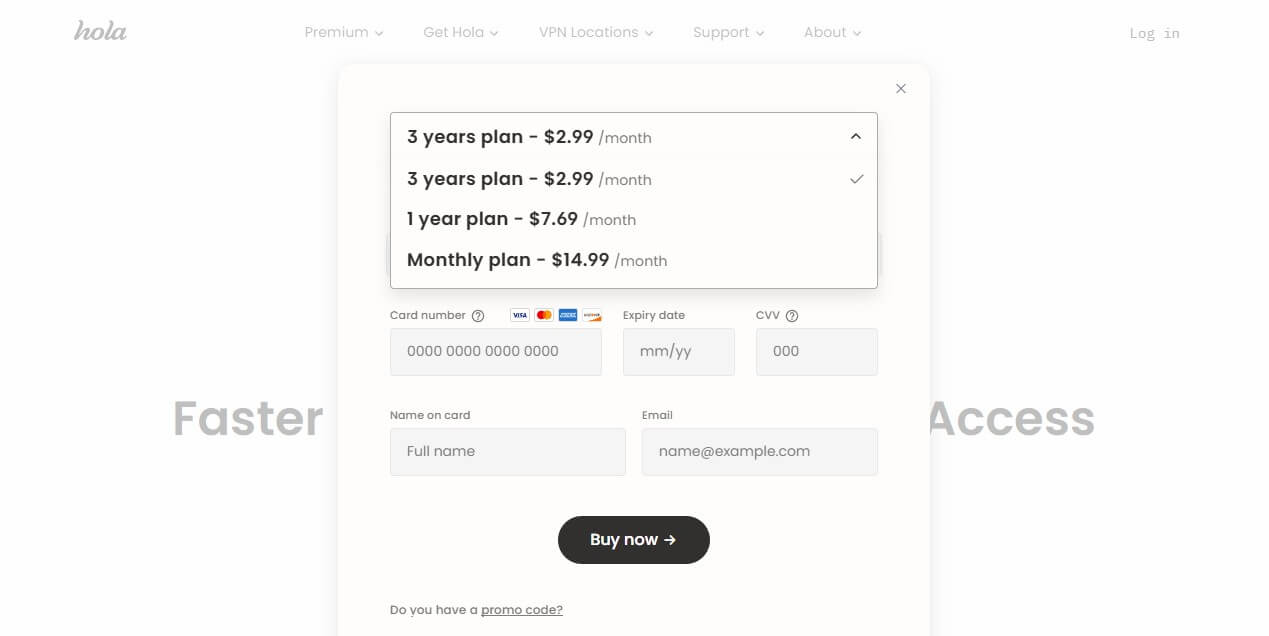
- Monthly: $14.99
- Yearly: $7.69 per month (billed $92.26 annually)
- Three-Year Plan: $2.99 per month (billed $107.55 every three years)
The premium version bypasses the P2P network, offering faster speeds, unlimited usage, and access to additional servers. It also supports streaming in HD, making it a more traditional VPN experience. Interestingly, Hola’s Pro proxy service appears to be discontinued, as its dedicated webpage returns an error.
The appeal of Hola VPN’s free plan is undeniable, but the privacy trade-offs are humongous. Premium plans have better security and functionality, but at this price, other options, like NordVPN, ExpressVPN, and the affordable Private Internet Access are safer and have no-logs policies.
Hola VPN Review: Server Network and Speed Tests
When it comes to VPNs, speed and server coverage are at the heart of user satisfaction. For this review, we tried Hola VPN’s unique server architecture and conducted speed test results to evaluate its performance. Spoiler alert: the result was a mixed bag. As discussed, Hola VPN doesn’t operate like VPNs with real servers.
Instead, it uses a peer-to-peer network, meaning your traffic is routed through other users’ devices. It’s a clever workaround to offer free service, but it has significant and quite serious drawbacks that include:
- Bandwidth Sharing Risks: Your device is used as an exit node for other users; your IP may be associated with activities for which you’re not responsible.
- No Dedicated Servers: While premium VPNs optimize their servers for speed and security, Hola relies on unpredictable connections from its user base.
While Hola has over 190 countries, our review showed that these connections often lack the reliability you’d expect from a VPN. The peer-based system, while innovative, feels more like a compromise than a feature. On the other hand, paid VPNs like NordVPN and ExpressVPN cover up to 140 countries, but each server is tried and tested for reliability and performance.
Speed Test Results: Our Findings in Hola VPN Review
For this review, we tested Hola VPN’s speeds using a connection of 100 Mbps from Florida. Can it be considered one of the fastest VPNs? The results were inconsistent, revealing limitations in its peer-to-peer architecture. When connecting to Canada, Hola VPN delivered download speeds averaging 35-45 Mbps.
While this is decent for light browsing and HD streaming, the connection wasn’t stable enough for uninterrupted video calls or FHD streaming. Upload speeds hovered around 20-25 Mbps, limiting tasks like sharing large files. However, speeds dropped drastically in local locations such as Australia.
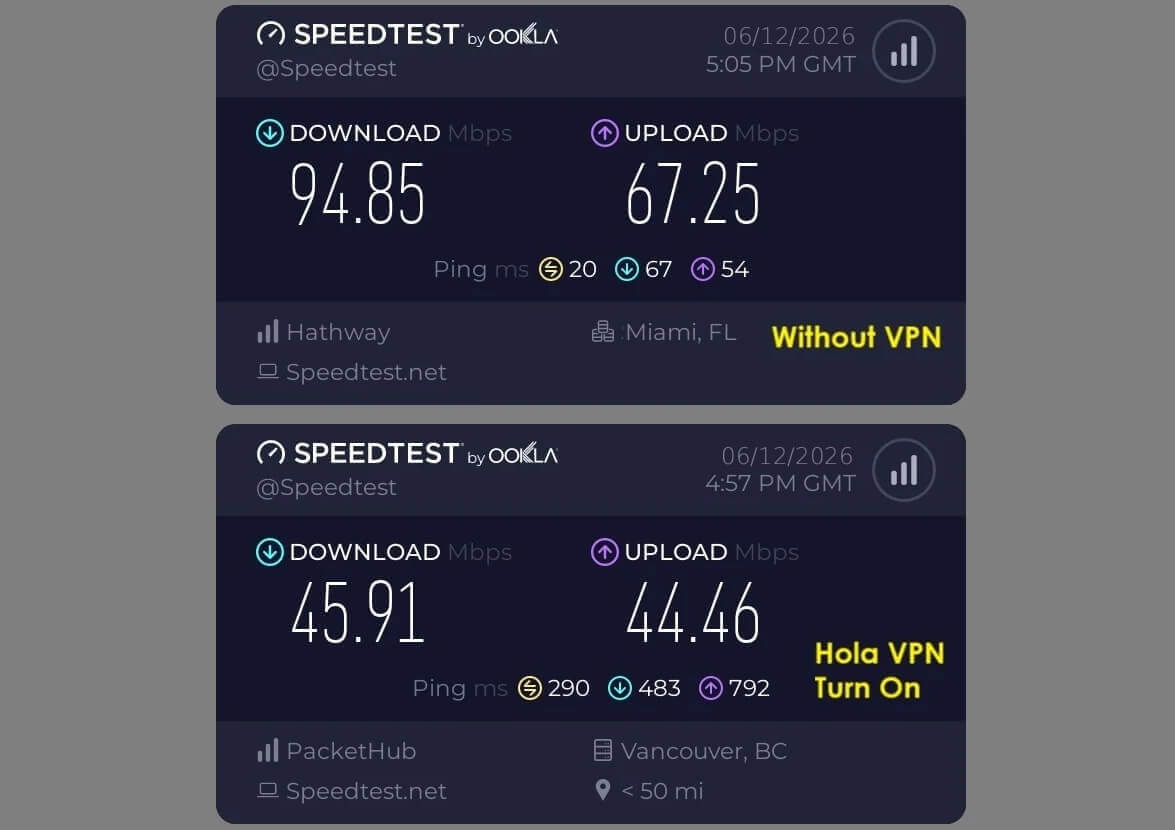
Download speeds averaged 10-15 Mbps, and uploads barely managed 5-8 Mbps. Streaming in HD was almost impossible, with consistent buffering and delayed loading times. Testing during peak hours (evenings and weekends) further exposed the limitations of Hola’s infrastructure.
Speeds frequently dipped below 10 Mbps, regardless of the location. Connection drops were also frequent, disrupting downloads and causing frustration. It became clear that Hola’s P2P network couldn’t handle heavy traffic. High user activity severely impacted performance, making the VPN unreliable for critical tasks.
Performance: Leaves Something to Be Desired
When testing Hola VPN, we investigated its ability to handle streaming, unblock websites, torrent securely, and provide a smooth gaming experience. Let’s examine what our analysis revealed. Another spoiler: It’s not very good.
Streaming: Hola VPN Can Barely Keep Up
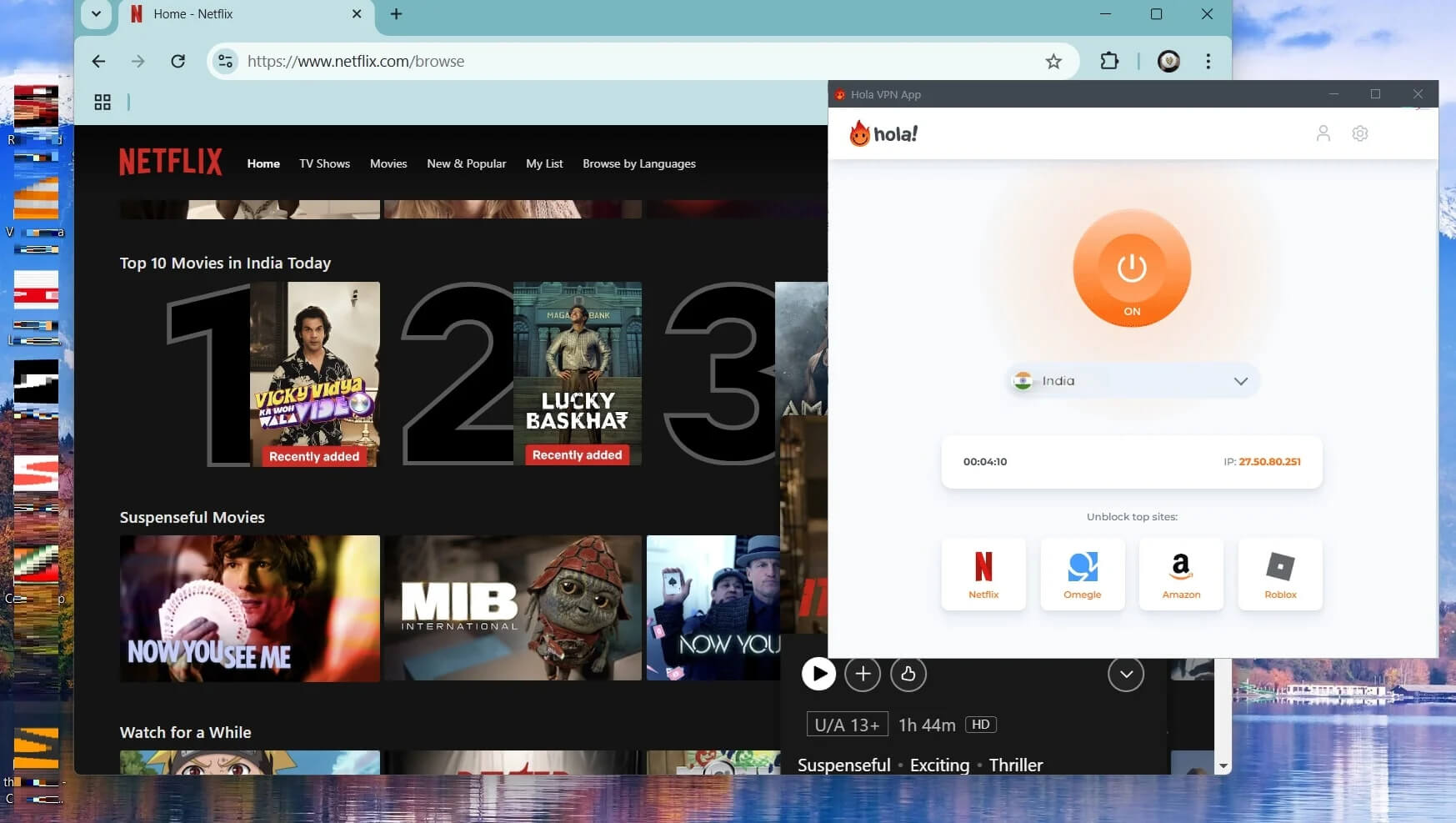
Our first stop was Netflix, where Hola unblocked the Indian library (barely). However, the victory was short-lived. During our review, using a base connection of 100 Mbps, there was constant buffering, making HD playback an exercise in patience. As you can tell, it’s difficult to consider it a good VPN for Netflix.
On local streaming platforms, we encountered similar frustrations, with playback frequently interrupted even at lower resolutions. We also tried accessing Hulu from outside the US. While we bypassed the geo-restrictions, sluggish speeds rendered content unwatchable. The streaming experience was far from seamless.
Hola’s lack of optimized servers for streaming clearly impacted its ability to maintain stable connections, and the absence of high-performance protocols like WireGuard only added to the instability.
Unblocking Websites: Hit and Miss
Hola delivered mixed results when bypassing regional restrictions on websites. It performed well in accessing restricted content on YouTube and loading videos without much delay. However, when we tried Hola to connect to regions with strict restrictions, such as China or Iran, the VPN struggled badly.
Unlike VPNs with obfuscation, Hola lacks the features to bypass advanced firewalls. For example, Hola VPN can’t help you unblock adult sites in the UAE (Dubai). But the same may apply to watching porn in Indonesia and Bali.
Torrenting: A Security Concern
We tried Hola VPN for torrenting, to discover that it’s not designed for P2P transfers. Worse, its P2P infrastructure raises significant privacy and security concerns. Instead of providing a secure tunnel for your traffic, Hola routes your connection through other users’ devices, exposing your IP address to strangers.
This approach creates vulnerabilities and makes Hola unsuitable for anyone valuing privacy while torrenting. For a VPN, avoiding torrenting is a glaring limitation, not seen in top competitors like NordVPN and ExpressVPN. The lack of P2P servers solidifies its place as a poor choice for this case.
Gaming: High Latency, Low Fun
As part of our Hola VPN 2026 review, we tested it while gaming. It was disappointing. With latency exceeding 250 ms in our speed tests, games like Fortnite and Call of Duty suffered from lag spikes and frequent disconnections. If you’re looking to get bot lobbies in Black Ops 7, you should consider alternatives.
In competitive gaming, where milliseconds matter, this made gameplay frustrating and, frankly, unplayable. Input lag was significant, with delays of up to 2 seconds between a button press and on-screen action.
Is Hola VPN Safe in 2026? How Secure is it?
When we conduct an in-depth review, we take a long and hard look at how the VPN protects your data. Security is the most important aspect of any VPN, and Hola VPN’s approach stands out, not in a good way. It markets itself as a convenient, free option, but our test displayed vastly different results.
Its security is nowhere near that of premium VPNs like NordVPN, ExpressVPN, or Private Internet Access. Free users are also at a disadvantage when it comes to encryption; there’s none. Without encryption, your online activities are left wide open, exposing your sensitive data to hackers, ISPs, and even Hola itself.
Hola’s Kill Switch: Limited and Unconventional
Kill switches are a lifeline for privacy, shutting down internet access the moment your VPN connection drops. Hola offers it, but it’s far from straightforward. On Windows, you need to manually add specific apps to the kill switch for it to work, an unusual and inconvenient approach we didn’t like.
In tests, this manual setup didn’t always activate instantly, leaving room for data exposure during the delay. On Android, the kill switch works more traditionally, securing your connection as expected. While this is a step in the right direction, inconsistent functionality leaves much to be desired.
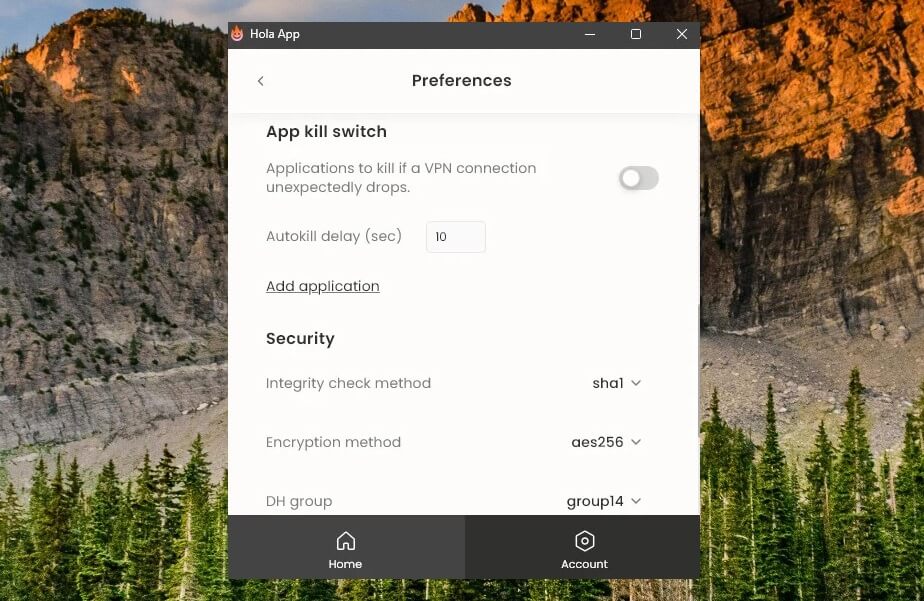
If you’re relying on a kill switch for peace of mind, Hola’s current implementation might not inspire confidence. For critical security features, simplicity and reliability should always be the standard that Hola VPN obviously doesn’t adhere to.
Hola VPN Peer-to-Peer Model: An Unusual Setup
One of Hola VPN’s main selling points is its unique peer-to-peer (P2P) structure. Instead of routing traffic through secure servers, Hola turns its users into a network of exit nodes, where your internet connection could be used by others. This design immediately raises privacy concerns, and these are pretty serious:
- Your IP Address Exposed: Unlike NordVPN or ExpressVPN, Hola doesn’t mask your IP securely. If someone uses your connection for malicious purposes, you could be implicated and knee-deep in trouble.
- Bandwidth Sharing: Free users unknowingly contribute their bandwidth to Hola’s paid business arm, Bright Data. This practice is questionable and unheard of in reputable VPNs.
More than just about sharing bandwidth, Hola VPN’s community-powered model also means your device could be used as an exit node for other users. In practical terms, this makes your IP vulnerable, potentially linking you to actions you didn’t commit.
Encryption of Hola VPN
Many VPNs scale down security features in their free plans, but Hola takes a somewhat unconventional approach. While its premium plans offer customizable encryption, giving users the flexibility to adjust encryption levels, free users are left without this crucial layer of protection. This flexibility might appeal to advanced users, but it also places the burden of security decisions on the user.
It’s something that most top-tier VPNs simplify by offering AES-256 encryption as a default standard. Hola’s encryption implementation hasn’t undergone independent audits, leaving room for doubt about its reliability. This lack of transparency further underscores the risks associated with relying on Hola for privacy-sensitive activities.
Does Hola VPN Protect Against Leaks?
To assess Hola VPN’s ability to protect users from leaks, we ran a series of tests on popular tools like ipleak.net and browserleaks.com. These tests are critical because even a minor slip-up in leak prevention can expose your real IP address or DNS requests, rendering the VPN useless for privacy. The results were disappointing.
During our hands-on testing, we observed multiple instances where Hola VPN failed to shield our real IP address. For example, when switching between servers or reconnecting after a dropped connection, the VPN struggled to maintain privacy. The WebRTC leak tests were no better, and we saw this coming.
Hola VPN couldn’t consistently block these leaks, exposing our real location in certain scenarios. In comparison, NordVPN and PIA aced this test, showing how robustly they secured this potential weak point.
Logging Practices of Hola VPN
When analyzing a VPN, its logging policy is one of the most critical aspects. Unfortunately, in our Hola VPN review, its policy raised several red flags. First, Hola openly admits to collecting user data, including IP addresses, browsing activity, and device information. This is highly unusual and concerning for a VPN.
Its primary purpose is anonymity and privacy, but Hola VPN begs to differ. By retaining this data, Hola creates a digital paper trail that could be exploited by third parties or, worse, handed over to the authorities if requested. Adding to the concern, Hola’s monetization relies heavily on its free users.
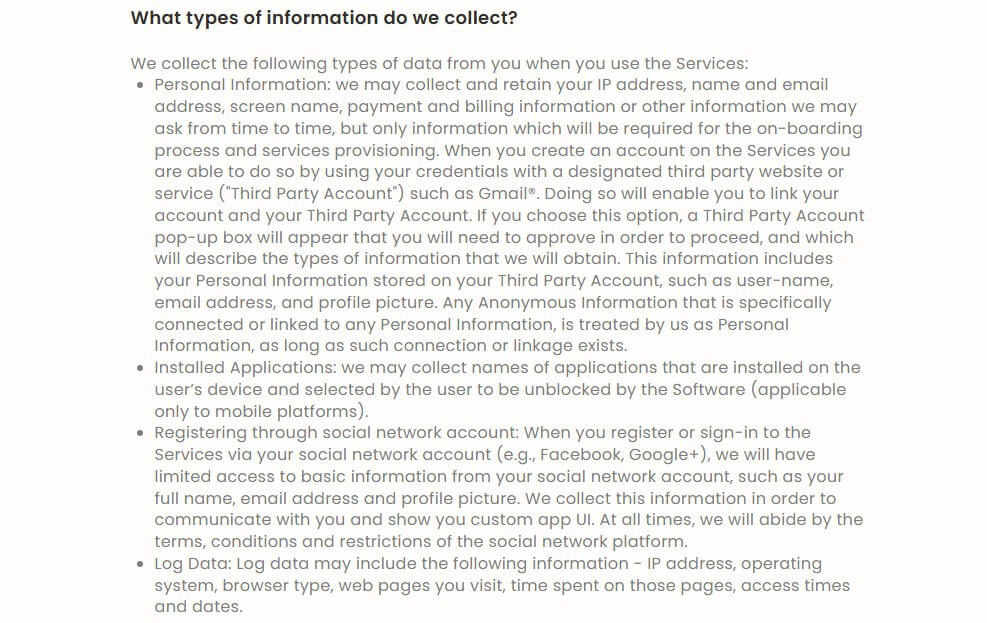
In essence, your internet bandwidth is pooled and sold to third-party companies through Bright Data, Hola’s commercial arm. While this setup might sound harmless, it opens up serious risks. Your connection could be used for activities you’re unaware of, and in the event of misuse, it’s your IP that’s exposed.
Most premium VPNs go to great lengths to store sensitive information. Hola VPN seems to prioritize its business model over user privacy. Here’s another big red flag. Hola VPN hasn’t gone through any third-party audits to confirm its privacy claims or security measures. This is standard practice for trusted VPNs.
Hola VPN Review: Ease of Use and Apps
When it comes to usability, a VPN should be straightforward to navigate and reliable across devices. Hola VPN’s claim to fame is its simplicity, which, on the surface, is a strong selling point, especially for casual users. But how does it stack up when we put it to the test? To be honest, better than expected.
Hands-On with the Hola VPN App Interface
Launching Hola VPN for the first time, we found the installation process to be effortless. The app is available for Windows, macOS, Android, iOS, and browser extensions for Chrome, Edge, and Firefox. The interface is minimalistic, almost bare-bones, compared to the easy-to-use VPNs like ExpressVPN or NordVPN.
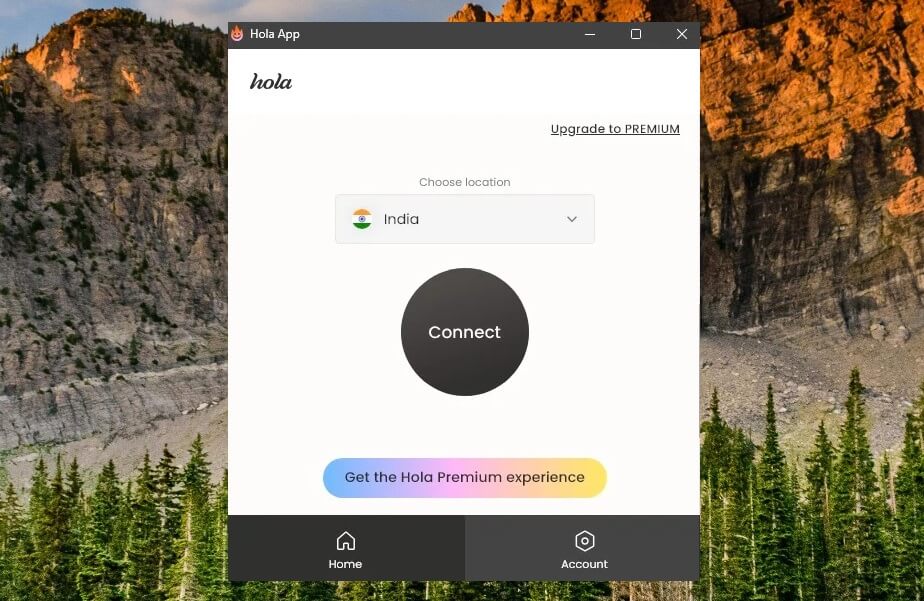
However, this simplicity comes with trade-offs: the lack of advanced settings may leave more seasoned VPN users wanting. For instance, there’s no option to select VPN protocols or even customize the interface. During our Hola VPN review on iOS and Android, the experience was solid, and we haven’t faced issues.
The Android app felt responsive and intuitive, with a user-friendly design that simplifies navigation. However, key features such as customizable encryption and the kill switch are missing from the macOS and iOS app versions. Plus, Hola VPN is free only for an hour; you have to upgrade to get more.
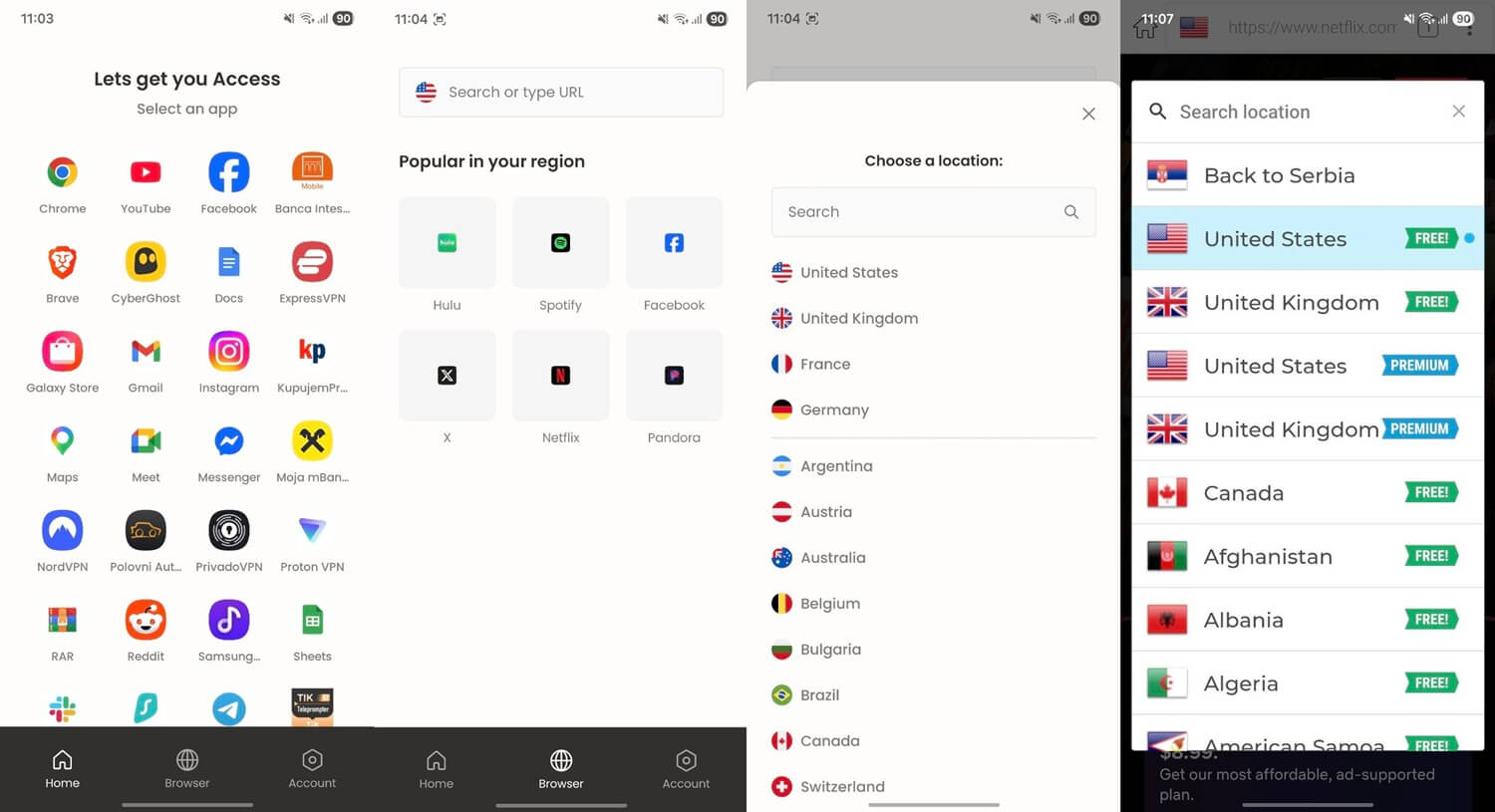
During Hola VPN review and testing, we noticed that its mobile apps are glorified proxies. You enter the URL of the site you want to visit and choose your location. Hola VPN functions more like a browser than a VPN, but surprisingly, it works well, and even unblocks Netflix, quite unusual.
Hola VPN Browser Extensions
One of Hola VPN’s unique selling points is its browser extension, but here’s the catch: it works more like a proxy than a full-fledged VPN. While this might suffice for unblocking websites, it doesn’t provide the same level of encryption or privacy as desktop or mobile apps from some of the best VPNs.
When we tested the extension on Google Chrome, it easily unblocked region-restricted websites. However, it fell short of encrypting our traffic, leaving a gap in security. Hola VPN is not supported in all regions. For instance, it didn’t work in India, and even in places where it works, the experience is unreliable.

Connections often feel like rolling dice; sometimes, they connect smoothly, but other times, they fail or offer subpar performance. On the compatibility front, Hola supports all major platforms, but router installation is not an option, limiting its use to devices like smart TVs, older Fire TVs, or gaming consoles.
In contrast, most premium VPNs we have reviewed offer router configurations for whole-home protection. If you need some, here are the best VPNs for routers, simultaneously way better options than Hola VPN in 2026.
Simultaneous Connections: An Odd Trade-Off
Hola VPN doesn’t impose traditional limits on simultaneous connections, which may seem like a win. But the caveat lies in its peer-to-peer network model, where your device can become a node for others. This unique system poses high security and privacy concerns that most users won’t want to risk.
Premium VPNs, by comparison, cap simultaneous devices (NordVPN allows 10), but they don’t involve your bandwidth in a similar trade-off. If ease of use is your priority and security isn’t a dealbreaker, Hola VPN might do the job. However, for those wanting a more secure option, NordVPN, ExpressVPN, or PIA VPN are better.
Customer Support and Refund Policy
Navigating customer support and understanding refund policies are crucial aspects of any service. Here’s an in-depth Hola VPN review to help you learn more.
Customer Support Experience
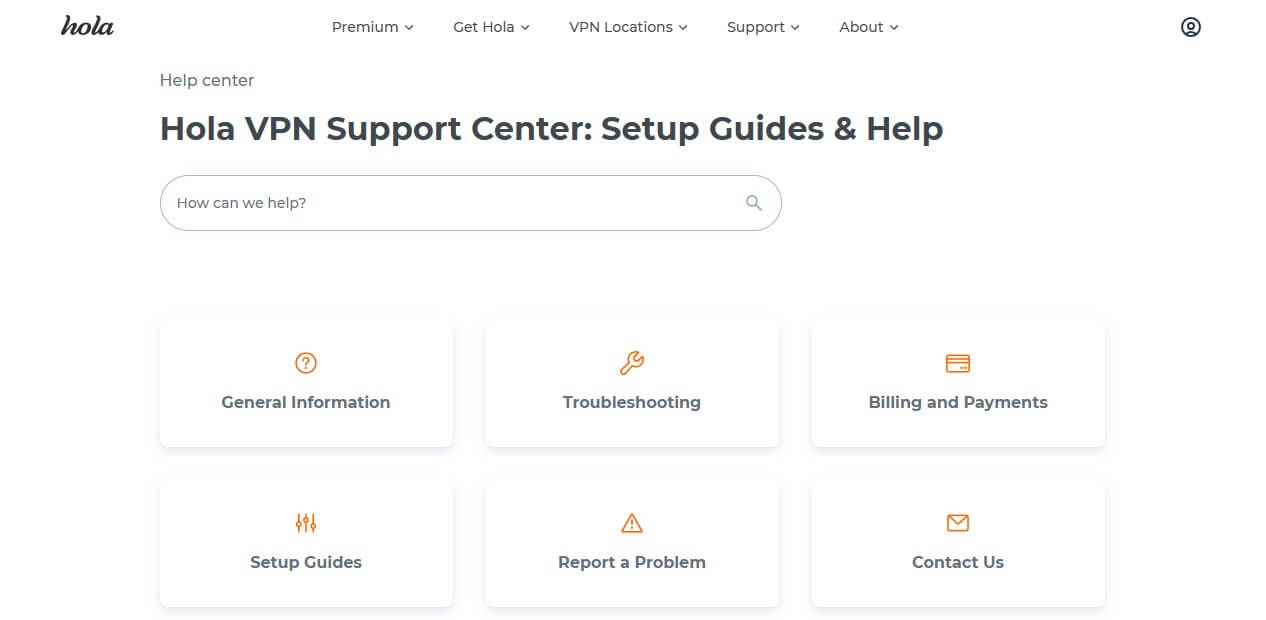
Hola VPN has a Help Center, featuring articles across various topics: account management, billing, and troubleshooting. While this self-service approach can be helpful, it lacks the immediacy of direct support channels. Notably, Hola doesn’t offer live chat or phone support, standard among premium VPN providers.
This absence can be frustrating if you have issues requiring prompt assistance.
Refund Policy Details
Hola VPN’s refund policy is ambiguous. They state that customers can use the service risk-free, but reserve the right to limit or deny refund requests at their discretion. Specifically, this is what you should know:
- Unused Premium Service: If you haven’t used the premium service, Hola offers a 14-day refund with no questions asked.
- Beyond 14 Days: The policy becomes less clear. There’s mention of a 30-day money-back guarantee, but the conditions are not explicitly outlined. This lack of transparency can lead to confusion for users seeking refunds after the initial 14-day period.
Additionally, refunds must be processed directly through those providers for payments made through platforms like Apple’s App Store or Amazon, as Hola VPN doesn’t handle them. This adds another layer of complexity to the refund process. On the other hand, premium VPNs offer user-friendly refund policies.
For instance, NordVPN provides a 30-day money-back guarantee with clear terms, allowing users to request a refund within the period without complications. Combined with 24/7 customer support via live chat, you get timely assistance.
Hola VPN Review Conclusion: Absolutely Avoid It
Hola VPN stands out as one of the most popular free VPNs, but it’s far from perfect. If your goal is casual browsing or bypassing geo-blocks, it may suffice. Its P2P model is unique in that it powers its free VPN, but with drawbacks for privacy and security. The lack of encryption, data-sharing risks, and questionable logging practices are red flags that privacy-conscious users can’t ignore.
The performance is also hit-or-miss. While it can unblock some streaming platforms, it struggles with maintaining speed and reliability for torrenting or gaming. The paid version of Hola VPN doesn’t fare much better. It doesn’t justify its cost compared to premium VPNs with superior military-grade encryption, dedicated servers, and more responsive customer support.
NordVPN, ExpressVPN, and Private Internet Access offer a polished and secure experience without compromises. If you value data security, want reliable speeds, and need a VPN for streaming, torrenting, and gaming without lag, you’ll be better off investing in a premium, high-quality VPN service.
Hola VPN Review FAQ
💎 Is Hola VPN Premium worth it?
No, Hola VPN Premium isn't worth it. It's expensive and still not as good as some of its main competitors, like NordVPN, ExpressVPN, and Private Internet Access. We suggest avoiding it at all costs, both as a free and premium provider.
🛡️ Is Hola VPN safe as a free VPN?
No, it's one of the most dangerous free VPNs you can use. Particularly concerning is that it stores and sells your sensitive information to third parties. However, it also uses a P2P model that allows other users to go online using your IP address.
🤔 Are Hola VPN and Bright VPN the same?
No, they're not the same, but Bright Data owns Bright VPN, and Hola VPN is a peer in the Bright Data network. Bright VPN is better privacy-wise, but still far from ideal compared to some of the top premium options.
🔒 Is Hola Browser safe?
No, Hola Browser is not safe. It relies on the same P2P model as its VPN, where you use an IP address of another user to go online and vice versa. While it works well for unblocking sites, it's a serious problem for privacy and security.