In Thailand, sharing the wrong post online can turn into a criminal case. Criticism of the monarchy can bring up to 15 years in prison per count. The Computer Crime Act also lets the authorities go after content they call false or a threat to public order.
On top of that, tens of thousands of web links are blocked every month, mostly gambling sites but also political pages. That’s why so many people in Thailand, locals and long-stay visitors alike, use a VPN. It encrypts your connection and lets you choose the country your traffic appears to come from.
In Bangkok, that means private browsing and your usual streaming services from home. Abroad, a Thai server brings back Thai streaming services and banking apps. Still, speed and privacy vary widely between VPNs. These five did best in our tests.
Five VPNs We Recommend for Thailand
- NordVPN: Best overall, with the fastest results in our tests and obfuscated servers for filtered networks
- Proton VPN: Best for privacy, with a Swiss base and a no-logs policy audited every year
- ExpressVPN: Easiest to use, with simple apps that disguise VPN traffic automatically
- Private Internet Access: Best value for families, with a low price and no device limit
- Surfshark: Best for streaming, with every service we tested unblocked except ITV
Thailand VPNs Compared Side by Side
Speed loss is the average drop across our UK, US, and Japanese servers, and the streaming column counts the nine services we tested, including Netflix US, BBC iPlayer, and Prime Video. They come from the same tests behind our best VPN rankings.
| VPN | Average speed loss | Streaming services unblocked | Traffic disguise | Devices | Price |
|---|---|---|---|---|---|
| NordVPN | 7.8% | 9 of 9 | Obfuscated servers (NordWhisper) | 10 | About $3.50 a month |
| Proton VPN | 10.2% | 7 of 9 | Stealth protocol | 10 | About $3 a month |
| ExpressVPN | 7.8% | 9 of 9 | Automatic on every server | 10 | About $3 a month |
| Private Internet Access | 12.7% | 6 of 9 | Shadowsocks proxy (OpenVPN) | Unlimited | About $2 a month |
| Surfshark | 9.6% | 8 of 9 | Camouflage Mode (OpenVPN) | Unlimited | About $2.50 a month |
Top VPNs for Thailand in 2026
These five have servers in Thailand and a way to disguise VPN traffic on networks that filter it. Beyond that, they differ in speed, privacy, and price.
1. NordVPN: Best Overall VPN for Thailand
Pros
- Servers in Bangkok
- Fastest speeds in our tests
- Unblocked every streaming service we tested
- Obfuscated servers for filtered networks
- Independently audited no-logs policy
- Covers 10 devices
Cons
- Higher renewal price
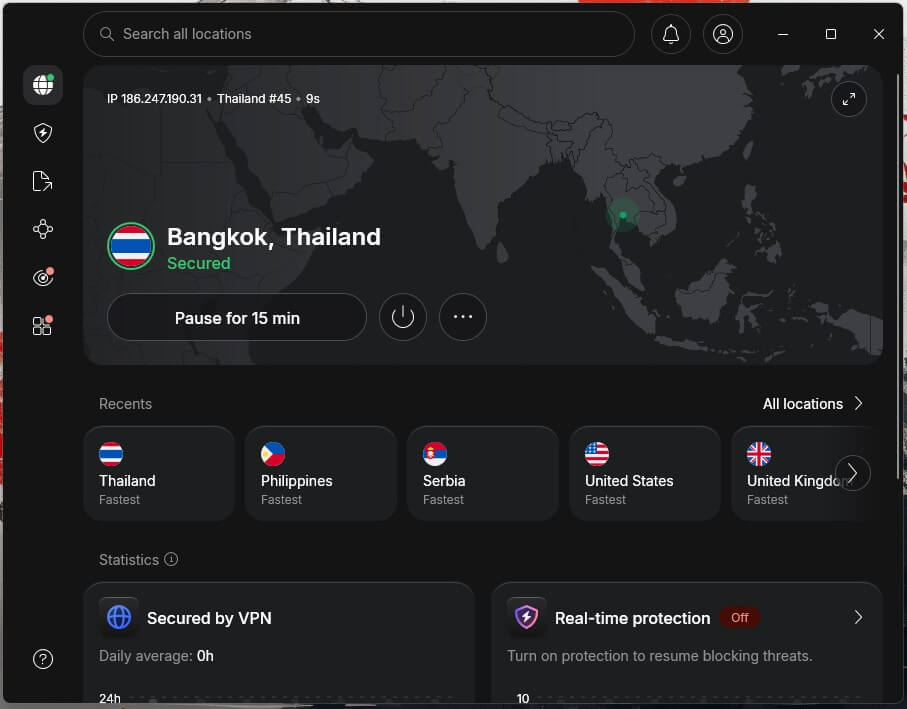
NordVPN came out on top in our tests, with a 7.8% average speed loss across the UK, the US, and Japan, tied with ExpressVPN as the best result we’ve recorded. In practice, video calls at home and 4K streams work as they would without a VPN.
As our NordVPN review shows, it also unblocked all nine streaming services we tested, from Netflix US to BBC iPlayer. Privacy is the main reason it ranks first for Thailand. Independent firms have audited its no-logs policy several times, so there’s no record of your activity to hand over. Some hotel and office networks block VPNs.
For those, the obfuscated servers use NordVPN’s NordWhisper protocol to disguise the connection as regular web traffic. NordVPN also has servers in Bangkok, which helps when you’re abroad and want Thai banking apps or streaming services.
As for cost, it’s about $3.50 a month on the two-year Basic plan, and one subscription covers 10 devices. The renewal price is noticeably higher, though, so a two-year term keeps the low rate the longest.
2. Proton VPN: Best for Privacy and Censorship
Pros
- Based in Switzerland
- No-logs policy audited every year
- Open-source apps
- Stealth protocol disguises VPN traffic
- Optional two-server connections for extra privacy
- Blocks ads and trackers
Cons
- No post-quantum encryption
- Couldn’t unblock ITV or Pluto TV
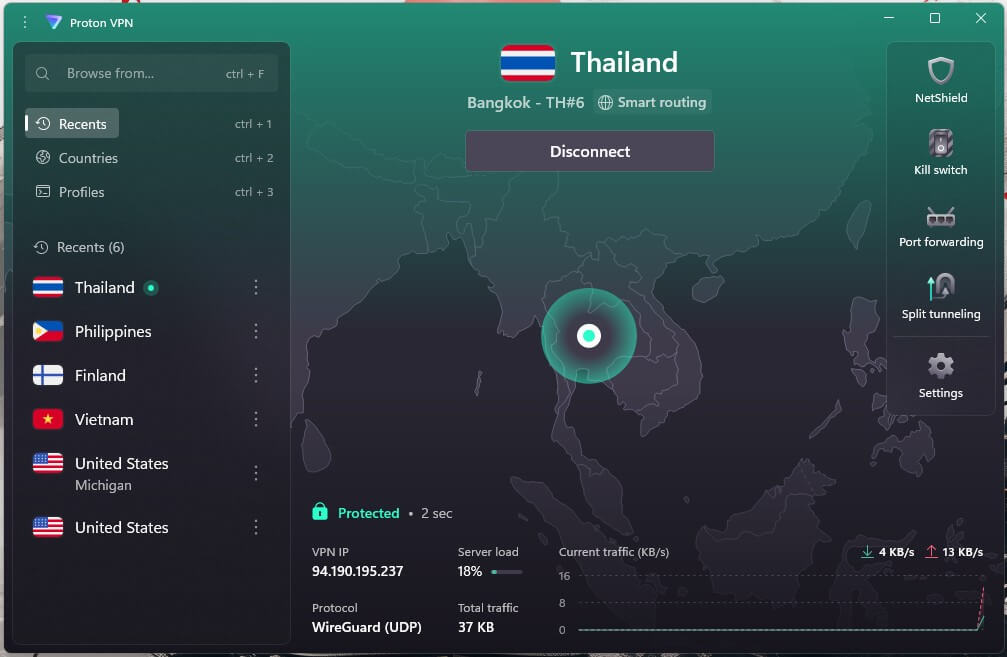
If the Computer Crime Act is the reason you want a VPN, Proton VPN is the one we’d choose. It’s based in Switzerland, and its no-logs policy has passed an independent audit every year since 2022. Its apps are open source, so security researchers can inspect the code.
With Secure Core enabled, your traffic first passes through a hardened server in Switzerland, Iceland, or Sweden. That adds a second layer between you and network monitoring. Its Stealth protocol disguises VPN traffic on filtered networks. Speed is close to the leaders, with a 10.2% average loss.
It also unblocked seven of our nine streaming services. ITV and Pluto TV were the exceptions, so if you watch British TV, NordVPN or ExpressVPN is the safer choice. There’s one thing Proton VPN lacks: post-quantum encryption, which NordVPN and ExpressVPN offer.
That’s protection against future decryption, and it won’t affect daily use today. The VPN Plus plan is about $3 a month if you pay for two years. It adds NetShield, which blocks ads, trackers, and malware sites.
3. ExpressVPN: Best for Ease of Use
Pros
- Disguises VPN traffic automatically
- Simple apps for every device
- Connects in a second or two
- Unblocked every streaming service we tested
- Thailand server location
Cons
- Few settings to adjust
- Higher renewal price
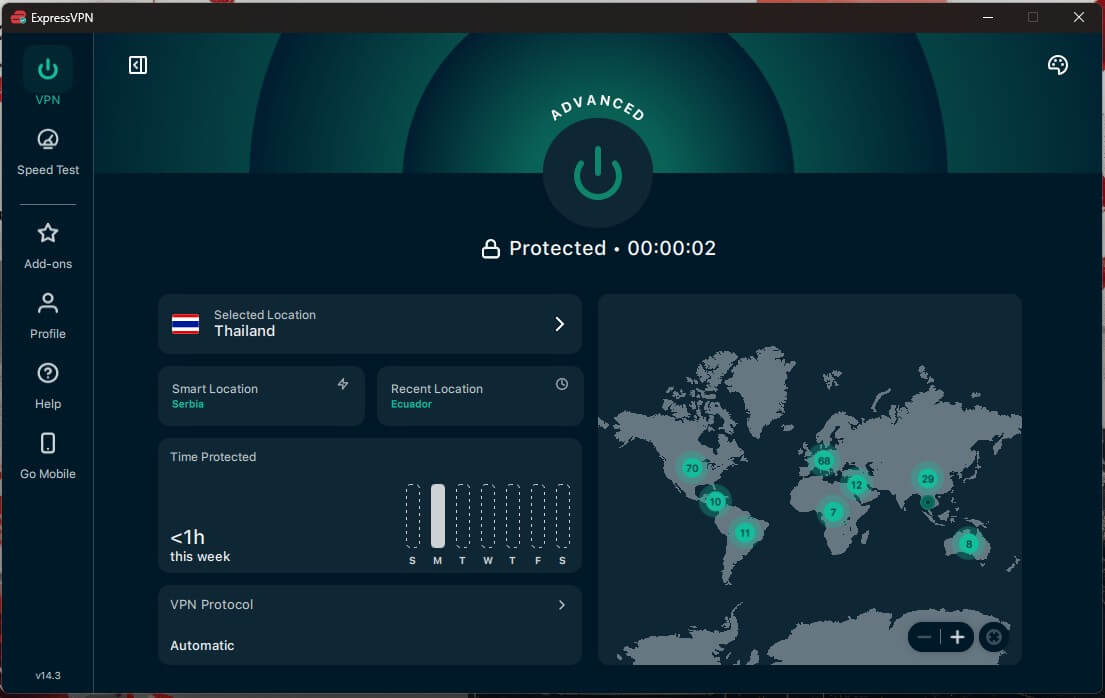
ExpressVPN is the easiest VPN to live with in Thailand, because there’s nothing to set up. Its apps disguise VPN traffic automatically on every server. So on a filtered network, you connect with one click, the same as on home Wi-Fi. It connected pretty much instantly in our ExpressVPN review, the quickest of any VPN we’ve timed.
Speed matched NordVPN at a 7.8% average loss. Its Japanese server was also the fastest we tested, which helps if you connect to nearby Asian locations. Like NordVPN, it unblocked all nine streaming services. Its router app can also cover a whole condo or house, including smart TVs without VPN app support.
On the other hand, you can’t tweak much. There’s no multi-hop option and few protocol settings. Beginners won’t miss them, but people who like control will. Its Basic plan is about $3 a month on a two-year term, and the renewal price is higher.
4. Private Internet Access: Best for Families
Pros
- Low long-term price
- Unlimited devices
- Strong ad and tracker blocker
- Servers in 113 countries
- No-logs policy proven in court
Cons
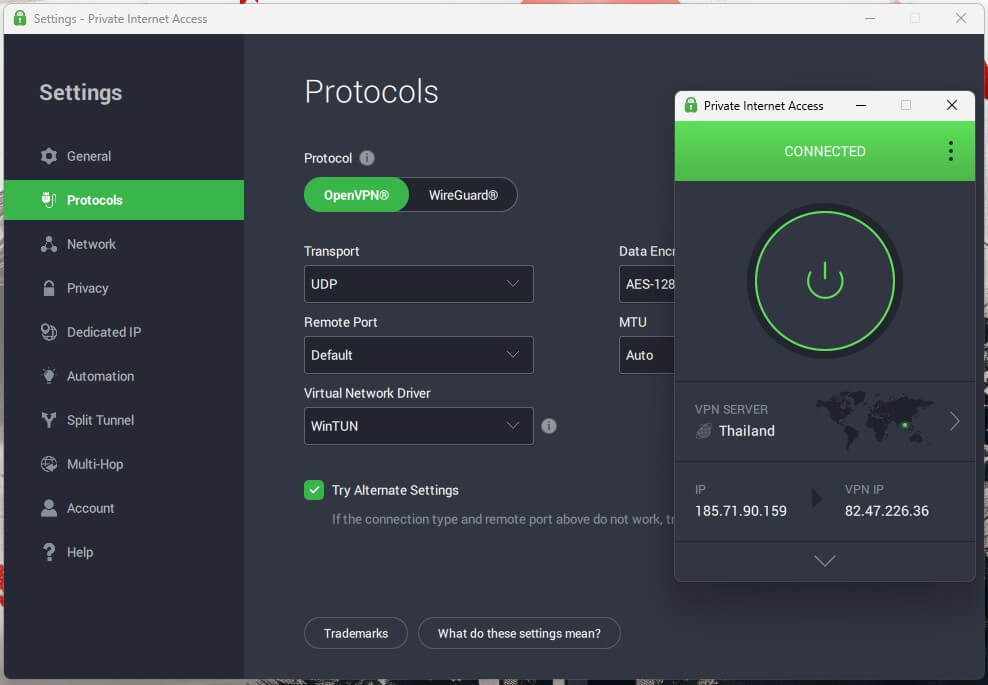
- Dated, cluttered desktop app
- Traffic disguise works on OpenVPN only
- Couldn’t unblock Prime Video or HBO Max
Private Internet Access costs the least of the five, at about $2 a month on its long plan, and it has no device limit. That makes it a good choice for a family or a shared condo. Its MACE blocker stopped 96% of the ads and trackers on our test page, the best result we’ve recorded.
PIA’s no-logs policy has also been tested in US courts, where it had no user data to hand over. Speed is where the low price shows. It lost 12.7% on average, the most of the five. It also couldn’t unblock Netflix Japan, Prime Video, or HBO Max. For browsing, banking, and HD streaming, that’s still more than enough.
To disguise VPN traffic, PIA uses a Shadowsocks proxy that works on OpenVPN only. So switch the protocol in Settings before enabling it. The desktop app also looks dated next to the others. Still, it’s the cheapest way to cover every device in your home.
5. Surfshark: Best for Streaming From Thailand
Pros
- Unblocked eight of nine streaming services
- Fastest on our UK server
- Unlimited devices
- Built-in ad blocker
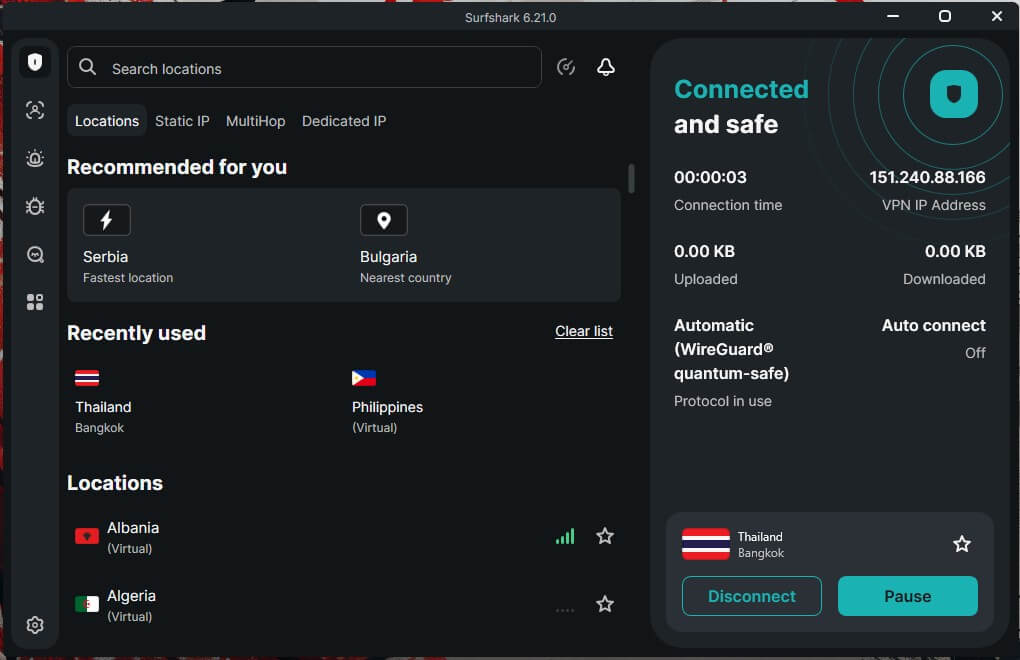
- Servers in Bangkok
Cons
- Slow to connect now and then
- Couldn’t unblock ITV
- Higher renewal price
For streaming, Surfshark came close to the top two. It unblocked eight of our nine services, with ITV the only exception. Its UK server also lost just 1.8% of our speed, the best UK result among the fastest VPNs we’ve tested. So you can watch BBC iPlayer, Netflix US, and Prime Video from a Bangkok condo.
Beyond streaming, its CleanWeb blocker removes ads and trackers, and there’s no limit on devices. Camouflage Mode disguises VPN traffic on OpenVPN, which helps on networks that block VPNs. The one annoyance is connection time.
Now and then, Surfshark took noticeably longer than the others to connect. It’s not a dealbreaker, but it stands out next to ExpressVPN’s near-instant connections. It costs about $2.50 a month on the two-year Starter plan, with a higher price at renewal.
Thailand’s Internet Laws and VPN Use
Freedom House rates Thailand’s internet as Not Free. Two laws do most of the work. Section 112 of the Criminal Code, the lèse-majesté law, sets prison terms of three to 15 years per count for criticism of the monarchy. Online posts and shares have been prosecuted under it.
The Computer Crime Act adds penalties for content the authorities consider false or harmful to national security. It also allows them to order websites blocked. Using a VPN is legal in Thailand. Locals and visitors use one every day for work, banking, and streaming. However, a VPN doesn’t change what’s legal.
Content that’s illegal without a VPN remains illegal with one. Our page on VPN laws around the world covers how other countries treat them.
In practice, there are three reasons to use a VPN in Thailand:
- Blocked sites: a server outside Thailand bypasses blocked news pages and other filtered content, one of several ways to unblock websites.
- Public Wi-Fi: airport, café, and hotel networks are shared with strangers, and a VPN encrypts everything you send over them.
- Streaming from home: Netflix and other services show Thailand a different catalog, so a server back home brings your usual shows back.
How to Set Up a VPN in Thailand
Setting up a VPN takes a few minutes, with similar steps on every VPN in our ranking. We’ll use NordVPN as the example:
- Subscribe to NordVPN. Choose a plan on its website. Every plan comes with a 30-day money-back guarantee.
- Install the app. NordVPN has apps for Windows, macOS, iOS, Android, and Linux, plus router setup. Sign in with the account you created.
- Choose a server. For blocked sites or your home streaming services, connect to a server outside Thailand. Abroad, connect to Bangkok for Thai services.
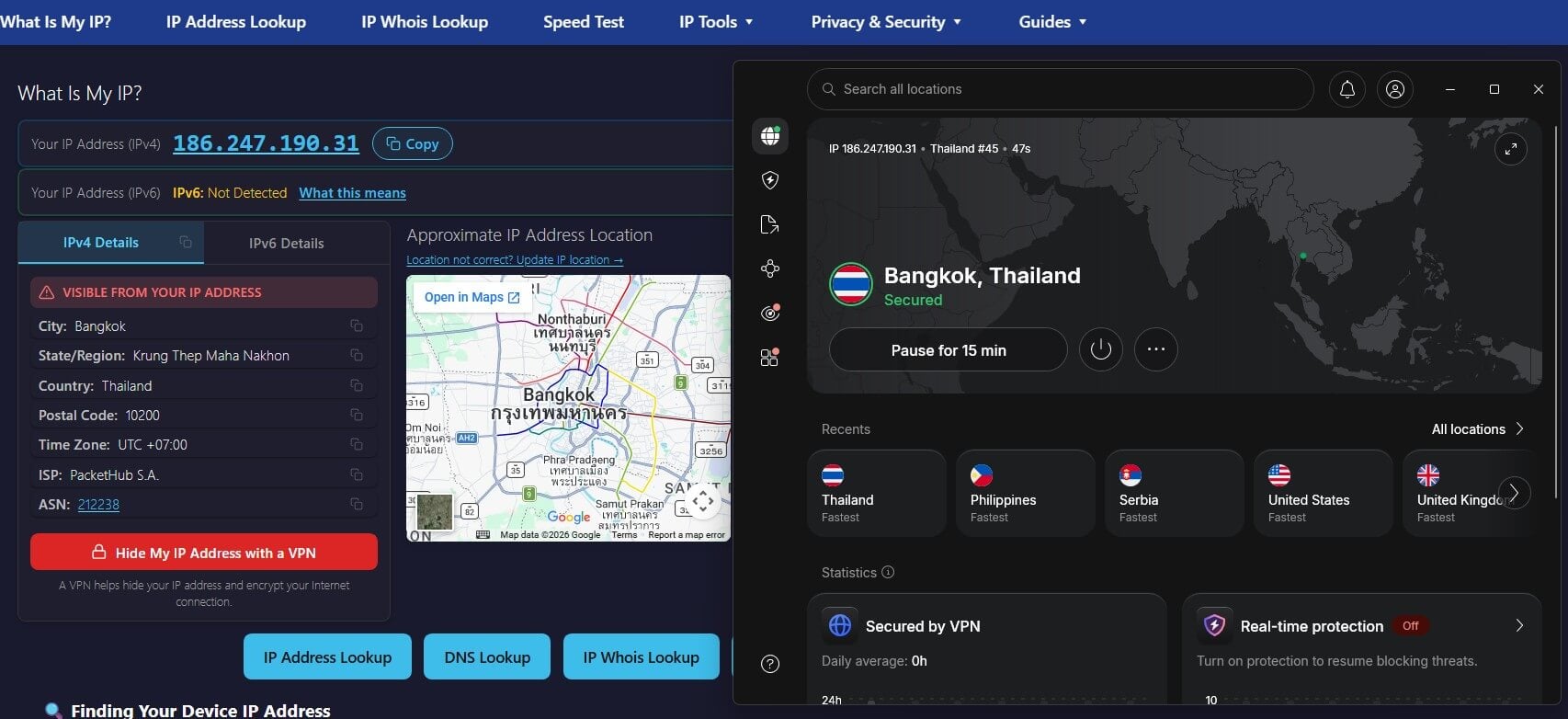
- Confirm the connection. Visit an IP lookup site, which should show the country of the server you chose.
Free VPNs and Thai Servers
Free VPNs are a poor fit for Thailand. The reputable free plans, such as Proton VPN’s and Windscribe’s, don’t offer Thai servers. As a result, they can’t connect you to Thai services from abroad. Proton VPN’s free plan also chooses your server country for you.
Free VPNs with Thai locations tend to fund themselves with ads and data collection. In a country with strict online laws, that defeats the point of a VPN. If cost is the concern, paid VPN prices start at about $2 a month with Private Internet Access.
A money-back guarantee also lets you test one first.
Verdict
In Thailand, privacy decides which VPN to choose, and speed breaks the tie. NordVPN does best on both, which is why it leads our ranking.
Proton VPN is the better choice when surveillance worries you more than streaming. Its Swiss base and open-source apps leave the least room for doubt. For a household with many phones and TVs, PIA’s unlimited devices cost the least. One limit remains: a VPN hides your connection, but a post that breaks Thai law is still a crime.
FAQ
Is it legal to use a VPN in Thailand?
Yes. VPNs are legal in Thailand, and many residents and visitors use them. However, content that breaks the lèse-majesté law or other Thai laws remains illegal with a VPN connected.
Do you need a VPN in Thailand?
No, not for everyday browsing, since most major sites work normally. A VPN is useful on public Wi-Fi, for accessing blocked websites, and for streaming catalogs from home while living in Thailand.
Which VPNs have servers in Thailand?
Open the VPN app, search for Thailand or Bangkok in the server list, and connect. Websites then see a Thai IP address until the VPN is disconnected or switched to another country.
How do you change your VPN location to Thailand?
Open the VPN app, search for Thailand or Bangkok in the server list, and connect. Websites then see a Thai IP address until the VPN is disconnected or switched to another country.
Is there a free VPN with Thai servers?
No, not among trustworthy free VPNs. Proton VPN, Windscribe, and PrivadoVPN don't include Thailand on their free plans, and free VPNs that do often rely on ads and collect user data.