A crypto exchange account is harder to protect than a bank account. There’s usually no fraud department to reverse a transfer, so a hijacked session or a fake login page can empty a wallet in minutes. At the same time, exchanges watch where you sign in from.
A login from an unfamiliar country can set off an email alert, a withdrawal hold, or a request for more ID. A good VPN deals with the first problem without creating the second. That means a server in the country your account is registered in and a connection that doesn’t fail silently mid-trade.
It also means protection from lookalike exchange sites before you type a password into one. Which VPNs manage all three? Here are our top 5 options:
Crypto Trading VPN Rankings for 2026
- NordVPN: Best overall, with double encryption that barely slows your connection
- Proton VPN: Best for private trading, thanks to open-source apps and Bitcoin payments
- ExpressVPN: Best for speed, with a kill switch that passed every failure test
- Private Internet Access: Best low-cost VPN, with the strongest ad blocker we tested
- Surfshark: Best for blocking malicious links, with masked emails for exchange sign-ups
How the Crypto VPNs Compare
Speed loss is each VPN’s average drop in download speed across our tests, and the blocking column is the share of a standard ad and tracker test list that its built-in blocker stopped.
| VPN | Speed loss | Ad and tracker blocking | Multi-hop | Crypto payments | Price |
|---|---|---|---|---|---|
| NordVPN | 7.8% | 76% (Complete plan) | Double VPN | Yes (CoinGate, Binance Pay) | About $3.50/mo |
| Proton VPN | 10.2% | 93% | Secure Core | Bitcoin | Under $3/mo |
| ExpressVPN | 7.8% | 71% | No | Yes (BitPay) | About $3/mo |
| Private Internet Access | 12.7% | 96% | Yes, through a proxy | Yes (BitPay) | About $2/mo |
| Surfshark | 9.6% | 79% | MultiHop | Yes (CoinGate) | About $2.50/mo |
The Best VPNs for Crypto Trading in 2026
1. NordVPN: Best Overall VPN for Crypto Trading
Pros
- Double encryption with almost no speed cost
- Kill switch can close chosen apps if the VPN drops
- Malware and phishing protection on the Complete plan
- Accepts crypto, including Binance Pay
- Independently audited no-logs policy
Con
- No malware protection on the Basic plan
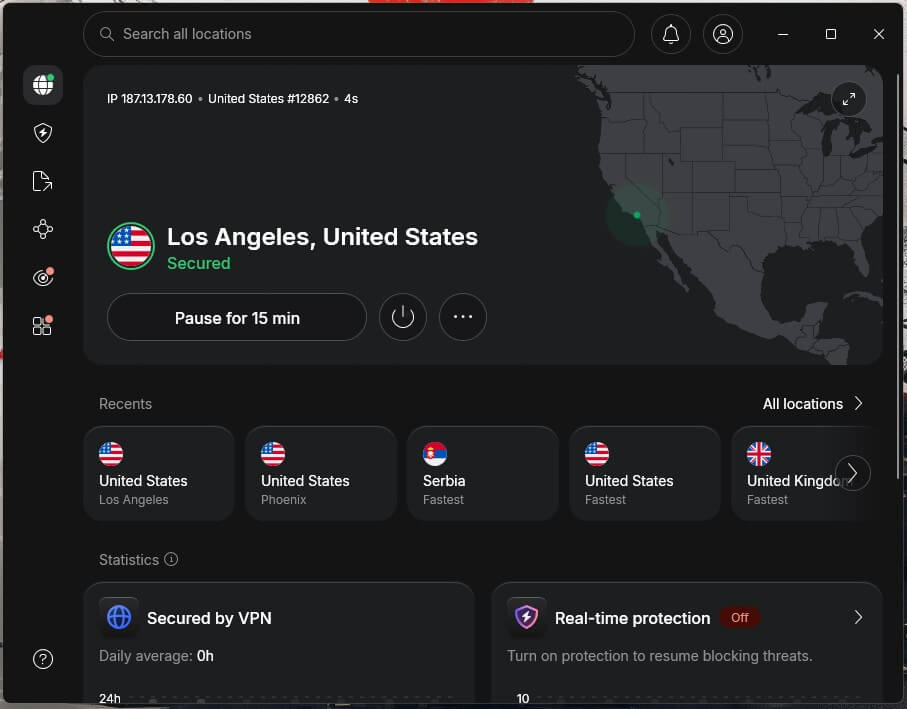
NordVPN’s Double VPN sends your connection through two servers and encrypts it twice. In our tests, it cost under 3% of the speed of a direct connection, light enough to keep on for every trading session. Without it, NordVPN tied ExpressVPN for the fastest results in our NordVPN speed tests.
What makes it stand out for traders is the kill switch. It passed every failure test we ran, including a full PC restart. An app-level version can also close your exchange or wallet app the moment the VPN drops. On the Complete plan, next-gen antivirus blocks malware and known phishing domains, so a lookalike exchange site in a search ad won’t load.
For payment, NordVPN accepts crypto through CoinGate, which also accepts Binance Pay, so the subscription never has to touch your card. The trade-off is that malware protection isn’t on the cheapest tier. NordVPN’s two-year Basic plan comes to about $3.50 a month, and next-gen antivirus starts on Complete, about a dollar more.
That’s the plan we’d choose for trading.
2. Proton VPN: Best Privacy VPN for Traders
Pros
- Based in privacy-friendly Switzerland
- No-logs policy verified by independent audits
- Open-source apps anyone can inspect
- Can pass your connection through Switzerland or Iceland first
- Pay with Bitcoin, with no processor in between
Con
- No post-quantum encryption
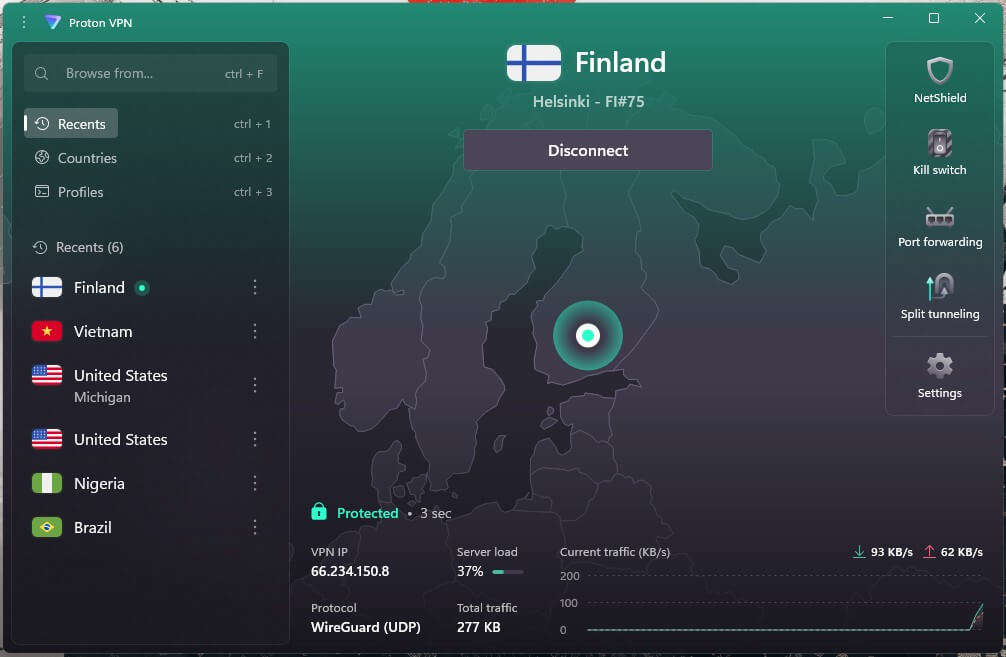
Proton VPN is built for traders who don’t want anyone looking over their shoulder. The company is based in Switzerland, and Proton VPN’s privacy record includes open-source apps that outside experts can inspect and an independently audited no-logs policy.
For large transfers, Secure Core adds another layer. Your connection passes through a hardened server in Switzerland, Iceland, or Sweden before it connects to the exchange. In our tests, that made it only about 12% slower than a direct connection, too little to notice when you approve a withdrawal.
In addition, NetShield stopped more ads and trackers than NordVPN’s or ExpressVPN’s in our blocking test. Our one reservation is encryption: Proton VPN doesn’t offer post-quantum protection yet, while NordVPN, ExpressVPN, and Surfshark do. It isn’t a practical risk for today’s trades, but long-term holders may want to watch for it.
The two-year VPN Plus plan is under $3 a month, payable in Bitcoin, and current Proton VPN coupons can lower it further.
3. ExpressVPN: Best for Speed
Pros
- Fast on nearby and distant servers
- Connects in a second or two
- Kill switch passed every failure test
- Easy apps for desktop and mobile
- Accepts crypto payments
Cons
- No multi-hop servers
- Higher renewal price
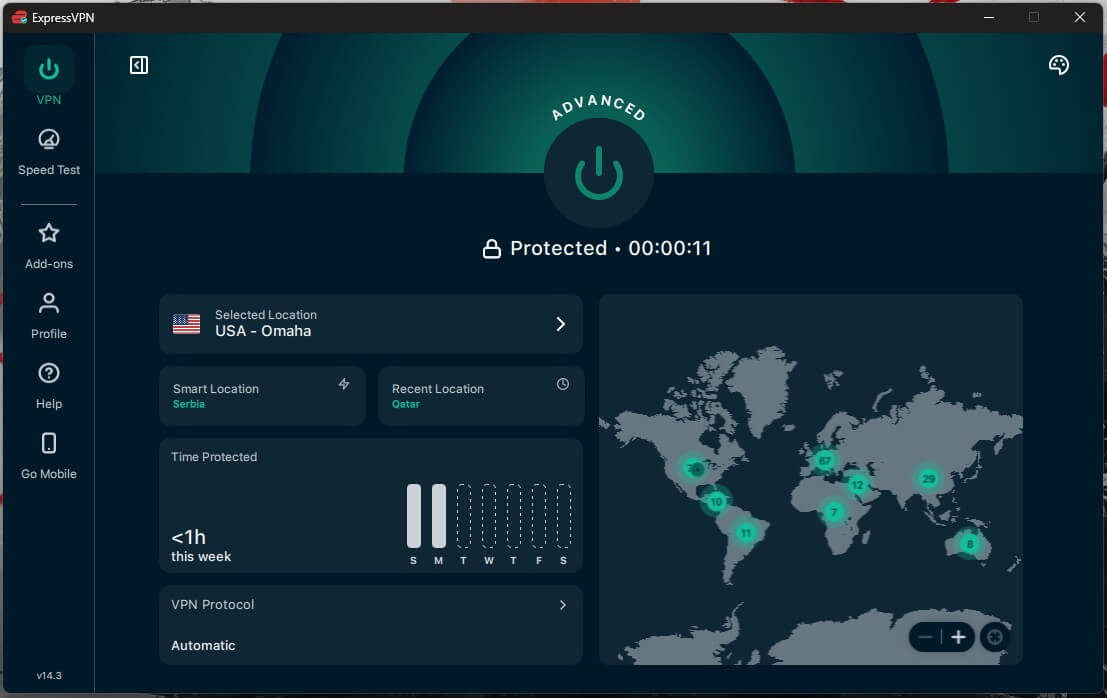
ExpressVPN’s average speed loss was 7.8%, and it was the fastest VPN on our most distant server. In other words, it and NordVPN were evenly matched on speed, which helps if you travel far from your account’s home country and still connect through a server there. That speed comes with very little setup.
The app was ready within a second or two of clicking Connect, faster than any other VPN we tested, and Network Lock, its kill switch, blocked traffic in every disconnect test as well. So if your Wi-Fi drops while an order is pending, nothing leaves your device unprotected.
On the other hand, ExpressVPN has fewer extras. It has no multi-hop servers, so for a double-encrypted connection, NordVPN or Proton VPN is the better fit. ExpressVPN’s Basic plan is about $3 a month on the two-year term, payable in Bitcoin or Ethereum through BitPay, and its renewal rate is noticeably higher.
4. Private Internet Access: Best Low-Cost VPN for Crypto
Pros
- Low long-term price
- Unlimited devices
- Ad, tracker, and malware blocking
- Court-tested no-logs policy
- Optional dedicated IP addresses
Cons
- Kill switch leaked during a PC restart
- Traffic disguise only works on OpenVPN
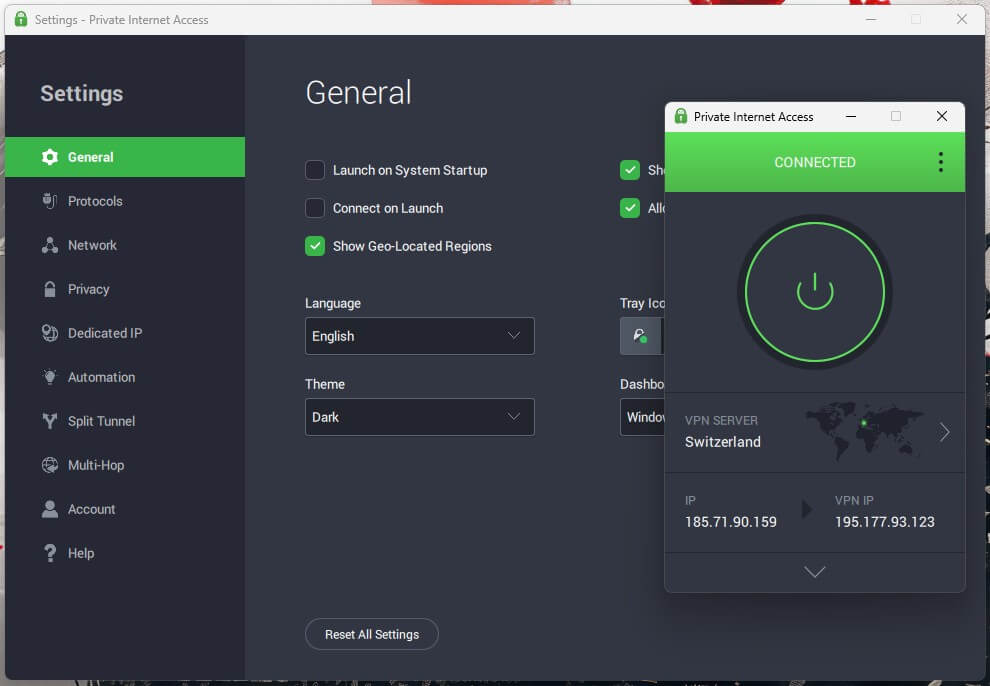
At about $2 a month on the two-year plan, Private Internet Access is the lowest-priced VPN we recommend for trading. It covers unlimited devices, so your phone, laptop, and a second trading PC fit on one account. Its no-logs policy has also been tested in court, where PIA couldn’t produce user records because it didn’t keep any.
Its strongest point for traders is MACE, the built-in blocker, which blocked a larger share of ads and trackers than any other VPN in our test. That helps with the scam ads that crowd crypto search results. PIA offers OpenVPN and WireGuard, and its Shadowsocks proxy, which disguises VPN traffic on networks that block exchanges, works only on OpenVPN.
However, one result disappointed us from a VPN that leans so heavily on privacy. PIA’s kill switch let traffic out when we restarted the PC with the VPN on. The fix was to enable its advanced kill switch, which is permanent and protects you from data leaks all the time.
5. Surfshark: Best for Blocking Malicious Links
Pros
- Blocks ads, trackers, and malicious links
- Masked emails for exchange sign-ups
- Unlimited devices
- Multi-hop servers for extra privacy
- Accepts crypto payments
Cons
- Occasional slow connections
- Renewal costs more than the first term
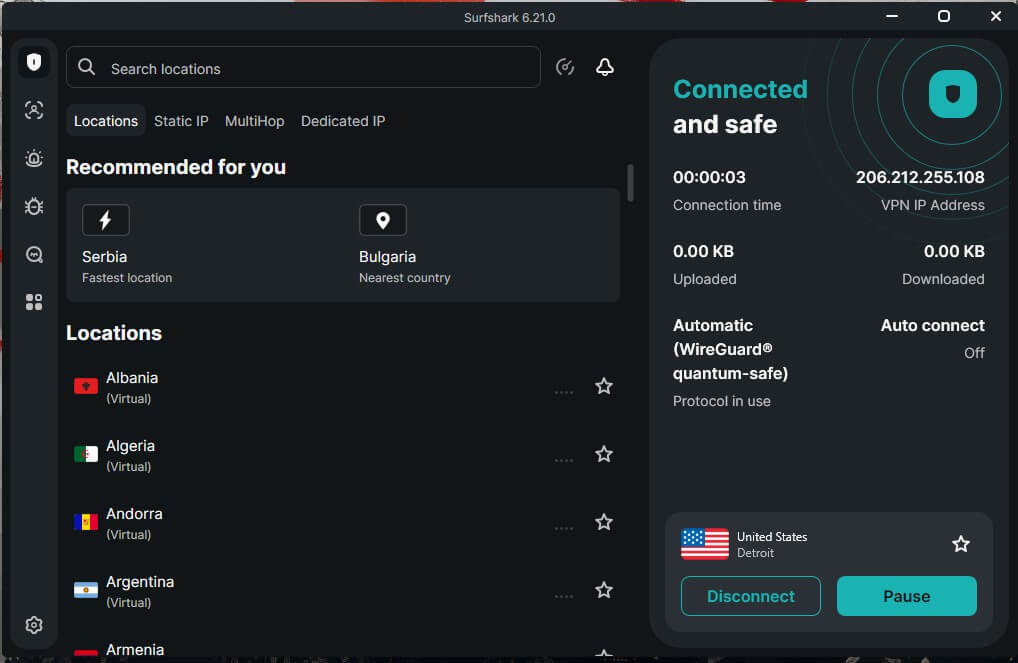
Many crypto scams start as a sponsored ad or a shortened link in a group chat. Surfshark’s CleanWeb blocks malicious sites like these, along with ads and trackers. Alternative ID creates a masked email address for each exchange account, so a data breach at one exchange doesn’t expose your main inbox to phishing.
As for speed, Surfshark averaged a 9.6% loss, close to ExpressVPN’s result in a head-to-head test. MultiHop sends traffic through two servers when you want extra privacy, and Surfshark accepts crypto through CoinGate. Surfshark’s two-year Starter plan is about $2.50 a month and covers unlimited devices.
Our one complaint is the occasional slow connection, a few seconds longer than with the other four VPNs. For that reason, connect before you open the exchange, so the delay happens before any order is on the screen.
What a VPN Does for Crypto Traders
For traders, a VPN helps in three situations, a narrower set than the everyday reasons people use a VPN:
- Shared networks: on coworking, hotel, or conference Wi-Fi, whoever operates the network can see which exchange you connect to and when. With a VPN, they see only a connection to the VPN server.
- Phishing sites: blockers such as NordVPN’s next-gen antivirus and Surfshark’s CleanWeb stop known fake exchange and wallet domains from loading.
- Blocked networks: some workplace, school, and public networks block exchange sites. A VPN lets you access your account from those networks.
Exchange Rules and VPNs: What Can Go Wrong
Using a VPN is legal in most countries, including the US, the UK, and EU member states. Even so, an exchange’s own terms still apply to your account, and most exchanges verify a government ID and proof of address.
Many exchanges also block countries they don’t serve. If an exchange decides you’ve signed in from one, it can limit your account to withdrawals or close it, and a VPN doesn’t remove that risk. Binance is the clearest example, and our page on VPNs for Binance lists where it doesn’t operate.
A few habits keep your logins consistent:
- Use a server in your account’s home country. Exchanges compare each login with the previous one, and a new country stands out.
- Keep that server when you travel. Connect to it before you sign in, wherever you are.
- Consider a dedicated IP address. A dedicated IP address remains the same every session, and NordVPN, ExpressVPN, PIA, and Surfshark sell one as an add-on.
Can You Pay for a VPN With Crypto?
Yes. NordVPN and Surfshark accept payments through CoinGate, which supports Bitcoin, Ethereum, USDC, and other coins, and NordVPN’s checkout also accepts Binance Pay. ExpressVPN and PIA use BitPay. Proton VPN accepts Bitcoin directly, with no payment processor in between, once you’ve created a free account to upgrade.
Paying with crypto keeps the subscription off your card statement, but it doesn’t make you anonymous. You still sign up with an email address, and the exchange you bought the coins on knows who you are.
Is a Free VPN Safe for Crypto Trading?
Most free VPNs pay their bills by showing ads, capping data, or selling user data. For an exchange account, that’s a poor trade, and it’s the main difference between free and paid VPNs.
Proton VPN’s free plan is the exception we’d consider, with no ads, no data cap, and the audited no-logs policy that covers paid users applies to it too. The problem is server choice.
Free accounts are assigned a server automatically, so you can’t keep signing in from your account’s country, and switching servers too often locks you out for a while.
Verdict
For trading, judge a VPN by what it does when something goes wrong: whether it locks down your connection the moment it drops, and whether it stops a lookalike site before you sign in.
Of the five, only NordVPN covers both with an app-level kill switch and phishing protection on the Complete plan. It’s our first choice for anyone who trades on the same laptop or phone they use for everything else.
Try NordVPN Risk-Free for 30 Days
Frequently Asked Questions
Should I use a VPN for cryptocurrency trading?
Yes, especially on shared or public networks. A VPN hides which exchange a device connects to from the network owner, and many VPNs also block known phishing domains.
Is it legal to trade crypto with a VPN?
Yes, in most countries. VPNs and crypto trading are both legal in the US, the UK, and the EU, but exchange terms can still restrict accounts that connect from unsupported regions.
Can crypto exchanges detect a VPN?
Yes, many can. Exchanges compare IP addresses against known VPN ranges and account details, and some restrict accounts that appear to connect from an unsupported country.
Do you need a dedicated IP for crypto trading?
No. A shared VPN server in the home country works for most traders. A dedicated IP helps when an exchange sends security checks every time the login IP address changes.