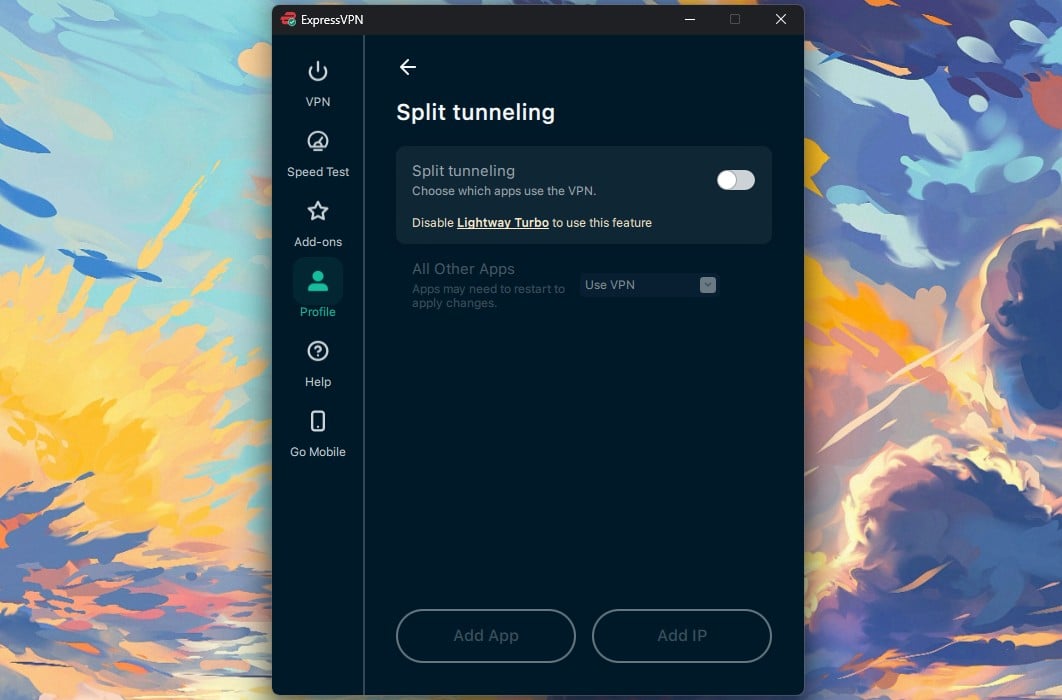
Lightway Turbo is the feature ExpressVPN sells hardest, and on our connection it made no measurable difference. On the same British server, Turbo recorded 186.19 Mbps. Plain Lightway came in at 185.74 Mbps and WireGuard at 184.44 Mbps, so the spread is under 1%. Turbo also added 9 ms of ping and switched split tunneling off completely. The rest of this ExpressVPN review is stronger.
It lost 7.8% of our 190.36 Mbps connection across three server locations in October 2026, a figure only NordVPN matched. Every streaming service we tested opened. The kill switch passed both failure modes. A refund request through PayPal was back on the account in 15 minutes. And Advanced Protection, the ad and tracker blocker, stopped 96 of 135 domains on d3ward’s test, or 71%.
ExpressVPN
ExpressVPN loses the least speed over long distances of anything we've tested, opens every major streaming service, and has the simplest apps in the category. It lacks multi-hop and port forwarding, the ad blocker is the weakest we've measured, and Basic renews at nearly three times its opening rate.
Pros
- Fast on distant servers
- Obfuscation by default
- Post-quantum encryption
- Simplest apps around
- Netflix and iPlayer unblocked
- Apple TV and Fire TV apps
- Long public audit history
Cons
- No multi-hop
- No port forwarding
- Weak ad blocking
ExpressVPN Review: Quick Look
| Starting price | $2.99 per month, $83.72 for 28 months (Basic) |
| Renewal | $99.95 a year on Basic, so $8.33 per month |
| Money-back guarantee | 30 days, new subscribers only |
| Protocols | Lightway UDP and TCP, Lightway Turbo, WireGuard, OpenVPN |
| No-log policy | Yes, KPMG-audited as of 28 February 2025 |
| Countries | 113, counted in the app |
| Download speed loss | 7.8% averaged across our three server locations |
| Upload speed loss | 8.9% averaged |
| Streaming | All 14 streaming services we tested |
| Multi-hop | No |
| Port forwarding | No |
| Ad and tracker blocking | Advanced Protection, 71% on d3ward’s test |
| Simultaneous connections | 10 on Basic, 12 on Advanced, 14 on Pro |
| Supported platforms | Windows, macOS, Linux, iOS, Android, Fire TV, Apple TV, routers, browsers |
| Customer support | 24/7 live chat, email, help center |
ExpressVPN Speed Test Results
For this review, we measured on a 190.36 Mbps connection on Windows 11 from Europe, Ethernet, using Speedtest. Each location was checked at three times of day across three days. The protocol was Lightway, which is what the app selects on Automatic. Those are strong figures at every distance.
| Server | Download | Upload | Ping | Download loss |
| No VPN | 190.36 Mbps | 19.37 Mbps | 10 ms | n/a |
| UK | 185.74 Mbps | 18.02 Mbps | 44 ms | 2.4% |
| US | 177.03 Mbps | 17.74 Mbps | 125 ms | 7.0% |
| Japan | 163.94 Mbps | 17.15 Mbps | 266 ms | 13.9% |
| Average | 175.57 Mbps | 17.64 Mbps | n/a | 7.8% |
The Japanese server is the most remote location we tested. Even so, it returned 163.94 Mbps, enough for 4K on several screens at once. The 44 ms ping to the UK is low enough for gaming on European servers.
Lightway, Lightway Turbo and WireGuard Compared
Turbo opens several Lightway tunnels at once and spreads traffic across them. As a result, the figure climbs on very fast connections. We tested it in dual-tunnel mode against plain Lightway and WireGuard on the same UK server.
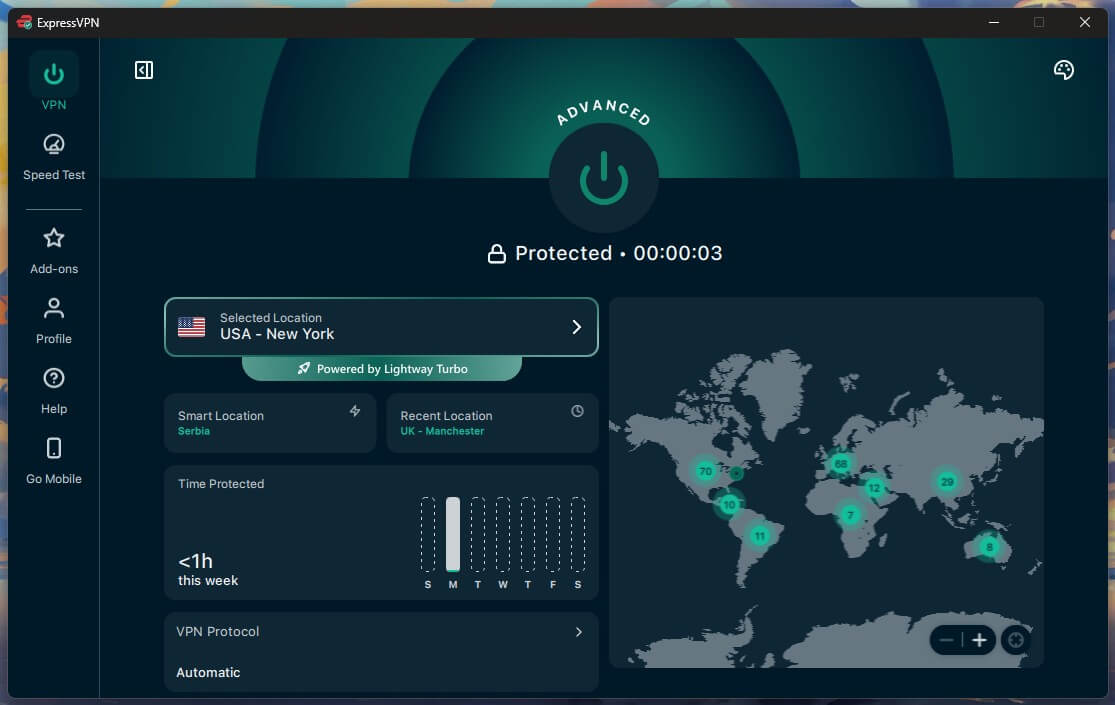
Turbo finished 0.45 Mbps ahead of plain Lightway, within the variation between two consecutive tests on the same server. It cost 9 ms of ping.
| Protocol | Download | Upload | Ping |
| Lightway Turbo | 186.19 Mbps | 18.16 Mbps | 53 ms |
| Lightway | 185.74 Mbps | 18.02 Mbps | 44 ms |
| WireGuard | 184.44 Mbps | 18.70 Mbps | 53 ms |
Turbo targets connections fast enough that a single tunnel becomes the limit. At 190 Mbps, that limit is nowhere near. Therefore, the feature adds nothing, and the split tunneling switch stays greyed out while Turbo is active. Turbo may earn the setting on a gigabit line. On a normal home connection, there is no reason to switch it on, and one concrete reason not to.
ExpressVPN Price and Plans
Three tiers share the same VPN. The extra money buys device slots and tools. The connection underneath is identical on all three.
- Basic: $2.99 a month on the 28-month term, $83.72 for the term, then $99.95 a year. Covers 10 devices and includes Lite Protection, which blocks ads, malicious sites, and adult sites but leaves trackers alone.
- Advanced: $4.49 a month, $125.72 for the term, then $119.95 a year. Covers 12 devices and adds tracker blocking, the ExpressKeys password manager, ExpressMailGuard aliases, and part of Identity Defender.
- Express Pro: $7.49 a month, $209.72 for the term, then $199.95 a year. Covers 14 devices and includes a dedicated IP address instead of selling it as an add-on. Also the only tier with ExpressAI.
Annual plans arrive with three extra months at $4.99, $5.99, and $8.99 a month. Monthly plans are $14.99, $16.99, and $22.99, which is poor value compared to the term prices. The ExpressVPN pricing breakdown covers what each tier includes. Meanwhile, current discount codes change often enough to check before paying. For most people, Basic is enough. ExpressVPN pushes the Advanced tier. For this review, the password manager was the only part worth paying extra.
Refunds and the Free Trial
The 30-day guarantee applies to new subscribers. We asked for a refund on a secondary account through live chat, paid by PayPal. The money was returned within 15 minutes. There is no free tier. The ExpressVPN free trial on iOS and Android is 3 days, which we confirmed in the Play Store.
It covers the full feature set, and the trial requires credit card information, as is the case with NordVPN. Our wider VPN free trial guide has the alternatives. Payment methods are card, PayPal, and Google Pay.
Security Features and What They Cost You
The security set is smaller than NordVPN’s or Surfshark’s, and the parts that exist work well. Two of them get in each other’s way.
Encryption, Kill Switch and Post-Quantum
Lightway uses AES-256-GCM or ChaCha20, with ML-KEM post-quantum protection enabled by default. OpenVPN uses AES-256-GCM. Forward secrecy applies to every session, so each connection uses a key that disappears on disconnect. Network Lock is the kill switch.
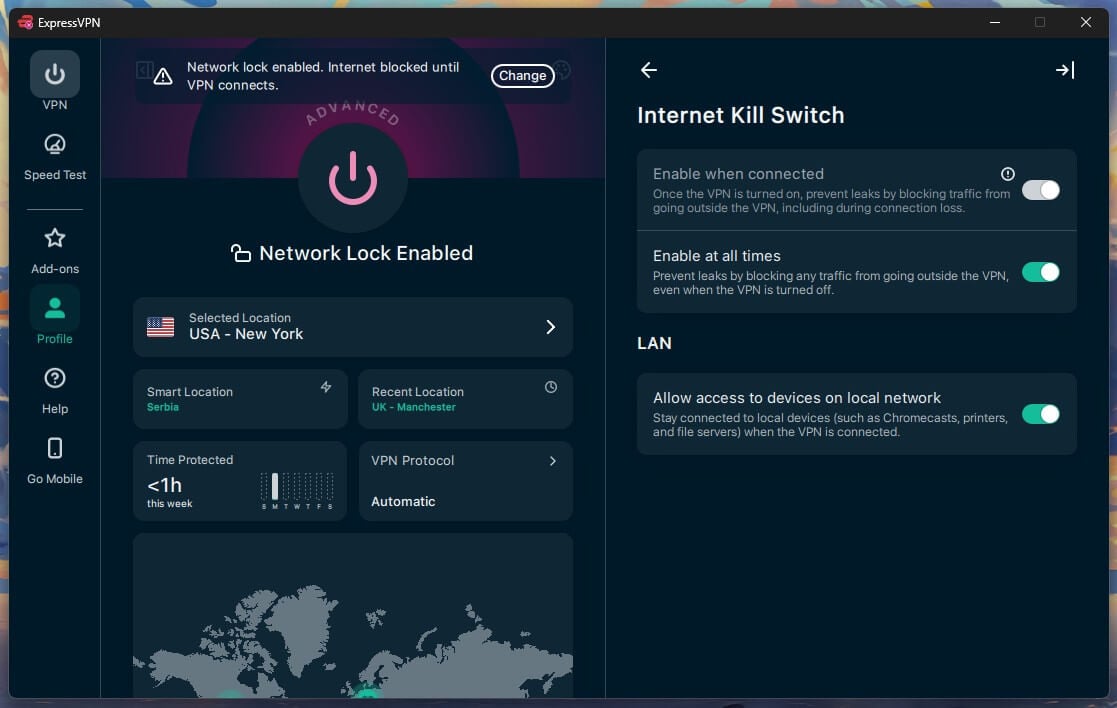
We tested it on Windows 11 the same two ways we test every VPN. First, the Ethernet cable was pulled mid-session. Second, the app process was killed from Task Manager, with a continuous ping active. No traffic escaped in either test.
Advanced Protection Scored 71% in My Test
Advanced Protection blocks ads, trackers, malicious sites, and adult sites at the DNS level. With all four toggles enabled on a British server, it stopped 96 of 135 domains on d3ward’s blocklist test. That is 71%. PIA’s MACE stopped 96% of the same list, and Proton VPN’s NetShield stopped 93%. Therefore, 39 domains getting through is enough to notice on an ad-heavy news site.
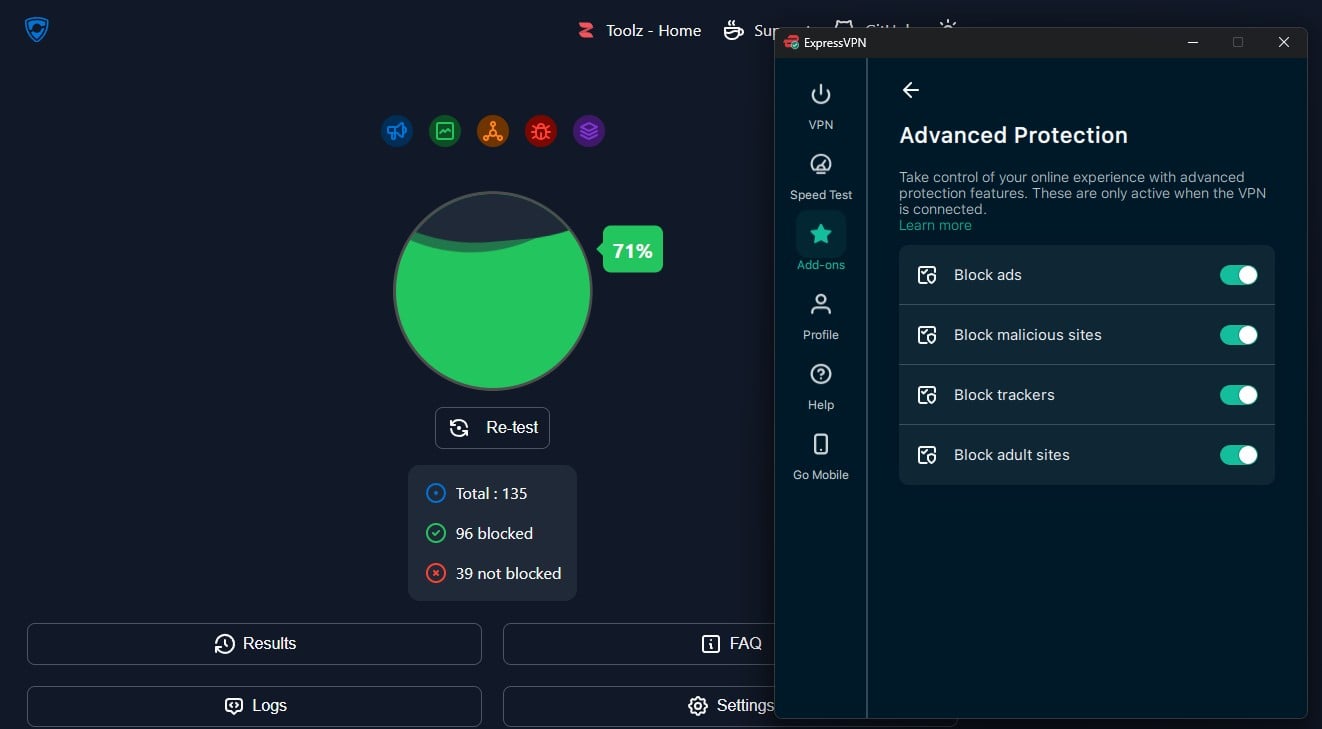
Basic subscribers receive Lite Protection, which leaves trackers unblocked, so the 71% figure applies to Advanced and Pro. Switching Advanced Protection on also greys out WireGuard and OpenVPN. The feature works on Automatic or Lightway only, so the ad blocker and the protocol menu are mutually exclusive. The adult site toggle doubles as parental control. It blocks Pornhub, RedTube, and similar sites at the DNS layer, across every device on the account.
Split Tunneling, MCP and the Missing Features
Split tunneling works at the app level on Windows. However, it cannot operate while Lightway Turbo is active. An MCP server appeared in the Add-ons panel in August 2026, and no other VPN offers it. When switched on, it publishes a local address with an access token.
An AI client can read the connection state, change server location, and switch protocol through ordinary instructions, without opening the app. It works on annual and 2-year plans, including Basic. What is still absent after years of asking: no multi-hop, no port forwarding, and no Tor support.
Multi-hop is the one we would most like back, since PIA and NordVPN both offer a version of it. ExpressVPN’s position is that TrustedServer and ShuffleIP, which changes your IP address between sites, make a second server unnecessary.
Leak Test Results and the 2024 DNS Incident
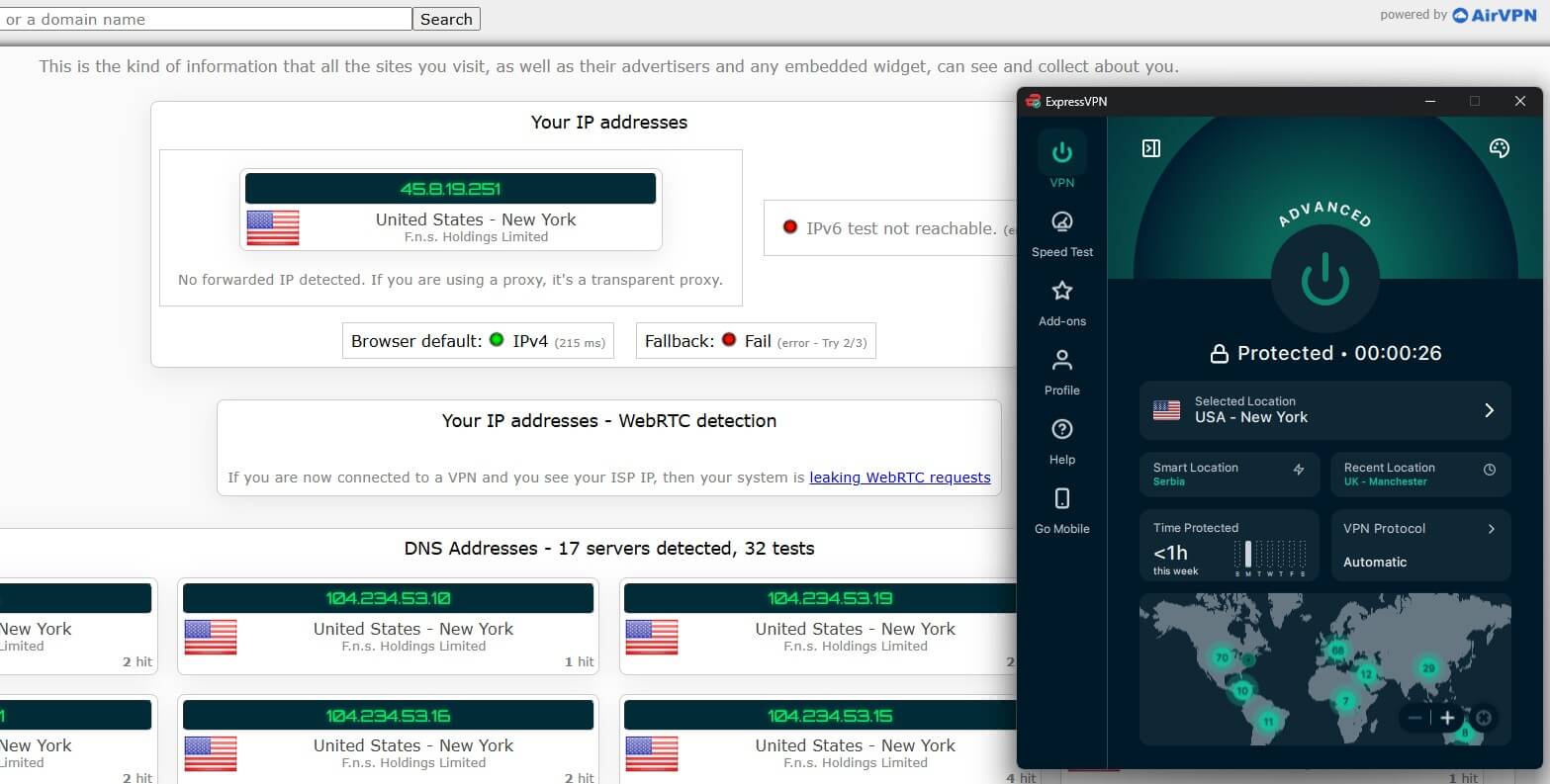
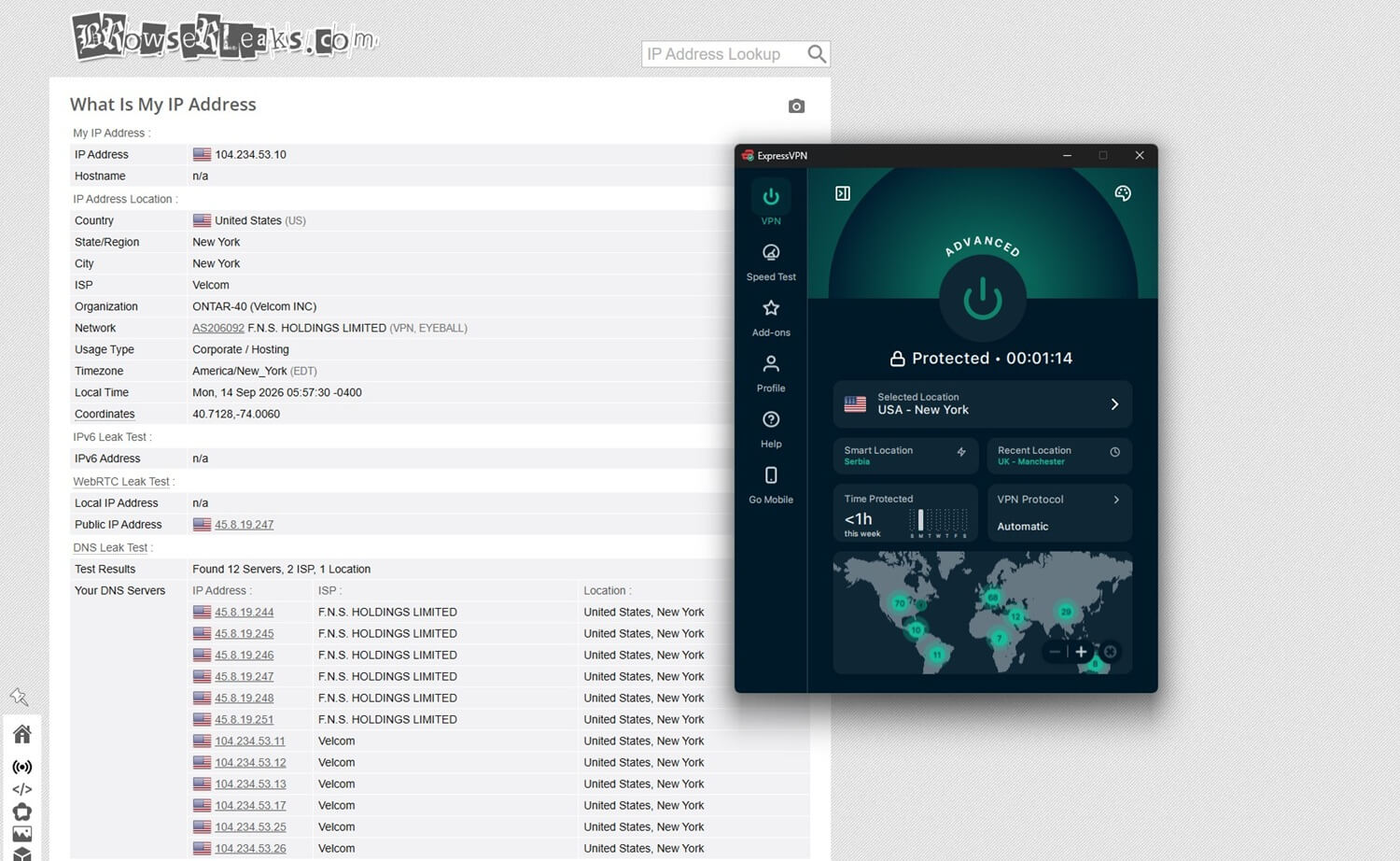
We checked ipleak.net and browserleaks.com on the British, American, and Japanese servers. Windows 11, with the browser cache deleted between sessions. No IP address leaks, no DNS leaks, and no WebRTC exposure. Our home IP address appeared nowhere, including the IPv6 test.
Between May 2022 and February 2024, ExpressVPN’s Windows app leaked DNS requests to the user’s ISP. The fault appeared in one split tunneling mode, “Only allow selected apps to use the VPN“. It went unnoticed for 21 months and through several audits. A reviewer at CNET found it before ExpressVPN did. The company then pulled split tunneling from the Windows app within days and released a fix in version 12.73.0.
It restored the feature in April 2024 and paid Nettitude to verify the repair. Meanwhile, the second cause matters here: other VPN apps on the same machine could interfere with its filtering rules, even when idle.
Is ExpressVPN Safe? Jurisdiction, Logs and Audits
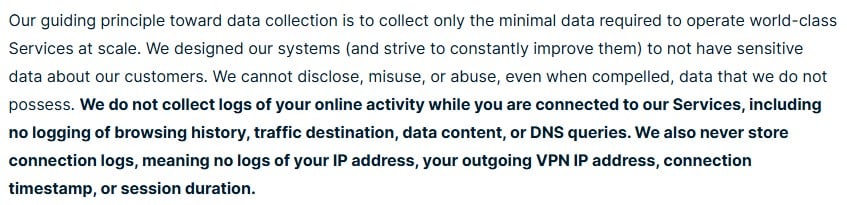
ExpressVPN operates from the British Virgin Islands, with no data retention requirement and no intelligence-sharing arrangement. The privacy policy states that it does not store IP addresses, DNS queries, browsing history, traffic destination or content, connection logs, or timestamps. It does keep an email address for billing, aggregate diagnostics, and the country of connection, with no timestamp.
In addition, it counts connected devices, since the plan caps them. KPMG examined TrustedServer and the privacy policy as of 28 February 2025. The audit found reasonable assurance that the system collects no activity or connection logs. Read the standard before the headline. An ISAE 3000 Type I engagement tests how the controls look on a given date. A Type II would test whether they worked over a period. It’s a stronger instrument, and most VPN audits skip it.
The stronger evidence is older and came without an invitation. In 2017, Turkish authorities seized an ExpressVPN server during an investigation. They examined it and found no logs and no connection records. Kape Technologies owns the company, and if the name sounds familiar, it’s because it owns CyberGhost and PIA.
Streaming and Torrenting
There are no specialized servers. Every server allows streaming and P2P, so there is no separate list to hunt through. ExpressVPN opened all 14 streaming services we tested, with no server hopping required on most of them. Netflix libraries in the US, Canada, and Japan all loaded. Similarly, BBC iPlayer and Channel 4 worked from British servers, and JioHotstar opened on an Indian server.
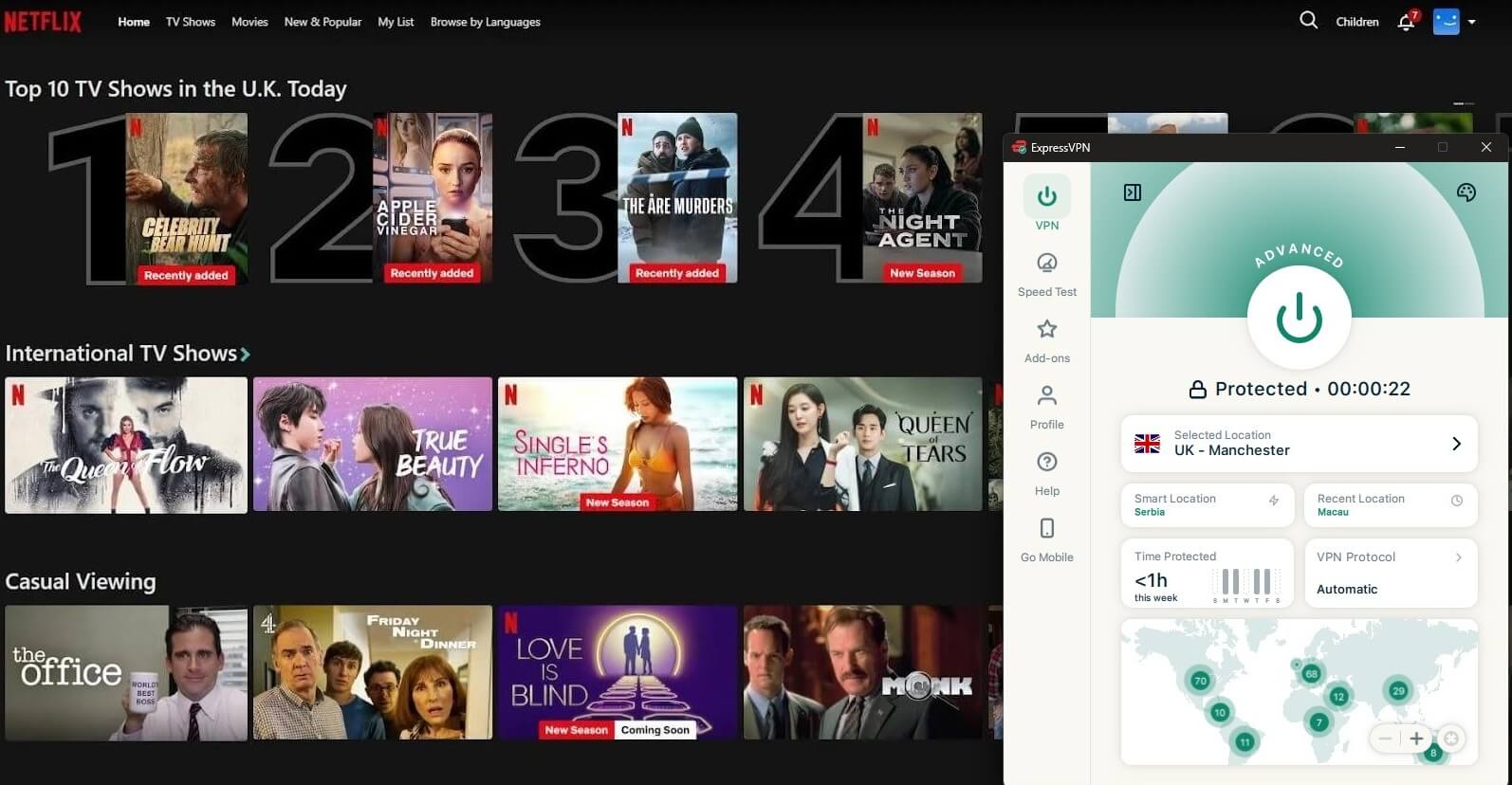
Two qualifications. ITVX and Prime Video detected the connection on several attempts and required a different server in the same country. Disney+ blocked the desktop app, as it does with desktop VPN apps generally. It opened only with location spoofing in the browser extension, so we count that as a workaround.
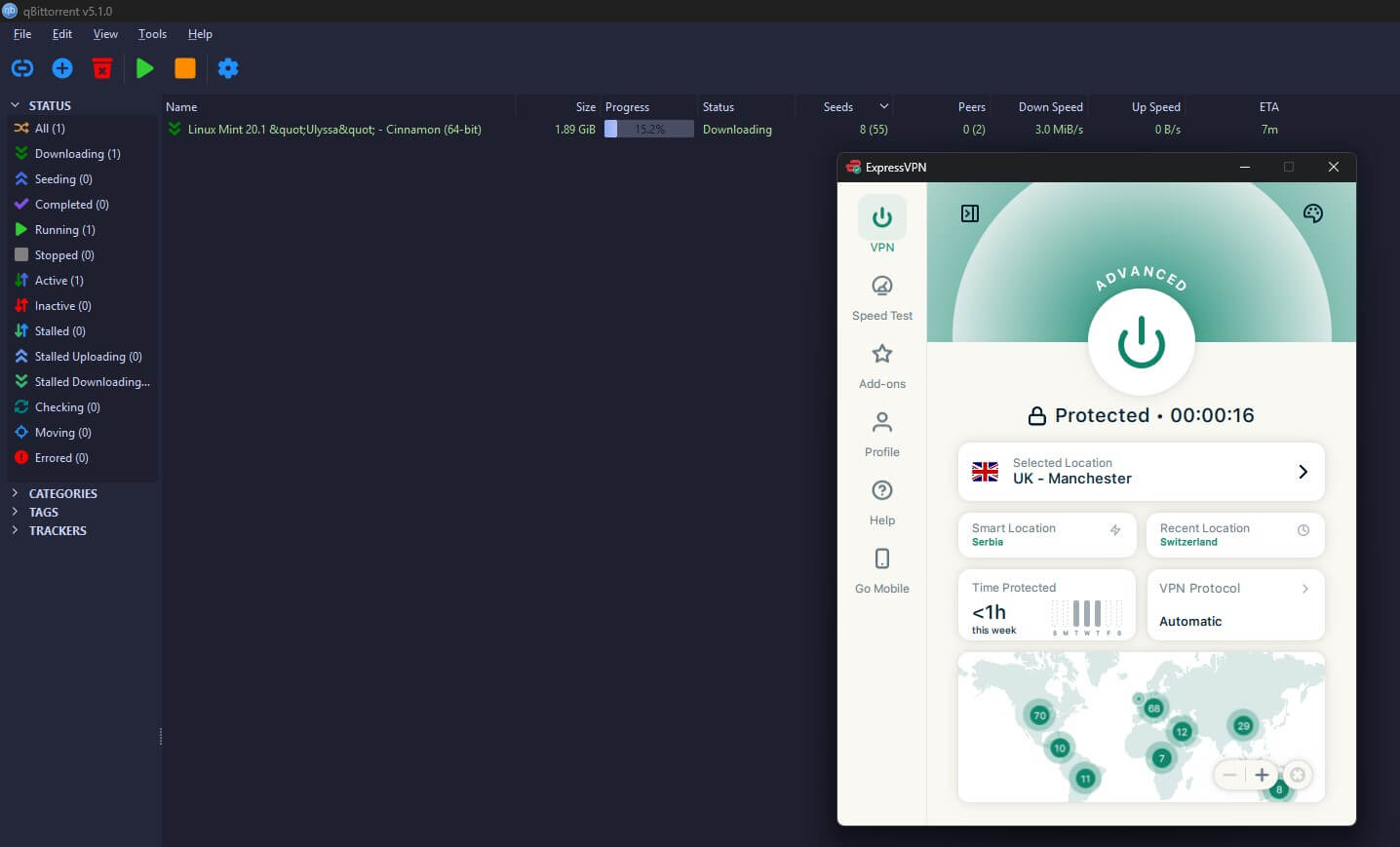
Torrenting is where the absence of port forwarding bites. Downloads are quick, and every server accepts P2P. However, seeding ratios on private trackers depend on an open port, and ExpressVPN argues that port forwarding creates more exposure than it is worth. If that describes your use, this VPN is wrong.
Server Network and Coverage
The app lists 113 countries, with city-level entries across the larger markets. However, ExpressVPN does not publish a total server count. Country breadth is the trade-off it makes against raw server numbers. In practice, that suits a user who wants a specific country more than a specific city. The American network covers more than 20 cities, and Canada has Toronto, Montreal, and Vancouver.
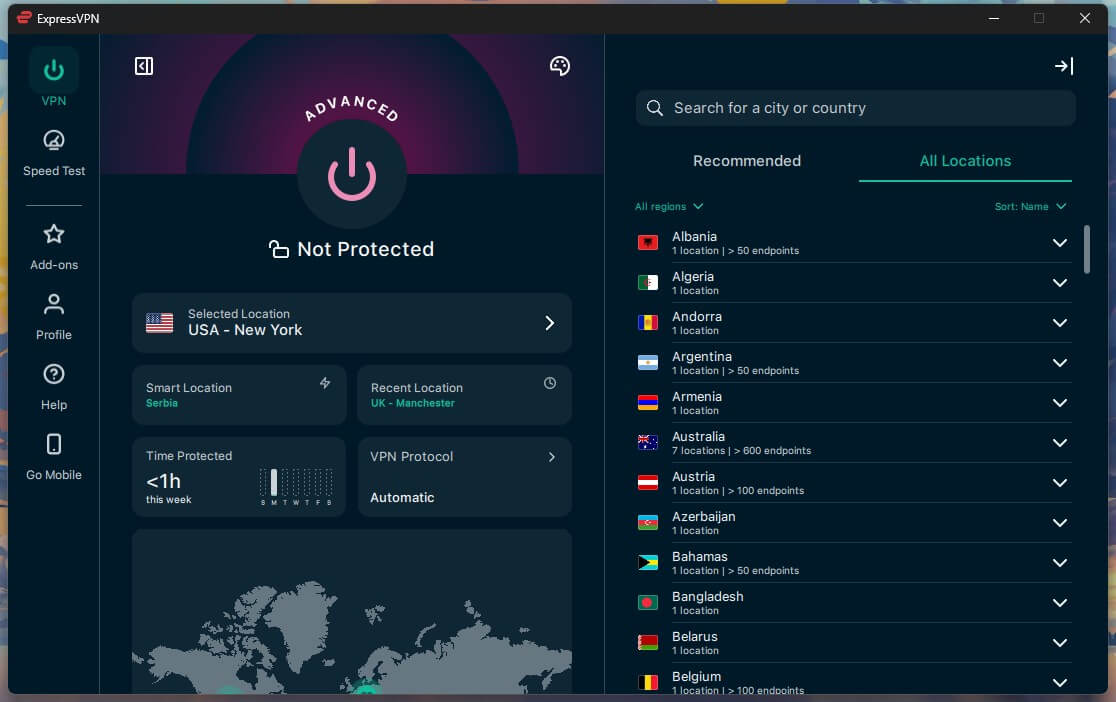
Some locations are virtual. The IP belongs to the advertised country while the hosting happens elsewhere, and ExpressVPN labels those in the app. India is the clearest case, since its data retention law makes local hosting impractical. Router setups go through Aircove, ExpressVPN’s Wi-Fi router with the VPN inside the firmware, and general router support is being wound down in its favor. Dedicated IPs are an add-on on Basic and Advanced and included on Pro.
Does ExpressVPN Work in Censored Countries?
I haven’t tested ExpressVPN inside China for this review. Every Lightway connection applies obfuscation automatically. Deep packet inspection has the hardest time with that design. ExpressVPN’s own guidance is to install the app before traveling, since China blocks the website.
Our ExpressVPN in China page tracks which servers keep working. For the milder cases, a work network or a hotel Wi-Fi that blocks VPN traffic, the automatic obfuscation opened everything we pointed it at without a setting change.
Apps and Ease of Use
ExpressVPN redesigned the Windows app in early 2026. It is still the simplest in the category: one connection button, recent locations underneath, the full list one click away. The mobile builds mirror it closely enough that switching between them requires no relearning. The redesign moved things around in ways this review found unhelpful. There is no Settings menu.
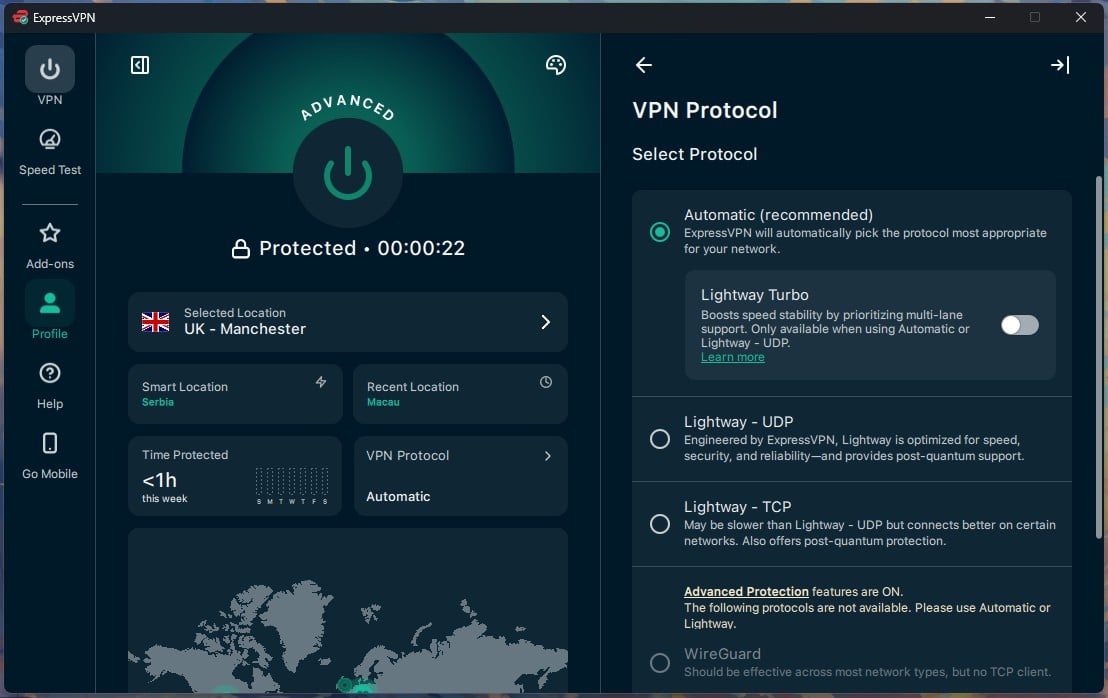
The protocol picker, kill switch, split tunneling, and auto-connect rules are under Profile, and Advanced Protection is under Add-ons beside the dedicated IP and the MCP server, an odd home for an ad blocker. Everything is there, but the first week involves hunting. Connections took 1 to 2 seconds, quick enough that the app works as a toggle, with no wait.
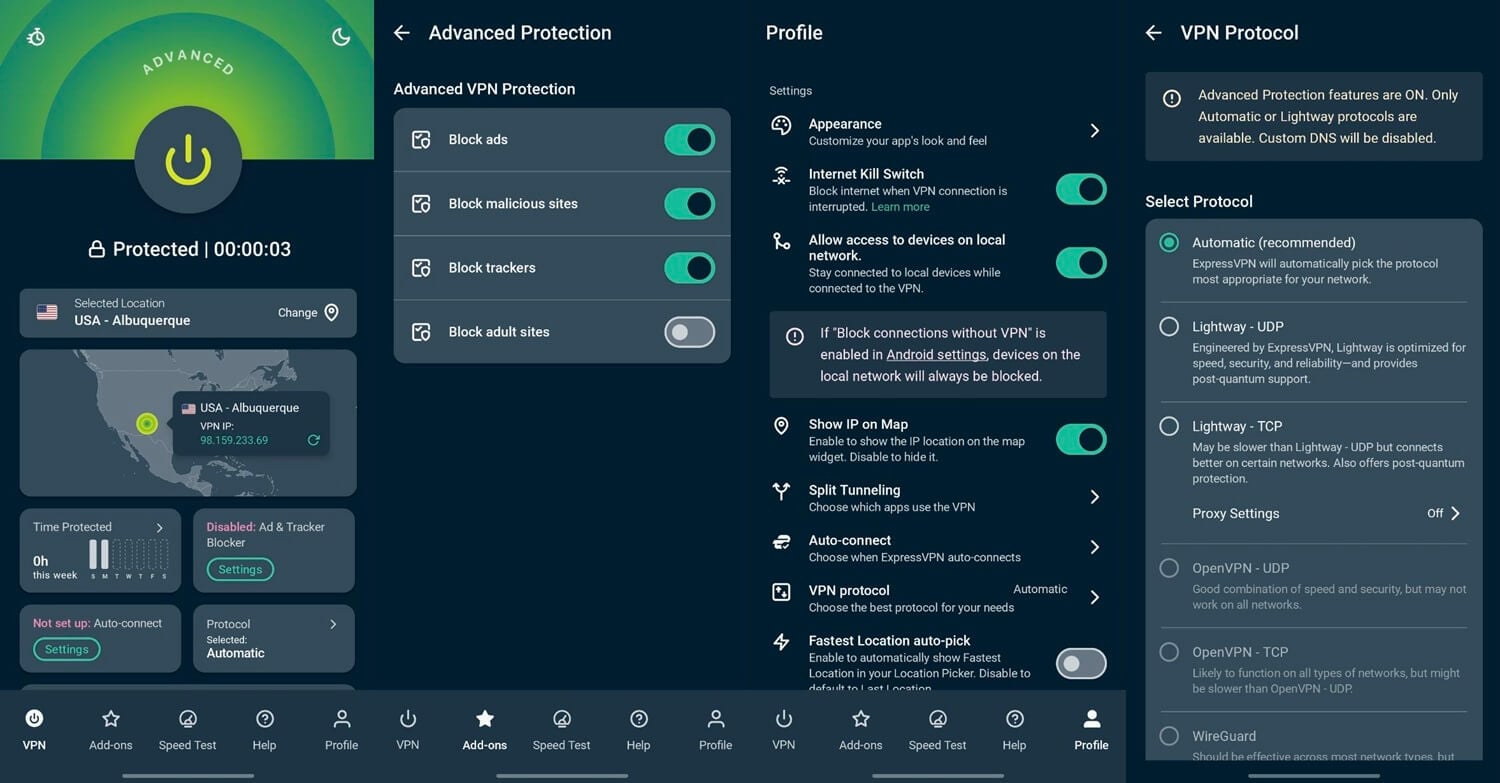
ExpressKeys, the bundled password manager, generates and autofills credentials and lacks family sharing and a proper recovery flow, so the dedicated password managers remain a better buy for people who take that seriously. One fault I recorded: on two occasions, the Windows app would not connect.
A PC restart fixed it, and stopping other VPN apps from launching at startup stopped it from recurring. ExpressVPN documented that exact interaction during the 2024 split tunneling repair, so the cause is no mystery.
Customer Support
Live chat opens with a bot, and the transfer to a human took under 20 seconds on every attempt. Agents answered product questions without deflecting, including the awkward one about Turbo blocking split tunneling, which the agent acknowledged instead of explaining away. The setup guides are thorough enough that we point people at them. Still, the help center barely covers torrenting.
How ExpressVPN Compares to Other VPNs
ExpressVPN vs TunnelBear
TunnelBear is where many people start, since its free plan gives 2 GB a month and never expires. ExpressVPN is the usual next step once that allowance runs out. In our head-to-head across 8 categories, ExpressVPN won 6, TunnelBear took price, and apps ended in a draw.
| 🏆 ExpressVPN | TunnelBear | |
| Starting price 🤑 | $2.99/mo (28 months) | $3.33/mo (3 years) |
| Renewal 🔁 | $99.95/year (Basic) | $59.88/year |
| Free plan 🆓 | No | Yes, 2 GB a month |
| Money-back guarantee 🪙 | 30 days | None |
| Jurisdiction 🕵️ | British Virgin Islands | Canada (5 Eyes) |
| Countries 🏠 | 113 | 47 |
| Netflix 📺 | 15+ catalogs | US only, unreliable |
| Simultaneous connections 📟 | 10 to 14 | Unlimited |
TunnelBear’s case is long-term cost. At renewal it charges $40.07 less per year than ExpressVPN Basic, allows unlimited devices, and has published a Cure53 audit every year since 2017. The trade-offs are a missing refund policy, apps for only four platforms, ad blocking limited to a browser extension, and obfuscation you have to switch on manually.
ExpressVPN pulls ahead everywhere else. In a separate head-to-head on a slower 50 Mbps line, it downloaded 103% faster to Tokyo than TunnelBear, and it opened streaming services TunnelBear kept getting caught on. It also reaches Linux, TVs, and streaming devices TunnelBear doesn’t support. Get TunnelBear if budget is the deciding factor or 2 GB a month covers you, and our full TunnelBear review goes deeper. Everyone else gets more from ExpressVPN for the extra $40 a year.
ExpressVPN Review: Conclusion
Buy ExpressVPN when nothing about the setup should require thought. Distance costs it less than almost any rival, every streaming service works, the apps are the easiest to use, the audit trail is long, and a seized server in Turkey tested the no-log claim in a way no audit can. There is no multi-hop, port forwarding, or Tor support.
Advanced Protection blocks less than the tools it competes with. Lightway Turbo delivered nothing measurable on a 190 Mbps connection and disabled split tunneling. At $99.95 a year on renewal, Basic costs more than twice its opening rate.
- Get ExpressVPN if you want the fastest connection to distant servers, you stream across several streaming services and want them all to work, you value an app that takes no learning, or you want a long public audit history behind the no-log claim.
- Skip ExpressVPN if you seed on private trackers and require port forwarding, you want multi-hop or Tor support, you rely on the ad blocker doing the heavy work, or the renewal price is the deciding factor.
The ExpressVPN vs NordVPN comparison covers the first case, and these alternatives cover the rest. For a lower price with deeper customization, the low-cost ranking is the place to start for you.
Frequently Asked Questions
Is ExpressVPN worth it?
Yes, for speed and simplicity. ExpressVPN loses little over long distances and opens every major streaming service. It lacks multi-hop, port forwarding, and Tor support.
How much does ExpressVPN cost?
ExpressVPN Basic costs $2.99 a month on the two-year plan, $83.72 for the term, and renews at $99.95 a year. Advanced costs $4.49, and Express Pro costs $7.49.
Is Lightway Turbo faster than Lightway?
Barely. Turbo opens several tunnels at once, which helps only on very fast connections, and it disables split tunneling while switched on.
Does ExpressVPN work with Netflix?
Yes. ExpressVPN opens Netflix libraries in the US, Canada, Japan, and the UK, alongside BBC iPlayer and Channel 4. Disney+ blocks the desktop app.
Does ExpressVPN keep logs?
No. ExpressVPN's servers operate from RAM and retain no browsing history, DNS queries, or connection logs. A server seized in Turkey contained no records.
Does ExpressVPN work in China?
Yes, usually. Obfuscation applies to every Lightway connection automatically, with no separate server list to select. The app requires installation before arrival, since the website is blocked.
Does ExpressVPN have a free trial?
Yes, on mobile. The iOS and Android apps include a 3-day free trial, but it requires a credit card, so it's vital to cancel before the trial ends.
Is ExpressVPN good for torrenting?
Yes. Every server allows P2P, and downloads are quick, though ExpressVPN doesn't offer port forwarding, claiming it costs privacy.