Surfshark and Proton VPN sell privacy, and both deliver it. Surfshark went wide: unlimited devices, an antivirus, a dark web monitor, and a price almost nobody undercuts. Proton went deep: Swiss jurisdiction, open-source apps, servers under its own control, and a free plan that logs nothing. Proton VPN takes this comparison 3 rounds to 1, with 4 draws. It wins on privacy, speed, and server coverage.
Surfshark wins on price, and the two finish even on apps, features, streaming, torrenting, and China. We compared them on prices, security, privacy, performance, ease of use, and streaming across months of testing. Here’s what came out of it.
Surfshark VPN vs Proton VPN: Quick Comparison
| Surfshark | 🏆 Proton VPN | |
| Our Current Ranking 📋 | #5 | #2 |
| Prices 🤑 | Starting at $2.49/mo | Starting at $2.99/mo |
| Money-Back Guarantee 🪙 | 30 days | 30 days |
| Free Version/Free Trial 🆓 | No/7 day free trial on iOS/Android | Yes/No free trial |
| Logging/Jurisdiction 🕵️ | No/Netherlands | No/Switzerland |
| Protocols 🌐 | OpenVPN, WireGuard, IKEv2 Dausos (macOS) | OpenVPN, WireGuard, IKEv2, Stealth |
| Servers 🏠 | 4,500+ in 100 countries | 20,000+ in 148 countries |
| Specialty Servers ✅ | Dedicated and Static IP, MultiHop | Torrenting, Tor over VPN, Secure Core |
| RAM-Only Servers 🛡️ | Yes | No (full-disk encryption) |
| Working With Netflix 📺 | Yes, all major catalogs | Yes, all major catalogs |
| P2P Allowance ↔️ | Yes | Yes, dedicated servers |
| Customer support ☎️ | Live chat, email | Live chat, email |
| Concurrent Connections 📟 | Unlimited | 10 |
Apps and Compatibility
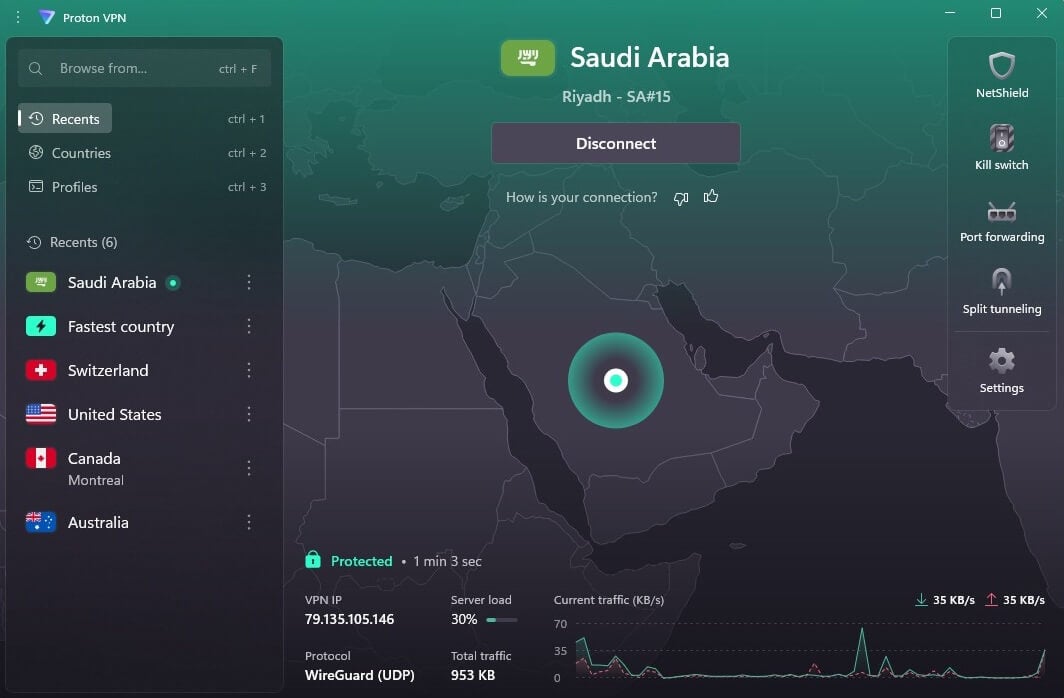
Proton VPN’s apps are quick to learn and quicker to open. The clients hold up across every platform we tried, and on Linux Proton gives you a full GUI. Surfshark still expects the command line. Coverage stretches from macOS, Linux, and Windows to Android and iOS phones and tablets, routers, and Fire TV sticks. Across months of use, dropped connections were rare enough that we stopped noting them.
Surfshark’s Windows app looks excellent and packs in everything you’d want. The mobile version mirrors it closely, so there’s no second learning curve. The Windows client is the weaker half, with connection times that occasionally stretch longer than they should. We saw none of that on iPhones or on several Samsung phones and tablets.
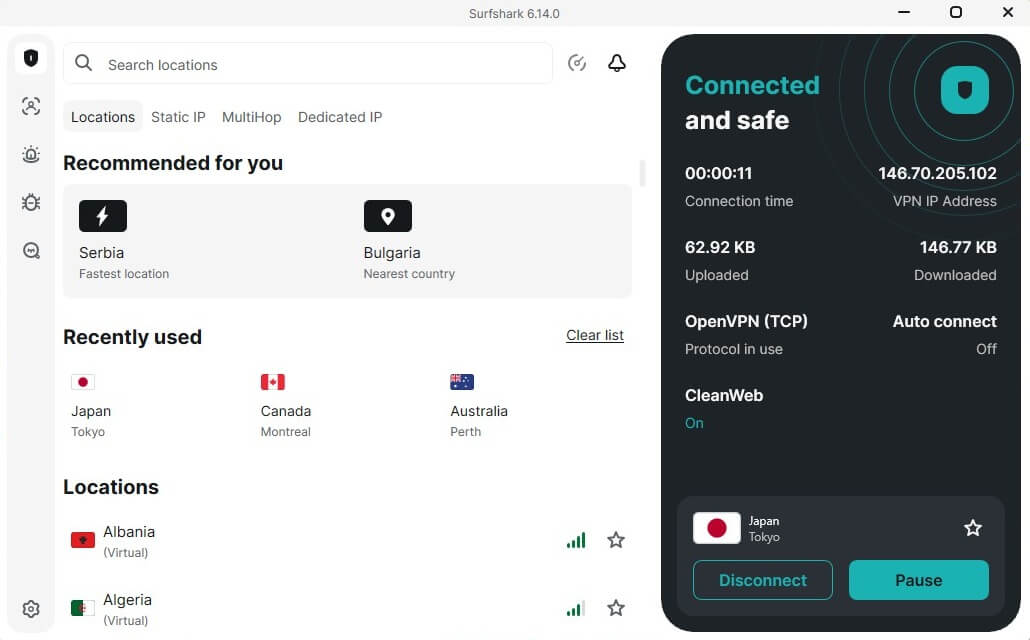
Surfshark also reaches a wide spread of devices, as our dedicated Surfshark review sets out. Neither VPN offers Smart DNS, so consoles and older smart TVs need the VPN configured at router level on either service. Proton VPN allows 10 simultaneous connections, which suits most households. Surfshark allows unlimited connections on a single subscription, which suits every household and its relatives.
Winner: Tie ⚖️
Proton VPN’s apps are more stable and properly support Linux. Surfshark answers with unlimited devices. Both are among the easiest VPNs to live with, and the strengths point in opposite directions.
Surfshark is Cheaper Than Proton VPN: Cost Compared
Money next, and this is the one round Surfshark takes. Both providers discount heavily on long terms, but they start from different places. Surfshark’s 27-month term (2 years with 3 extra months) opens at $2.49/mo for Starter, billed $67.23. One sits at $2.79/mo, billed $75.33, and adds antivirus, the Alert dark web monitor, and the Search engine. One+ at $4.49/mo folds in identity theft coverage and Incogni data removal. Alternative ID comes with every tier.
| 2-Year Price | 1-Year Price | Monthly Price | Renewal Price | |
| Surfshark | $67.23 | $50.85 | $16.45 | $79/year |
| Proton VPN | $71.76 | $47.88 | $9.99 | $83.88/year |
Annual plans stay cheap too, and our coupon code holds the discount. Every Surfshark tier also opens with a 7-day free trial, so nothing leaves your account before you’ve used the thing. Proton VPN’s pricing sits above it, discounted through our Proton VPN coupon. The 24-month plan comes to under $3/mo, and the annual plan to $3.99/mo. Line the two-year terms up, and the gap is small: Proton VPN asks $72 for 24 months; Surfshark One asks $75.33 for 27 months.
Proton VPN is the cheaper total; Surfshark buys you 3 more months and a bundle of extras for the difference. Both come with a 30-day money-back guarantee. Proton VPN has one card Surfshark can’t match. Its forever-free plan gives you unlimited data, the same no-logs policy, and 10 Gbps servers, with no expiry attached.
Winner: Surfshark 🥇
Surfshark is cheaper per month on every tier and adds 3 free months and a genuine trial. The margin is narrow now: Starter totals $67.23 against Proton’s $71.76. Proton’s free plan is the better long-term freebie in the category, though this round weighs the paid tiers.
Proton VPN and Surfshark Are Equally Secure
Price shows you part of the picture. Feature depth shows the rest, so here’s where each provider spent its effort.
How They’re Similar
We put both through leak testing before writing any of this, and neither exposed an IP or a DNS query at any point. Proton VPN and Surfshark both offer:
- Automatic kill switch
- IP and DNS leak protection
- Split tunneling
- MultiHop (Secure Core in Proton VPN)
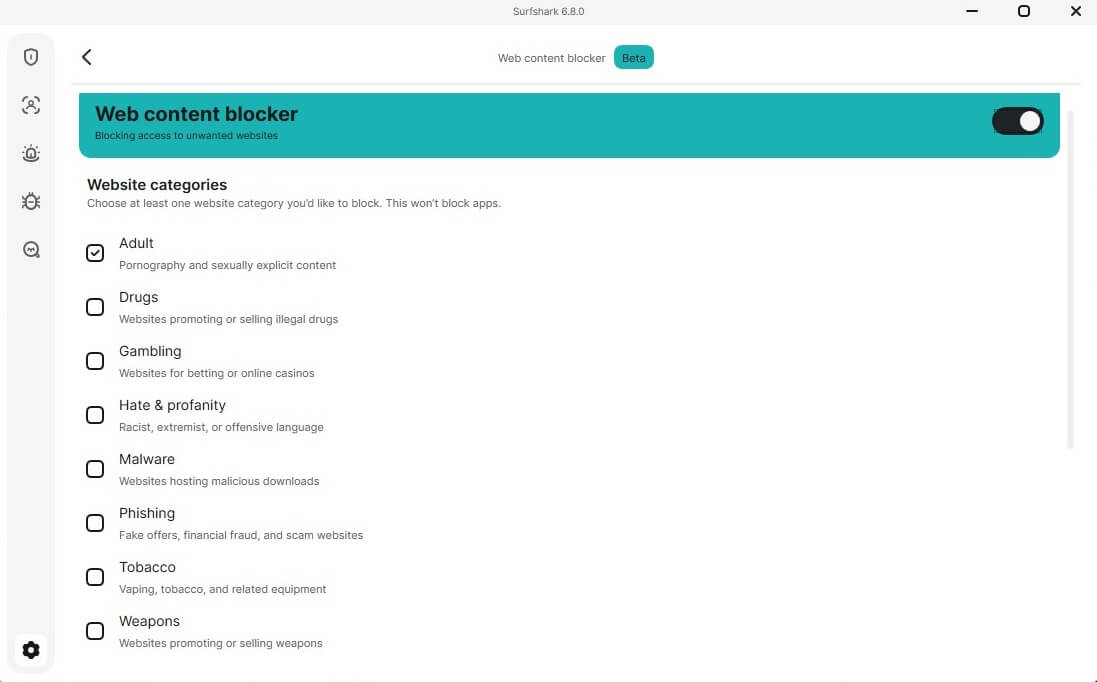
- Ad-blocking (CleanWeb in Surfshark and NetShield in Proton VPN)
- Perfect Forward Secrecy
- 256-bit encryption standard
- WireGuard and OpenVPN protocols
Most of those behave identically. Two don’t. Surfshark’s MultiHop lets you pick both ends of the chain yourself and doubles the encryption between them. Proton’s Secure Core chains the same way, except the first hop is always hardware Proton owns. Those servers are in Sweden, Iceland, and Switzerland, in facilities hardened against physical access as well as network attacks.
The kill switch deserves a note. Surfshark used to react slowly when a connection dropped. That’s fixed, but Proton VPN’s never had the fault to begin with.
Advanced Features Compared
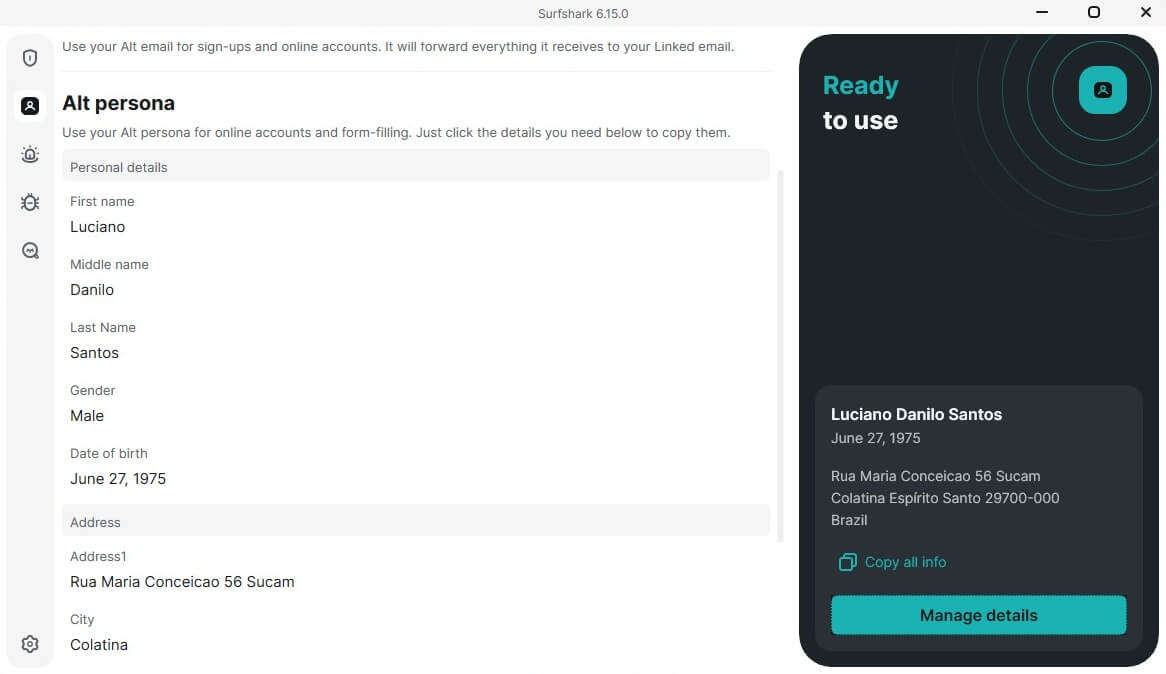
Surfshark’s extras arrive as software. The One tier adds an antivirus for every device, and a VPN and antivirus combination saves you a second subscription. One also brings Search, a tracking-free browser, and Alerts for dark web exposure. Alternative ID generates a new, substitute number, name, and email address on any plan. The IP Rotator cycles your address on a timer without dropping the tunnel, which frustrates long-term tracking and dynamic pricing alike.
A newer addition, scam text protection, flags or quarantines smishing attempts on iOS and Android. Then there’s Dausos, Surfshark’s own protocol, currently macOS-only. It gives every user a separate tunnel instead of a shared one, encrypts with AEGIS-256X2, and is post-quantum resilient, which Proton VPN can’t match.
Cure53 audited it independently. Proton’s extras arrive inside the VPN itself. Alternative Routing and Stealth slip past blocking on school and office networks. Tor over VPN servers reach onion addresses without a second browser, and Proton keeps an onion site of its own.
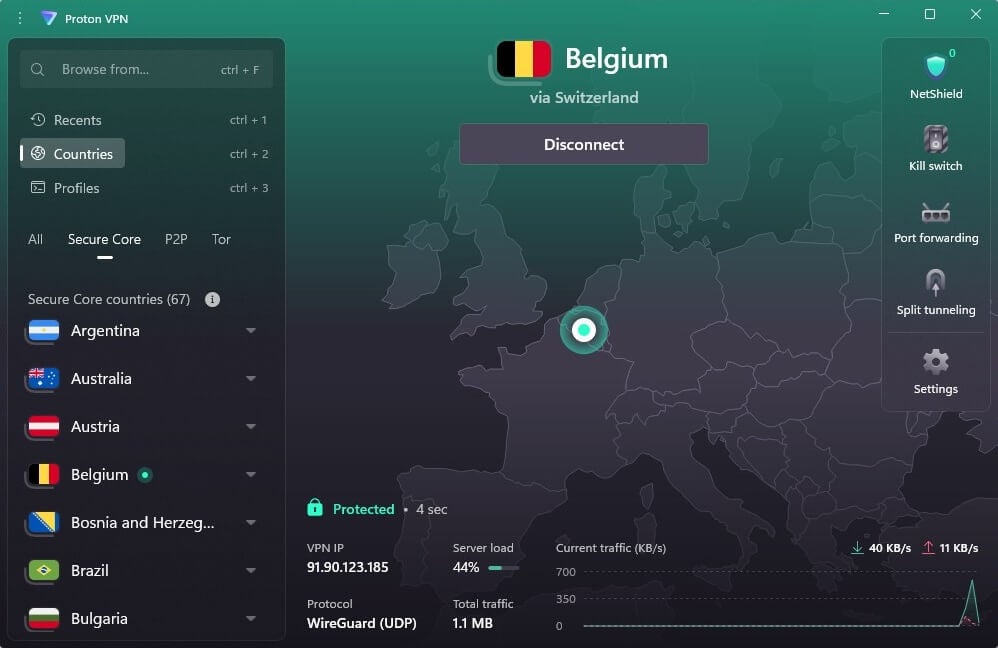
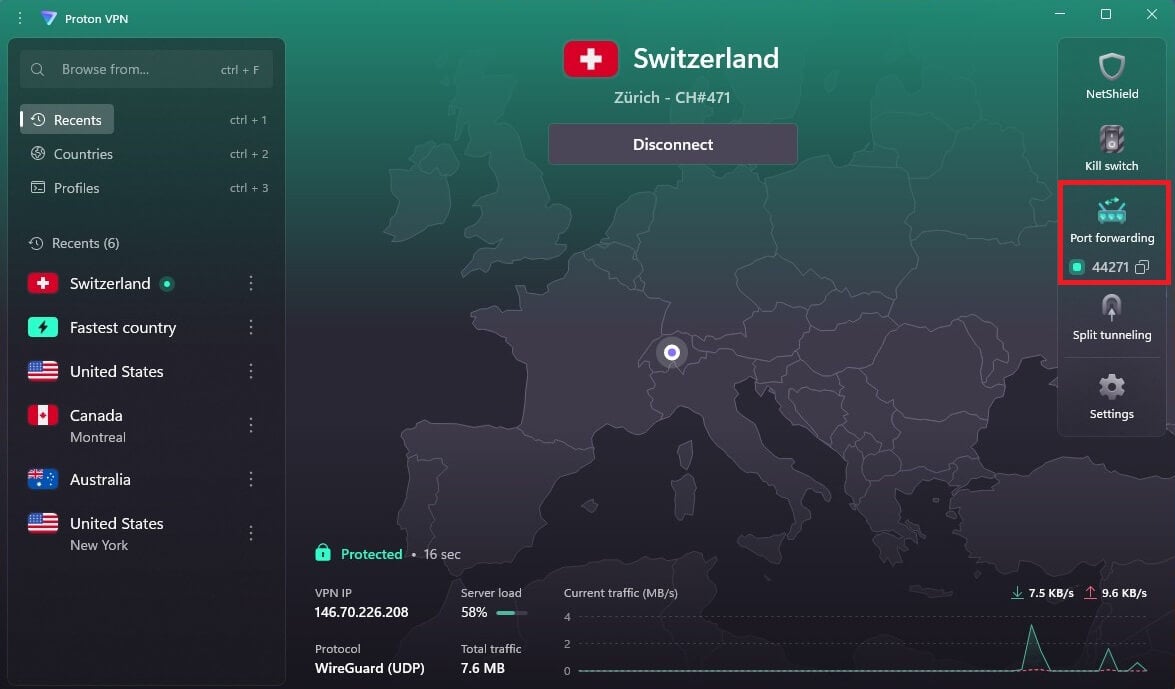
Port forwarding is here too, which Surfshark doesn’t offer at all. Its dark web monitor sits in the account dashboard instead of the app, which is the one place Proton VPN’s packaging trails.
Winner: Tie ⚖️
Surfshark hands you more software for the money, plus the only post-quantum protocol of the two. Proton spends its effort inside the tunnel instead, on Secure Core hardware, Stealth, Tor routing, and port forwarding, all of it available on every platform. Dausos being macOS-only is what keeps this even.
Proton VPN vs Surfshark Privacy: Proton VPN is Better
Neither provider keeps activity logs, and neither has had that claim contradicted. We read both privacy policies end to end before saying so. Proton VPN collects marginally less than Surfshark, and the reason is structural: Surfshark’s antivirus has to inspect files to scan them, so the wider product needs a wider footprint. What each stores is anonymized and deleted quickly.
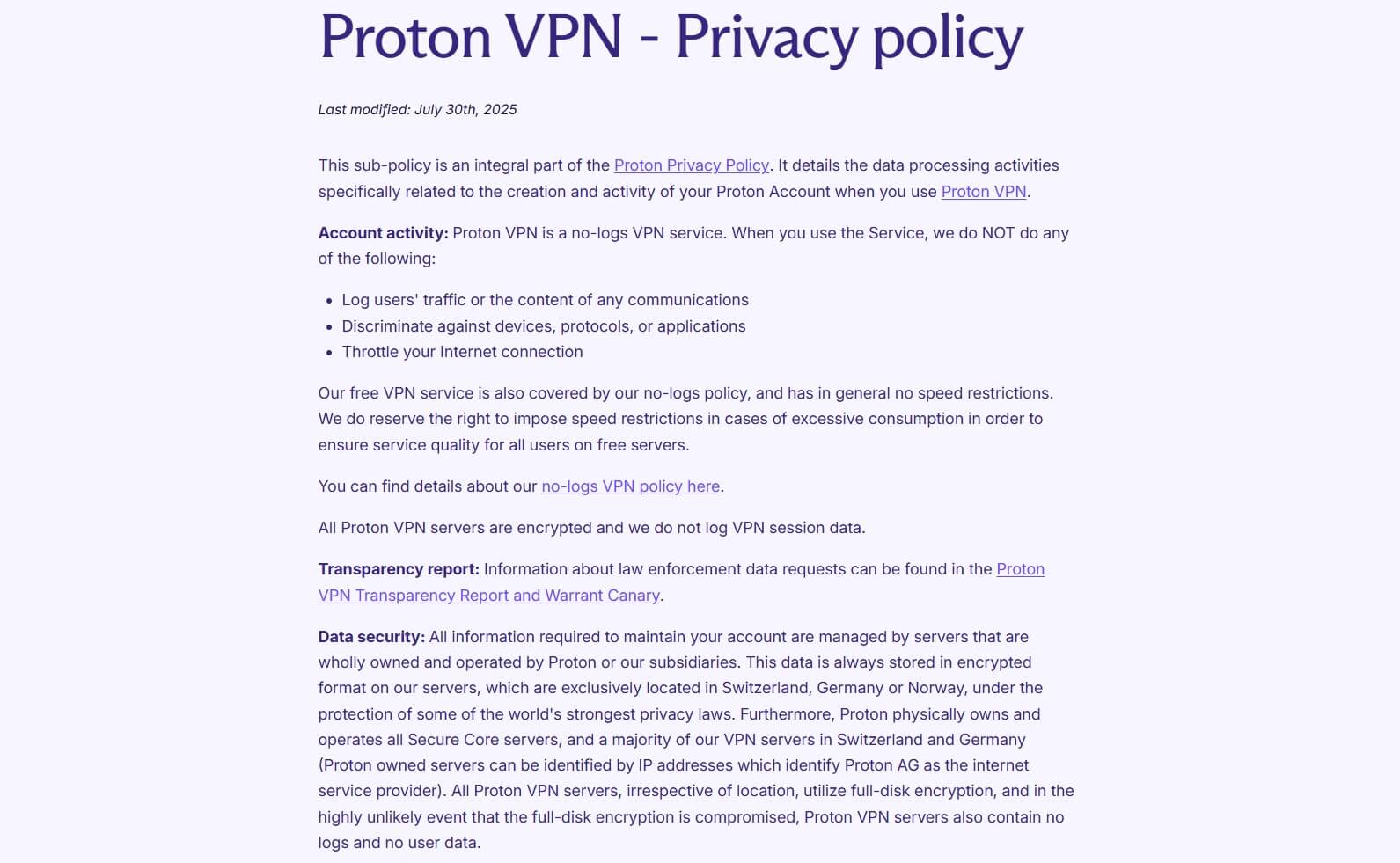
They secure it differently: Surfshark uses RAM-only servers, which hold nothing through a reboot, while Proton VPN uses full-disk encryption on its hardware. Surfshark’s approach is the tidier one, since encrypted disks still need keys managed and hardware still gets seized. Both have commissioned independent audits, which in 2026 is the minimum a paid VPN should be able to show.
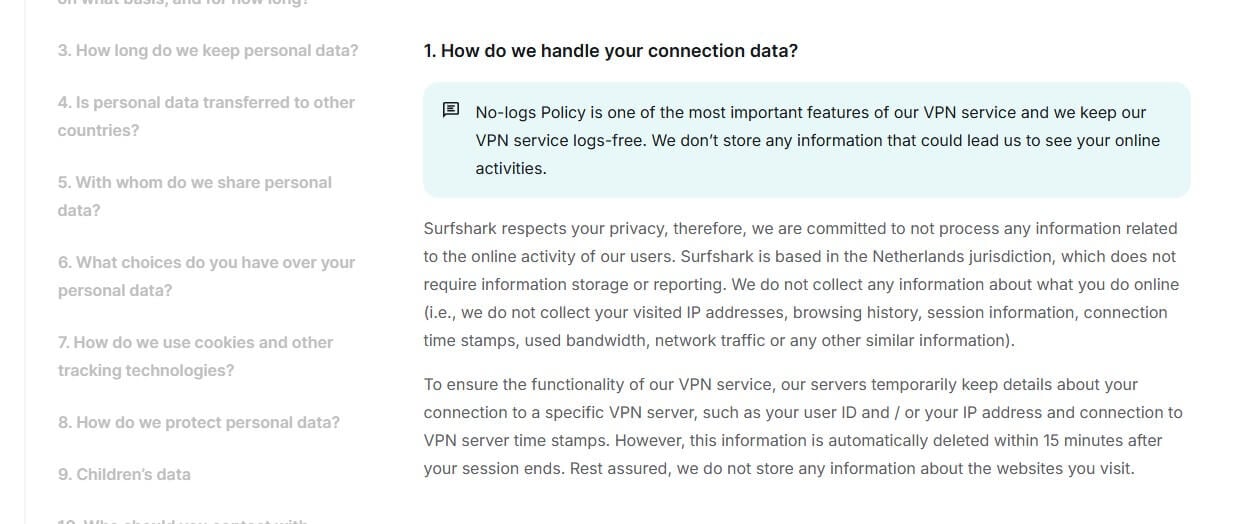
Jurisdiction is where they separate. Proton VPN answers to Swiss law, outside the 14 Eyes arrangement, and treats data requests restrictively. Surfshark is based in the Netherlands, a 9 Eyes member. That doesn’t make Surfshark unsafe, and its no-logs position means there’s little to hand over, but Switzerland is the stronger starting point and part of why Proton is so often the pick for privacy-first users.
Proton VPN’s apps are also open source on every platform, so the code doing the encrypting can be inspected by anyone who wants to. And the free plan is held to the same no-logs standard as the paid one, which is unusual: most free VPNs pay for themselves with the data they collect.
Winner: Proton VPN 🥇
Surfshark is a no-log service, and we’ve no reason to doubt it. Proton adds Swiss jurisdiction, publicly auditable code, and the same policy applied to users paying nothing, which is a harder combination to argue with.
Which VPN is Faster: Proton VPN or Surfshark?
Both providers support WireGuard, so neither is slow. We tested on WireGuard for that reason, since it’s quicker and more widely used than OpenVPN. Proton’s VPN Accelerator is on by default, and we left it there, since that’s how it arrives for everyone. Testing took place in Serbia over three consecutive days, three times a day, on three VPN server locations.
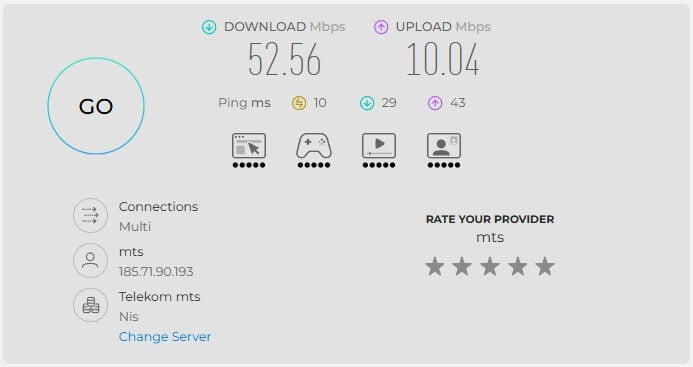
We picked the UK, the USA, and Japan so the results would cover a short hop, a medium one, and a punishing one. Here are the averaged losses:
| Proton VPN | Surfshark | |
| Download Speed Loss | 28% | 33% |
| Upload Speed Loss | 15% | 24% |
And the raw figures behind them:
| UK (Download/Upload) | US (Download/Upload) | Japan (Download/Upload) | |
| Proton VPN | 46.25/9.43 Mbps | 36.79/8.73 Mbps | 29.96/7.42 Mbps |
| Surfshark VPN | 40.99/8.33 Mbps | 35.74/9.53 Mbps | 27.85/4.82 Mbps |
Winner: Proton VPN 🥇
Proton VPN was quicker on every download test and steadier on upload. The margin isn’t dramatic, though it’s consistent, and lower latency made Proton VPN the better of the two for gaming as well.
Streaming and Torrenting Compared
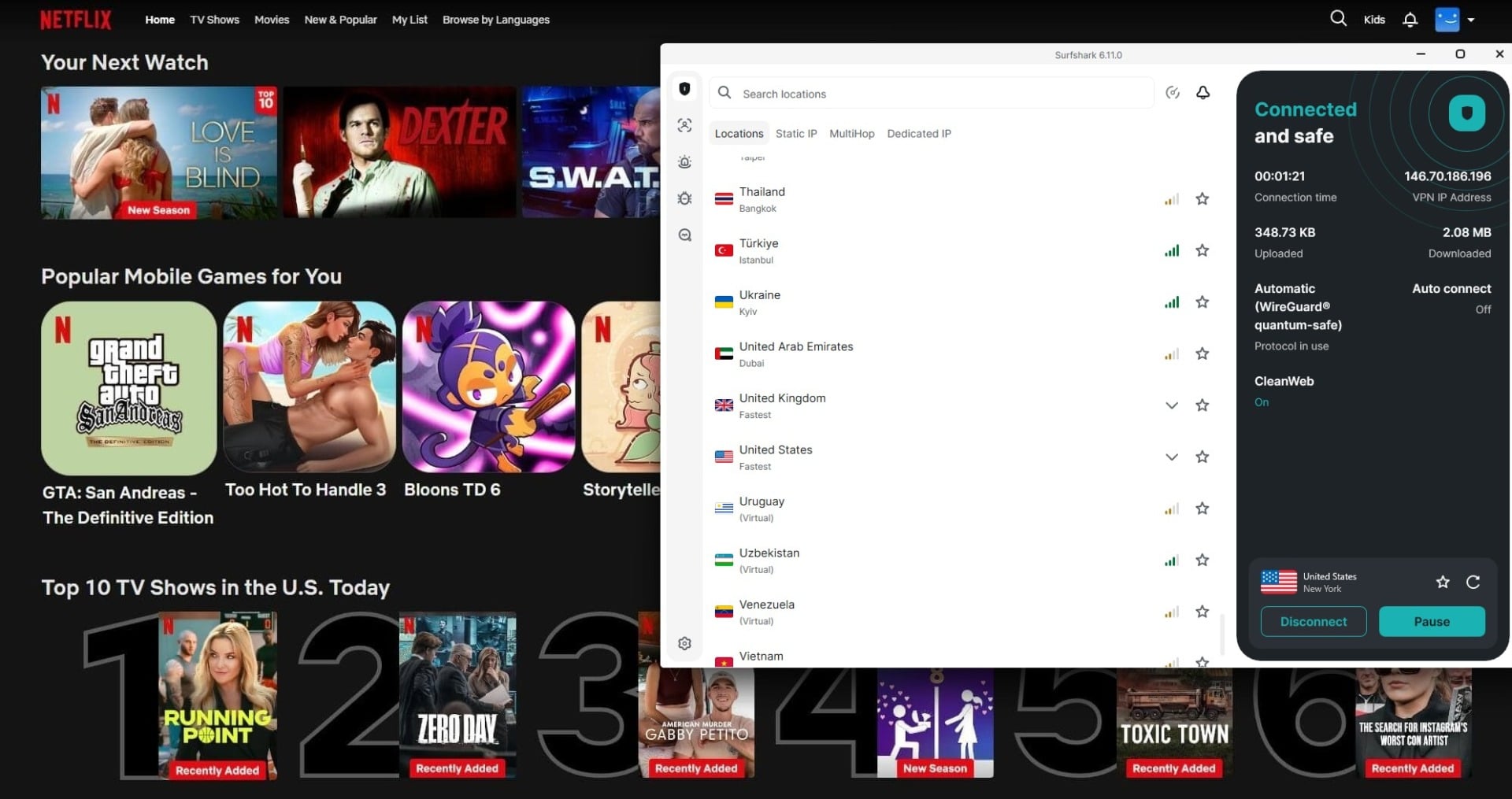
Netflix was the focus of our streaming tests, with other services alongside it. Surfshark has long been one of the best VPNs for video, working with nearly every Netflix library. Proton VPN meets it pretty much head-to-head. Across libraries in the USA, Japan, the UK, Germany, Turkey, and others, both providers held up. Surfshark opened a handful more regions.
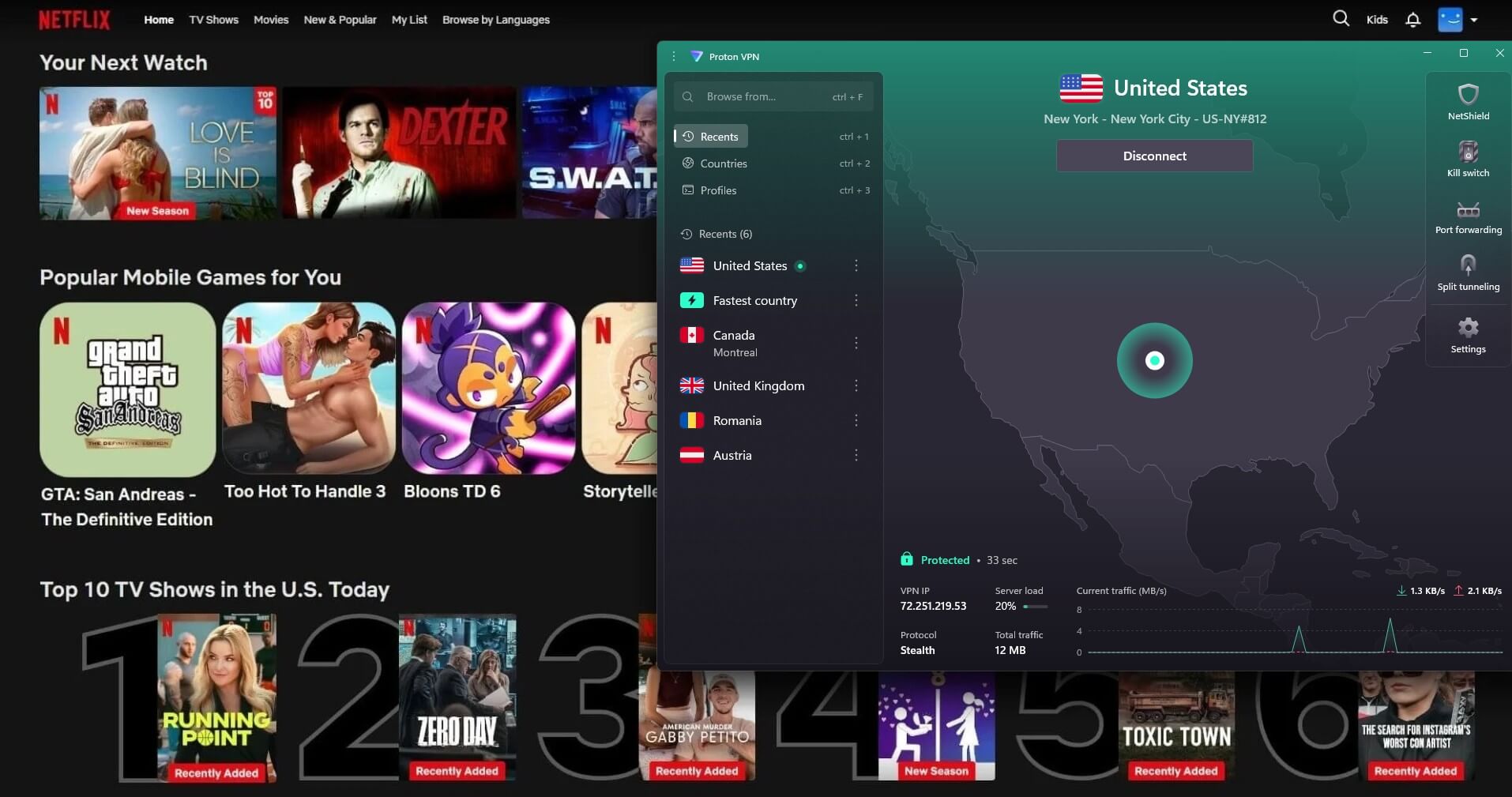
The pair also handled BBC iPlayer, Disney+, Hulu, ABC, and ITVX. Playback quality gave us nothing to complain about. Watching ITVX abroad took no setup, and 4K on Netflix Premium rarely stuttered. Off the clock, we picked up free NFL live streams and blackout NHL games on both providers without trouble.
Torrenting goes the other way. Proton VPN gives you P2P servers and port forwarding, which you can configure for better transfer rates. Its speed advantage compounds that, so downloads finish sooner. Surfshark’s P2P performance is fine for the money without being a highlight. Surfshark offers neither port forwarding nor a dedicated P2P category.
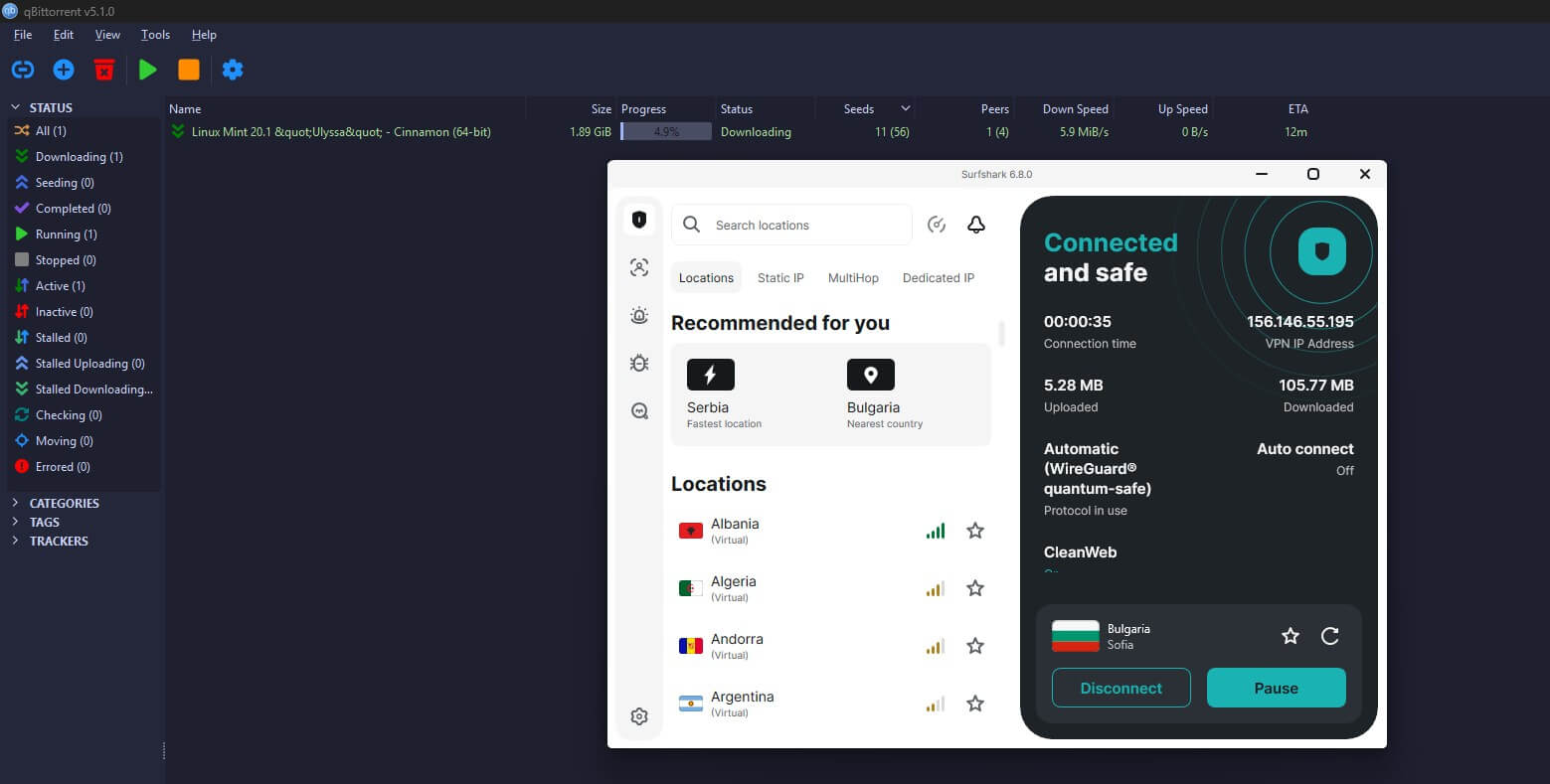
On its furthest servers, download rates drop sharply and upload can fall close to zero, which makes seeding awkward. Proton gave us that problem rarely, and switching servers solved it when it did.
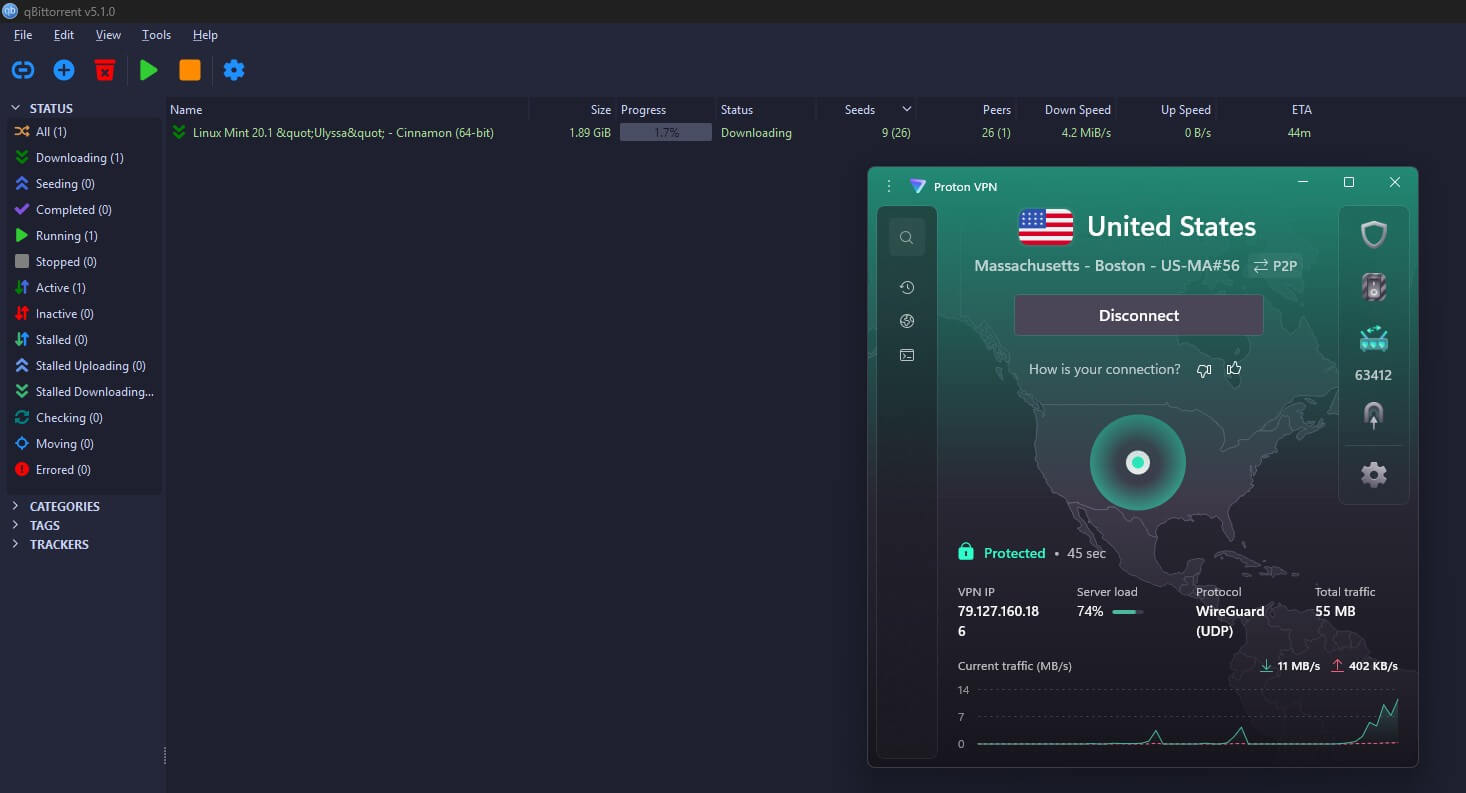
Winner: Tie ⚖️
Surfshark takes streaming by a small margin, on library count alone. Proton VPN takes torrenting by a wider margin, on dedicated P2P servers, port forwarding, and the VPN Accelerator. The two halves cancel out.
Server Locations
A bigger network only counts when the quality holds, and both providers clear that bar. 10 Gbps hardware, unlimited bandwidth, current protocols throughout.
The size difference is stark:
- Surfshark has 4,500+ servers in 100 countries
- Proton VPN has 20,000+ servers in 148 countries
Roughly four times the servers and 48 more countries. Surfshark’s counter is a deep bench of dedicated and static IP options, though the dedicated ones cost extra. Proton VPN splits its network into torrenting, Tor over VPN, and Secure Core categories at no additional charge. Denser distribution is what that buys in practice.
More endpoints per country means less crowding at peak hours, which is part of why Proton VPN posted the better speed figures above.
Winner: Proton VPN 🥇
More servers, more countries, and more specialty categories included in the base price. Proton VPN covers more ground and spreads the load better doing it.
Surfshark vs Proton VPN in China: Close One
Censorship lasts, and the short answer is that neither is a safe bet. Surfshark’s Camouflage Mode applies obfuscation and did connect for us from China, but with interruptions that sometimes turned into outages. The picture in 2026 is harder than it was. Camouflage Mode won’t reliably get past the Great Firewall, so any given trip becomes a gamble.
Proton VPN gave us the same result during our checks. Alternative Routing and Stealth got us online several times before dropping out again. Some users report the free plan working where the paid one doesn’t, though we couldn’t reproduce that. Both VPNs are usable in Turkey and Russia, where the filtering is less capable.
Winner: Tie ⚖️
Even, and not in a good way. Neither provider is dependable behind the Great Firewall. A better VPN for China is NordVPN, or Astrill VPN if the budget stretches, since both hold up in the country more consistently.
Conclusion: Proton VPN is Better than Surfshark
Proton VPN takes it 3 rounds to 1, with 4 draws. Three things decided it. Proton VPN was quicker on every download test. It answers to Swiss law instead of a 9 Eyes member, and publishes its app code for anyone to inspect. And its network is four times the size across 48 more countries.
Surfshark costs less, covers unlimited devices, bundles an antivirus, and opens a few more Netflix libraries. Proton VPN is still our pick in 2026, but nobody choosing Surfshark is making a mistake.
Surfshark vs Proton VPN FAQ
🆚 Is Proton VPN better than Surfshark?
Yes, by a narrow margin. The deciding factors are Swiss jurisdiction, faster measured downloads, and a network four times the size. Surfshark costs less every year and covers every device in the house. Neither VPN is a weak choice, so the tie-breaker is usually budget versus jurisdiction.
🆓 Does Proton VPN have a free version?
Yes, and it has no data cap. The free plan reaches 10 countries and protects one device at a time, with the app assigning a server automatically instead of offering a manual pick. The no-logs policy and the 10 Gbps hardware match what paying customers get. Surfshark has no free plan, only a 7-day trial.
🧲 Which VPN is better for torrenting, Surfshark or Proton VPN?
Proton VPN, mainly because port forwarding lets peers connect back to you, which raises seeding ratios and speeds up swarms that Surfshark users have to wait out. Surfshark permits torrenting everywhere on its network, so occasional downloading works fine there.
♾️ Can Surfshark be used on unlimited devices?
Yes. One Surfshark subscription covers any number of simultaneous connections, which is rare at any price. Proton VPN caps connections at 10, enough for most households but not for shared or extended-family setups.