NordVPN and ExpressVPN tied in our September 2026 round. Both averaged 175.57 Mbps across UK, US, and Japanese servers, a 7.8% drop from our 190.36 Mbps baseline, and both opened all 9 tested streaming platforms. Distance split the rest: TunnelBear lost 42.5% of our speed on Japanese servers and opened 2 platforms out of 9. We ranked all 10 on measured speed, streaming access, price, and what each one does badly, so the best VPN for a given job is clear before subscribing.
Best VPN Service: Top 10 VPN Providers Ranked
- NordVPN – Best VPN service overall
- Proton VPN – Most secure VPN for privacy
- ExpressVPN – Most consistent speeds worldwide
- Private Internet Access – Best cheap VPN software
- Surfshark – Best VPN for unlimited devices
- CyberGhost – Best VPN for TV and console setup
- Hide.me – Second-tier pick for MultiHop
- IPVanish – Option for covering every device
- TunnelBear – Easiest starting point
- Hotspot Shield – Fallback for filtered networks
See here how we test VPNs.
VPN Comparison: How the Top VPN Services Line Up
Compare VPN pricing, speed, and streaming access in one place. Speed loss is the average across the 3 server locations we tested, and streaming counts how many of our 9 test platforms opened.
| VPN | Price | Speed loss | Streaming | Countries | Devices | Refunds |
|---|---|---|---|---|---|---|
| NordVPN | $3.49/mo | 7.8% | 9 of 9 | 149 | 10 | 30 days |
| Proton VPN | $2.99/mo | 10.3% | 7 of 9 | 149 | 10 | 30 days |
| ExpressVPN | $2.99/mo | 7.8% | 9 of 9 | 113 | 10-14 | 30 days |
| PIA | $2.19/mo | 12.7% | 6 of 9 | 91 | Unlimited | 30 days |
| Surfshark | $2.49/mo | 9.6% | 8 of 9 | 100 | Unlimited | 30 days |
| CyberGhost | $2.19/mo | 13.3% | 8 of 9 | 100 | 7 | 45 days |
| Hide.me | $2.69/mo | 15.9% | 7 of 9 | 57 | 10 | 30 days |
| IPVanish | $2.49/mo | 21.7% | 5 of 9 | 105 | Unlimited | 30 days, yearly only |
| TunnelBear | $3.33/mo | 23.9% | 2 of 9 | 47 | Unlimited | Case by case |
| Hotspot Shield | $2.42/mo | 22.2% | 5 of 9 | 80 | 10 | 45 days |
Best VPN Services: Detailed Reviews
1. NordVPN: Best VPN Service Overall
Pros
- Panama jurisdiction
- Repeated Deloitte audits
- Double VPN routing
- Post-quantum encryption
- Next-gen antivirus
- NordWhisper obfuscation
- Apple TV app
Cons
- High UK latency
- Steep renewal price
- Windows connection failures
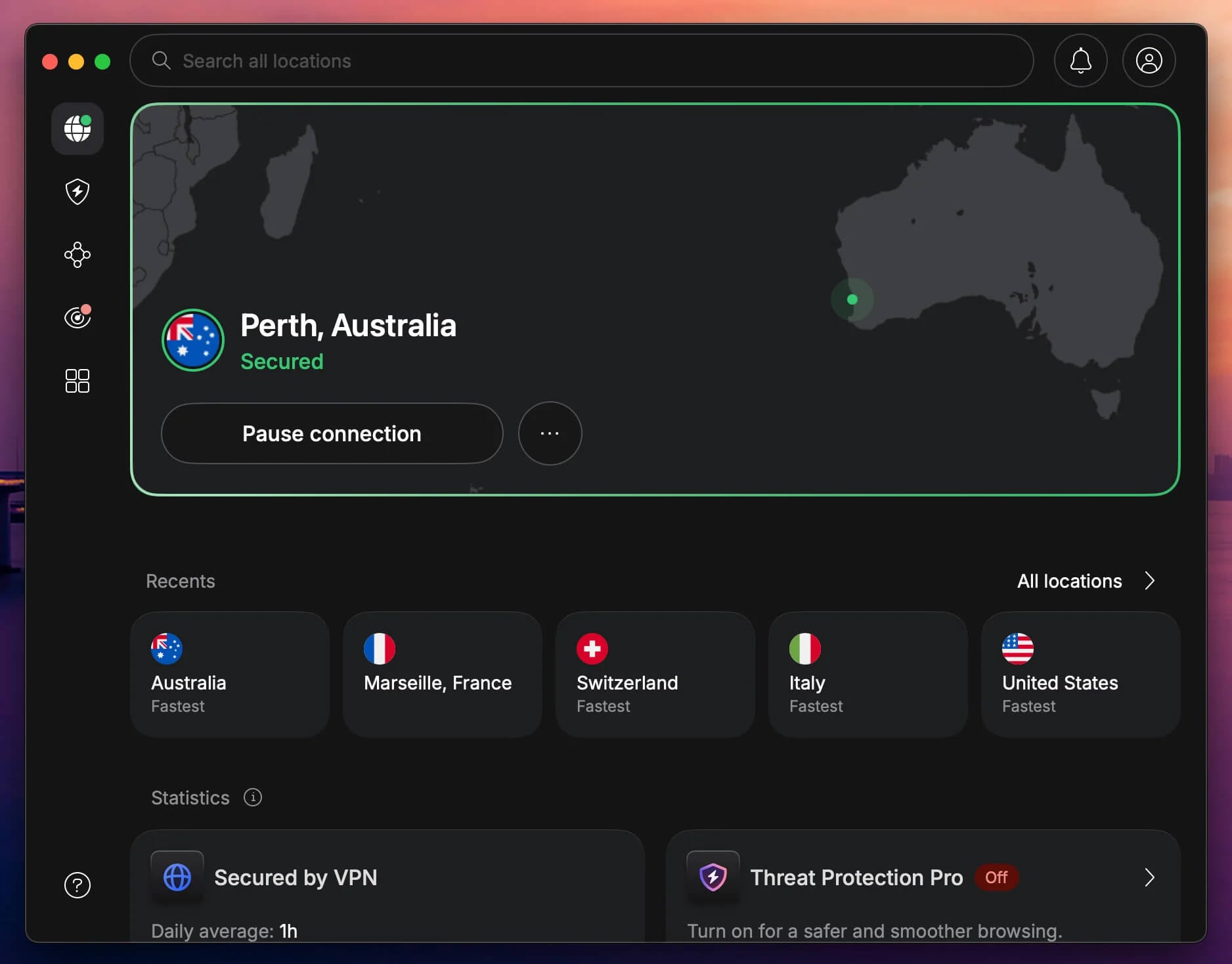
NordVPN was fastest on US servers at 181.50 Mbps, the highest figure any of the 10 recorded there. All 9 test platforms opened, though Pluto TV and Prime Video detected it a few times across repeat sessions. Its UK ping came in at 60 ms, the slowest we measured, when every other VPN stayed under 55. Panama keeps it outside data-retention law, and Deloitte has now confirmed the no-logs policy 6 times through February 2026. NordLynx also uses post-quantum encryption.
A defense against future code-breaking. NordWhisper is built for filtered networks, and Double VPN servers chain two hops for a second encryption layer. P2P is allowed on every standard server, so torrenting needs no special location. Threat Protection Pro, renamed next-gen antivirus in May 2026, blocked 96% of 275 phishing links in AV-Comparatives testing. There’s a VPN app for Apple TV and a full Linux GUI.
A recurring problem showed up on our Windows 11 machine. NordVPN often refused to connect while another VPN was installed and idle, and the app restart that fixed it signed us out. Proton VPN and PIA connected normally in the same state. NordVPN sells 3 tiers on the 27-month term:
- Basic plan: $3.49 a month, $94.23 up front
- Complete plan: $4.49 a month, adding next-gen antivirus, a password manager and 1 TB of storage
- Prime plan: $7.49 a month, adding identity theft cover
Each allows 30 days for a refund, and the Basic plan renews at $139.08 a year.
2. Proton VPN: Most Secure VPN for Privacy
Pros
- Swiss jurisdiction
- Open-source apps
- Secure Core routing
- Stealth obfuscation
- Tor over VPN
- Port forwarding
Cons
- Slow support replies
- No Smart DNS
- No post-quantum option
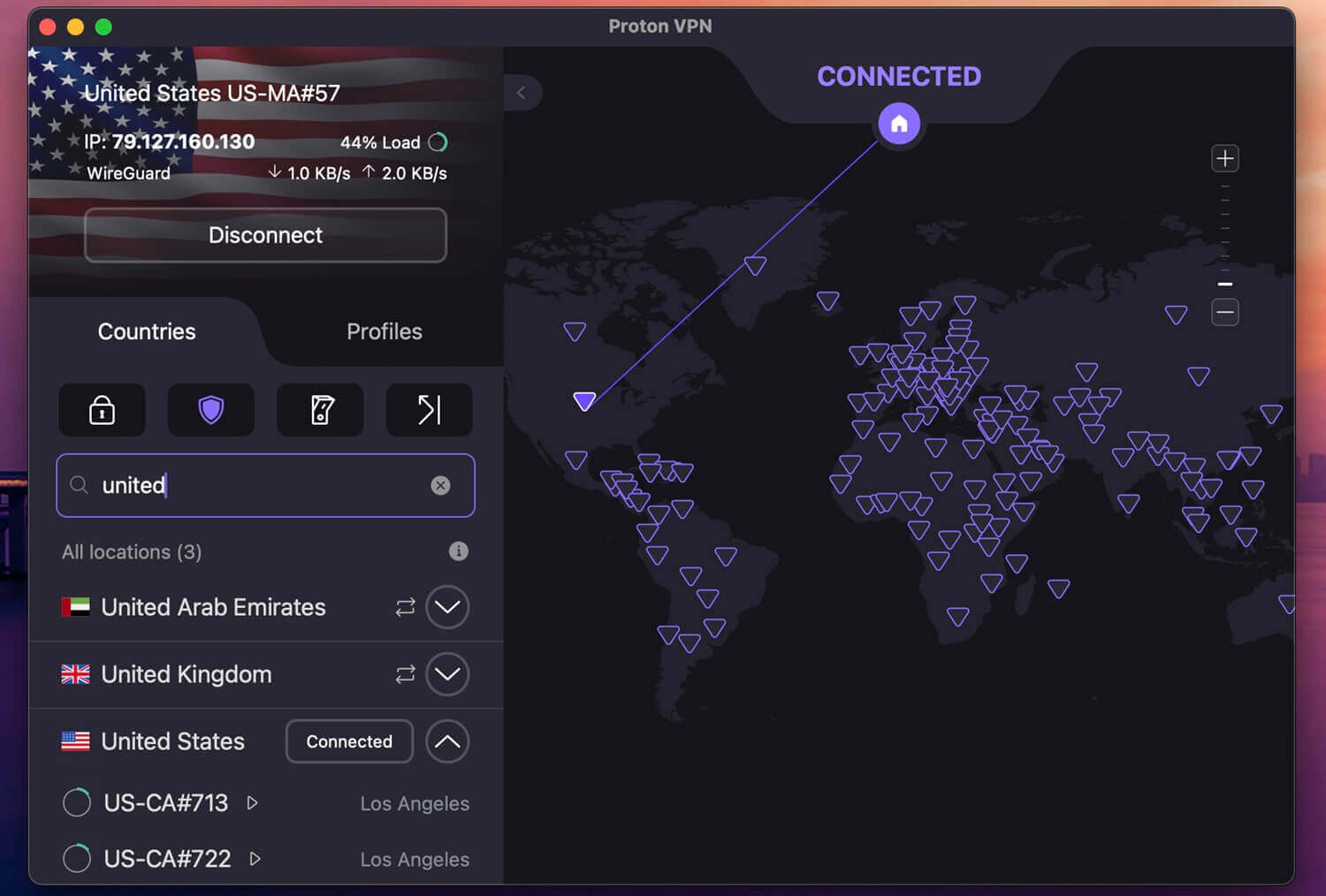
Proton VPN recorded the lowest US latency of the round at 109 ms and lost 10.3% of our download speed across the 3 server locations, with VPN Accelerator on. Pluto TV and ITV detected it; the other 7 platforms opened. Switzerland puts Proton VPN outside the 5, 9 and 14 Eyes intelligence-sharing arrangements. The apps are open source, so the code can be checked against the claims. Coverage now spans 149 countries from 196 locations.
Secure Core sends traffic through a second protected server before it leaves the network, Stealth hides the fact a VPN is in use, and there’s Tor over VPN. NetShield blocks ads and trackers, and port forwarding speeds up P2P. Servers use full-disk encryption instead of the RAM-only setup. Support was slower than expected. Live chat took about a minute to get us to a person, and an email query went a full day without a reply. We expected more from a no-logs VPN of this standing.
The 2-year plan comes to $71.76 up front, $2.99/mo. A single year is $47.88, or $3.99/mo. Refunds last 30 days on either plan, and each covers 10 devices.
3. ExpressVPN: Most Consistent Speeds Worldwide
Pros
- Automatic obfuscation
- RAM-only TrustedServer network
- KPMG-audited policy
- One-click apps
- Post-quantum Lightway
- Split tunneling
Cons
- No multi-hop feature
- Limited customization
- Expensive renewal
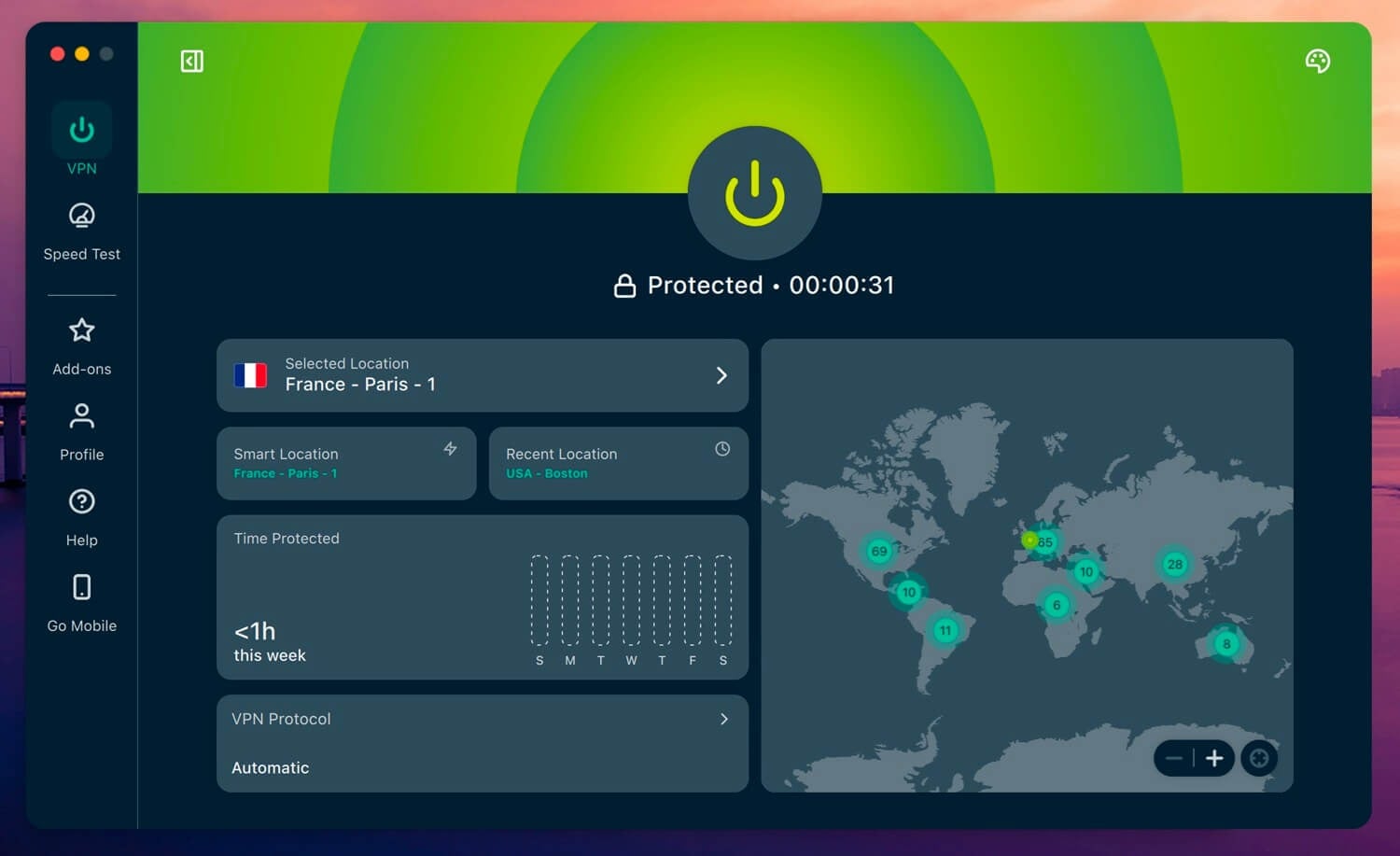
ExpressVPN matched NordVPN’s 7.8% average loss and beat it to Tokyo at 163.94 Mbps, the best Japan figure of the 10, while placing second on the other two. No other VPN placed that high on all three. All 9 platforms opened, with ITV and Prime Video detecting it on a few attempts. Obfuscation disguises VPN traffic as ordinary browsing so a network can’t spot it. ExpressVPN applies it to every connection automatically, whereas NordVPN and Proton VPN need a manual switch.
Lightway Turbo and WireGuard are available with post-quantum encryption, and the network is RAM-only, so nothing is written to disk. KPMG has audited the no-logs claim, and the British Virgin Islands base keeps it outside data-retention law. Split tunneling and a kill switch are in every app. On our Windows 11 setup, ExpressVPN sometimes refused to connect until we reinstalled it. There’s still no multi-hop, and the settings offer less to adjust than NordVPN or PIA.
Three tiers share the 28-month term:
- Basic plan: $2.99 a month, $83.72 up front
- Advanced plan: $4.49 a month, adding a password manager and identity tools
- Pro plan: $7.49 a month, adding a dedicated IP address and AI credits
Renewal prices move to $99.95/year on the Basic plan, which is quite high. Check ExpressVPN’s discounts before subscribing, and there’s a 3-day ExpressVPN free trial.
4. Private Internet Access: Best Cheap VPN Software
Pros
- No device limit
- Court-proven no-logs
- Every US state covered
- MACE ad blocking
- Open-source clients
- Shadowsocks obfuscation
Cons
- Cluttered, dated interface
- US jurisdiction
- Patchy streaming access
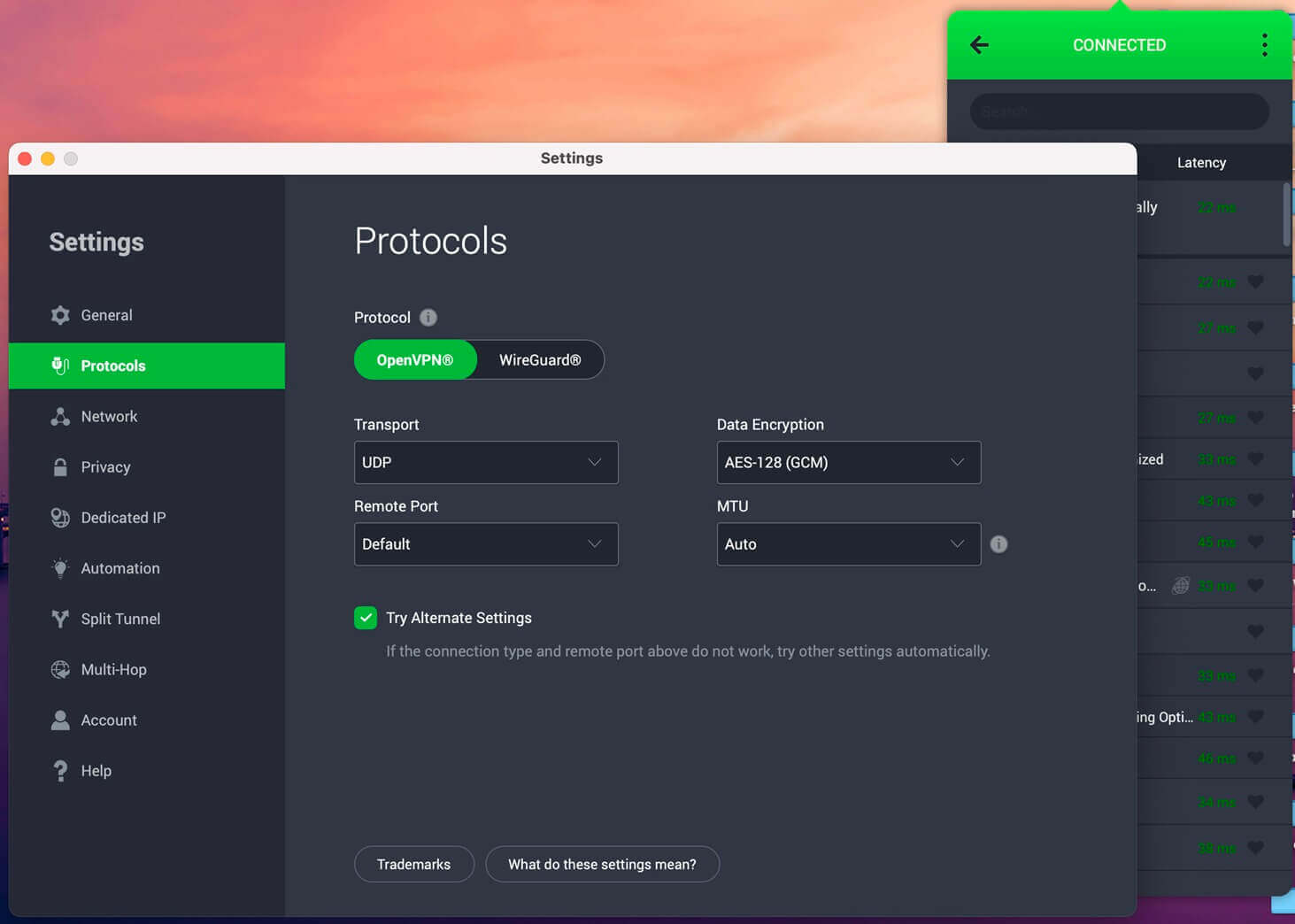
PIA answered fastest of the ten, moving us to a human agent in 10 to 20 seconds. Speed came in lower than we expected at a 12.7% average loss, and Japanese servers were its weakest result at 141.61 Mbps. Netflix Japan, Prime Video and HBO Max each blocked it, leaving 6 of 9. The court record settles the question. PIA has been asked for logs in US proceedings and had none to hand over, and Deloitte has since audited the policy in 2022, 2024 and 2025.
The apps are open source, the servers are RAM-only, and coverage spans 91 countries with a presence in all 50 US states. MACE blocks ads and malicious domains, Shadowsocks and SOCKS5 proxies are built in, and there’s no cap on simultaneous connections. The UI lets it down. It’s cluttered and looks a decade old on Windows and macOS, and it was our least favorite. Being based in the US also makes it part of the 5 Eyes, and the court result softens that without cancelling it.
PIA ranks among the best cheap VPN options and the strongest budget VPN software of the 10. In 2026, the pricing structure is:
- 2-year plan: $2.19 a month, $56.94 for 26 months
- 6-month plan: $7.50 a month
- 1-month plan: $11.99
5. Surfshark: Best VPN for Unlimited Devices
Pros
- Unlimited connections
- Static IP address included
- Dausos post-quantum protocol
- Web Content Blocker
- Camouflage Mode
- RAM-only servers
Cons
- Slow connection times
- Netherlands jurisdiction
- Dearer on renewal
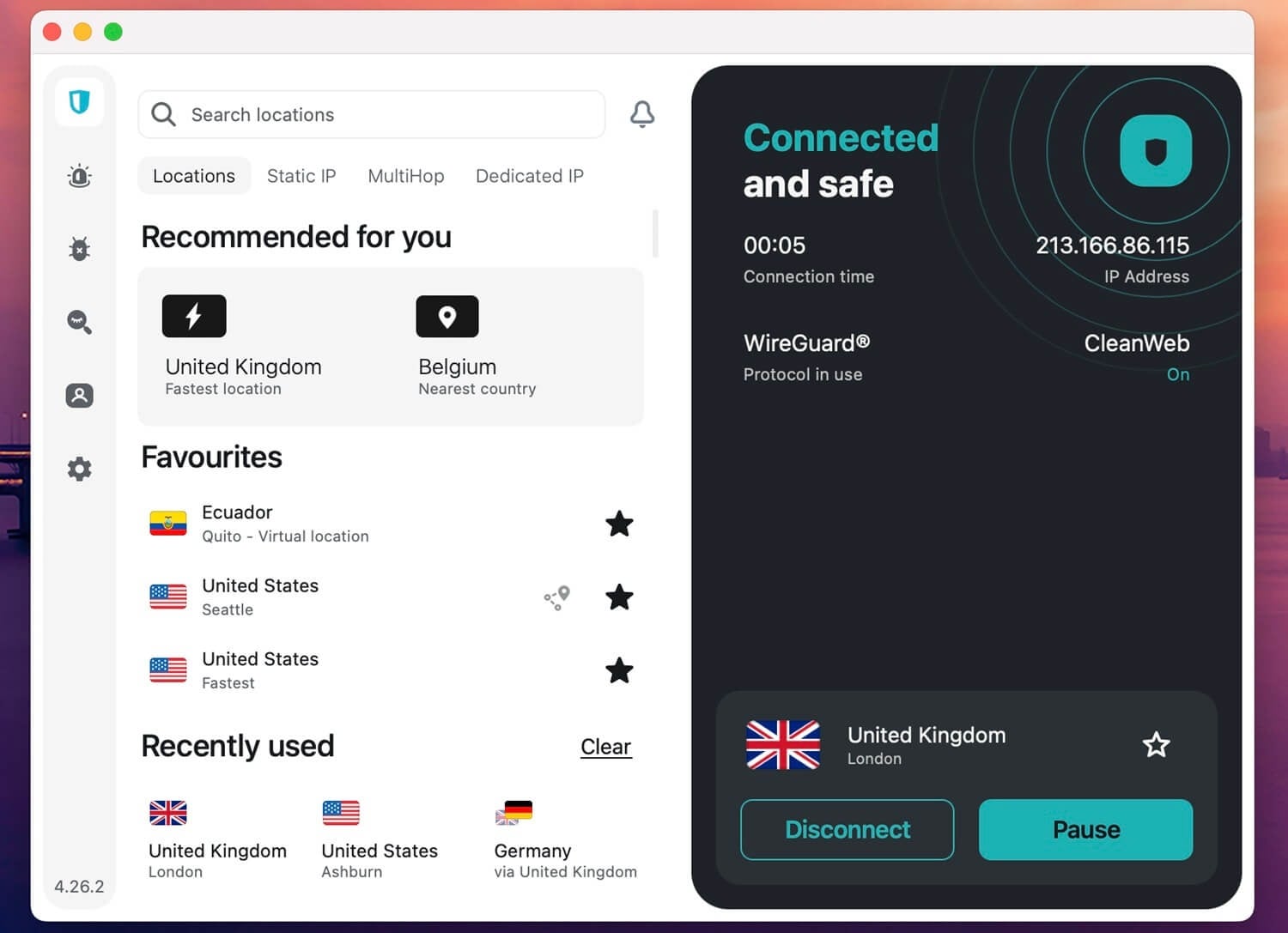
Surfshark recorded the fastest single figure of the round, 186.96 Mbps to London, a loss of just 1.8% off our unprotected baseline. ITV was the only block, leaving 8 of the 9 platforms open. This was the positive surprise of the test. The subscription covers every device in a household. A static IP address comes free with each plan. IP Rotation changes that address periodically while keeping the country fixed, and Web Content Blocker filters categories of sites, going past ads and trackers.
Dausos, its macOS protocol, uses AEGIS-256X2 encryption and is post-quantum resilient, audited separately by Cure53. Deloitte confirmed the no-logs policy in 2023 and again in 2025. The servers are RAM-only, so they store nothing once they restart. Camouflage Mode covers restrictive networks. Connections occasionally took longer to establish than we wanted, and the Netherlands base places it in the 9 Eyes group. There’s no SmartDNS either; it’s been discontinued.
All 3 tiers run on a 27-month term. Refunds are available for 30 days:
- Starter plan: $2.49 a month, $67.23 up front
- One plan: $2.79 a month, adding antivirus, alerts, and scam protection
- One+ plan: $4.49 a month, adding Incogni data removal
6. CyberGhost: Best VPN for TV and Console Setup
Pros
- Smart DNS included
- Platform-named servers
- NoSpy server network
- Quarterly transparency reports
- Romanian jurisdiction
- Long refund window
Cons
- Netflix Japan blocked
- Tight device limit
- No obfuscated servers
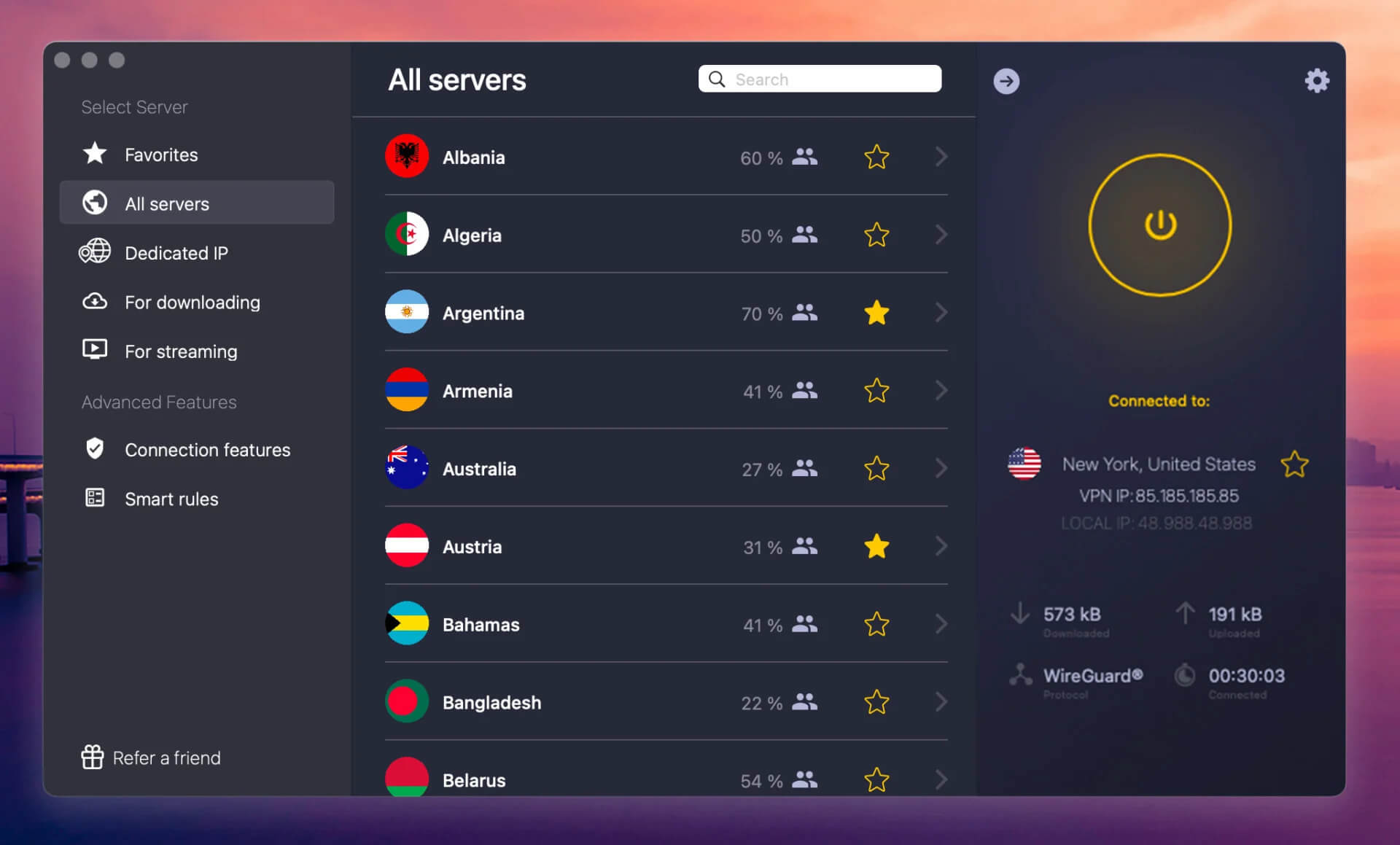
CyberGhost returned the lowest latency in the round, 39 ms to London, and it works well on TV setups. Smart DNS covers an Apple TV, a Samsung or LG set and a PlayStation console without an app. The server list names the platform you want, so there’s no guessing which location works. That said, Netflix Japan stayed blocked in our test despite it having a dedicated server for it. The other 8 platforms opened. Speed was mid-table at a 13.3% average loss.
Japan was where it slowed most, down to 149.74 Mbps. Romania keeps it outside EU data-retention rules, and it has published quarterly transparency reports since 2011, a cadence no rival keeps up. CyberGhost owns and operates the NoSpy servers, and they’re housed in Romania. There’s no obfuscation, so it’s a poor choice for heavily filtered networks, and 7 simultaneous connections is the tightest limit here. A 26-month term totals $56.94, $2.19 a month, same as PIA VPN.
The 45-day refund window is the longest of the ten providers here. A dedicated IP address adds $2.50 a month and Windows antivirus $1.
7. Hide.me: A Solid Second-Tier Pick for MultiHop
Pros
- Malaysian jurisdiction
- MultiHop connections
- Dynamic port forwarding
- SoftEther support
- Unlimited free data
Cons
- Small country list
- Free plan blocks P2P
- Weak long-distance speed
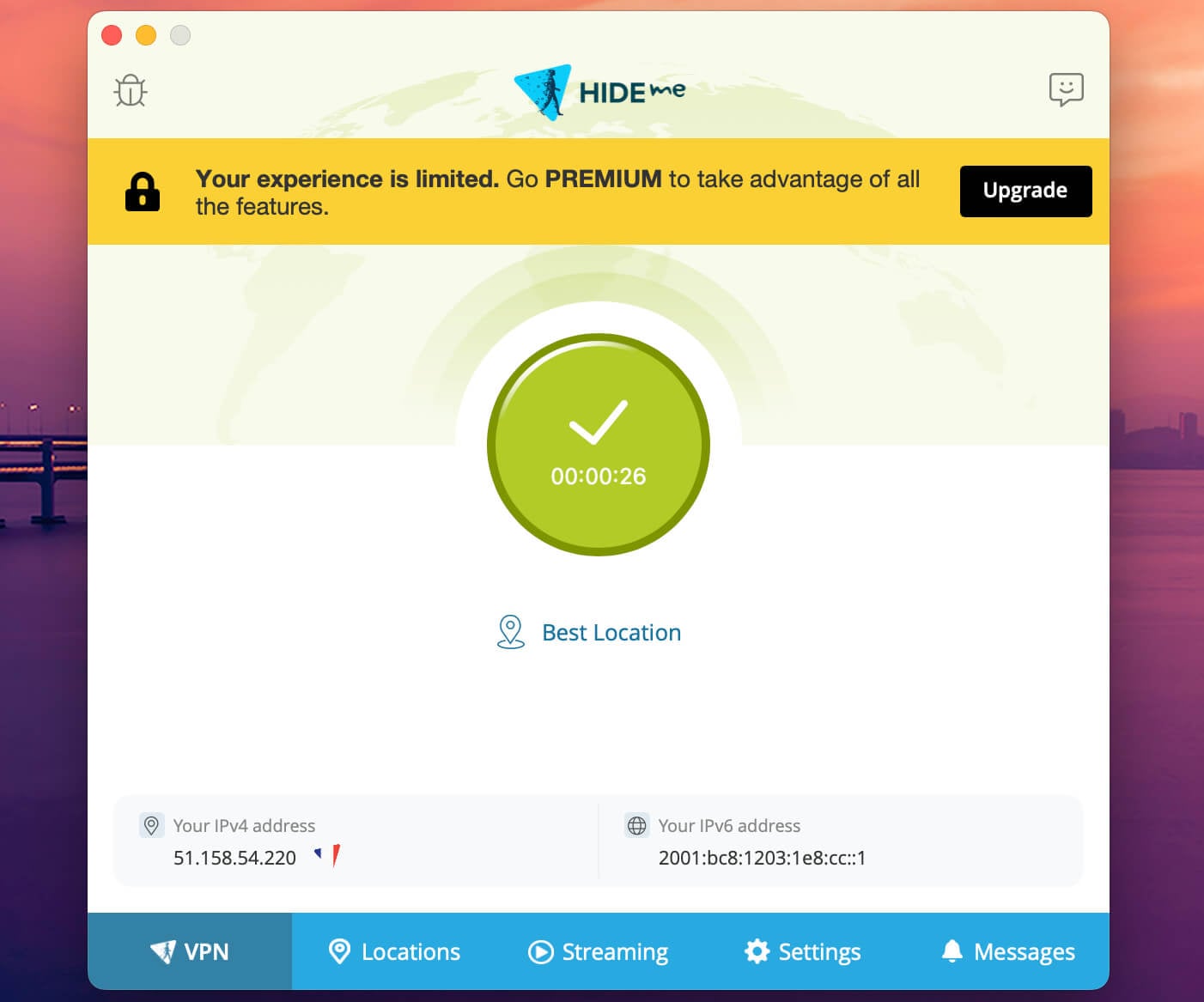
Hide.me is quick on nearby servers and slower on distant ones: 182.62 Mbps to London, then 127.56 Mbps to Tokyo, a 15.9% average loss. Prime Video and ITV blocked it, and the other 7 platforms opened. Malaysia falls outside the intelligence-sharing agreements, and SmartGuard blocks malicious domains.
Its 57 countries across 92 locations make up the second-smallest network of the ten. Its free tier allows unlimited data while blocking P2P and streaming completely. Paid access is $2.69 a month over a 26-month term.
8. IPVanish: An Option When Every Device Needs Cover
Pros
- Every device covered
- Audited no-logs policy
- SOCKS5 proxy
- Threat Protection filtering
- Wide country coverage
Cons
- Poor Netflix access
- No monthly refund
- Partial RAM-only network
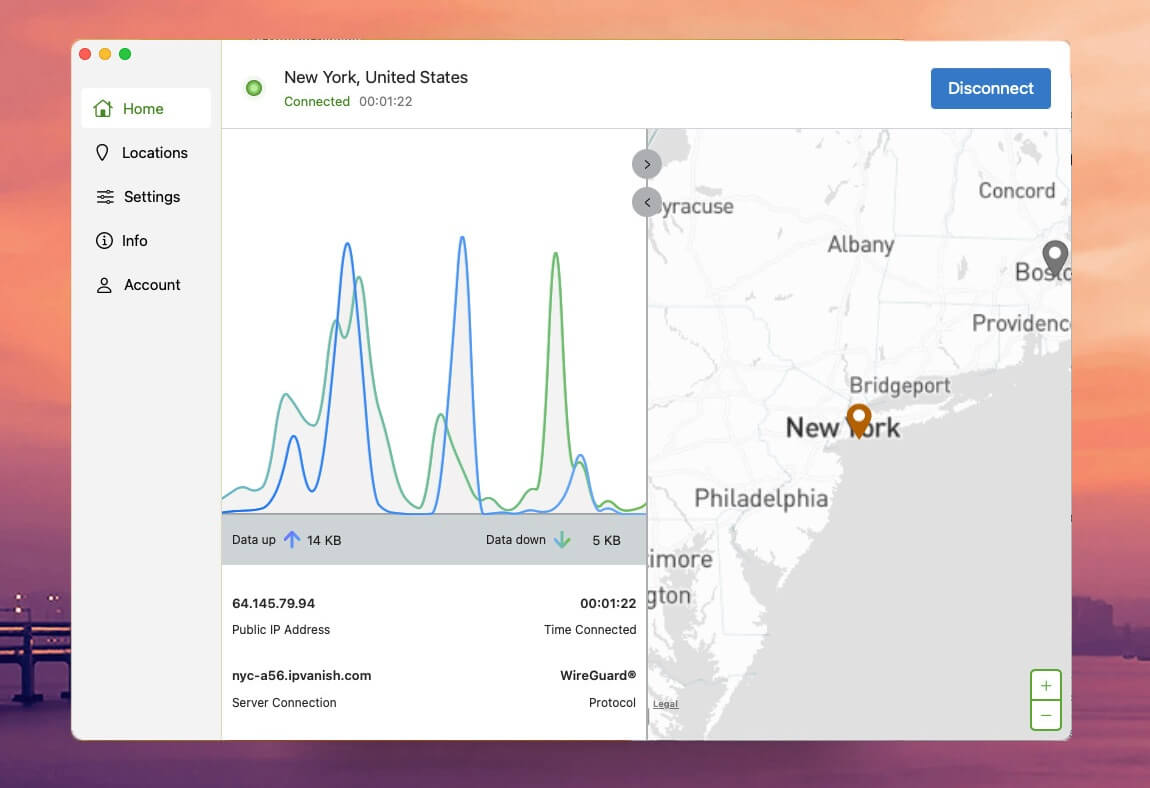
IPVanish came in at 184.82 Mbps to London and then slowed sharply, losing 38.6% on Japanese servers and 21.7% on average. Netflix blocked it in both the US and Canada, and ITV and Prime Video did the same, leaving only 5 platforms of 9. Coverage spans 105 countries across 150 locations, though only some locations use RAM-only servers instead of the whole network.
It’s the only one with no refund on the monthly plan, so a trial means committing to a year. The Essential plan is $2.49 a month across 24 months, and the Advanced plan is $3.59 with Threat Protection, a secure browser, and cloud backup.
9. TunnelBear: The Easiest Starting Point
Pros
- Simple interface
- GhostBear obfuscation
- Repeated independent audits
- No connection cap
Cons
- Low speeds
- Minimal streaming access
- No Linux app
- Case-by-case refunds
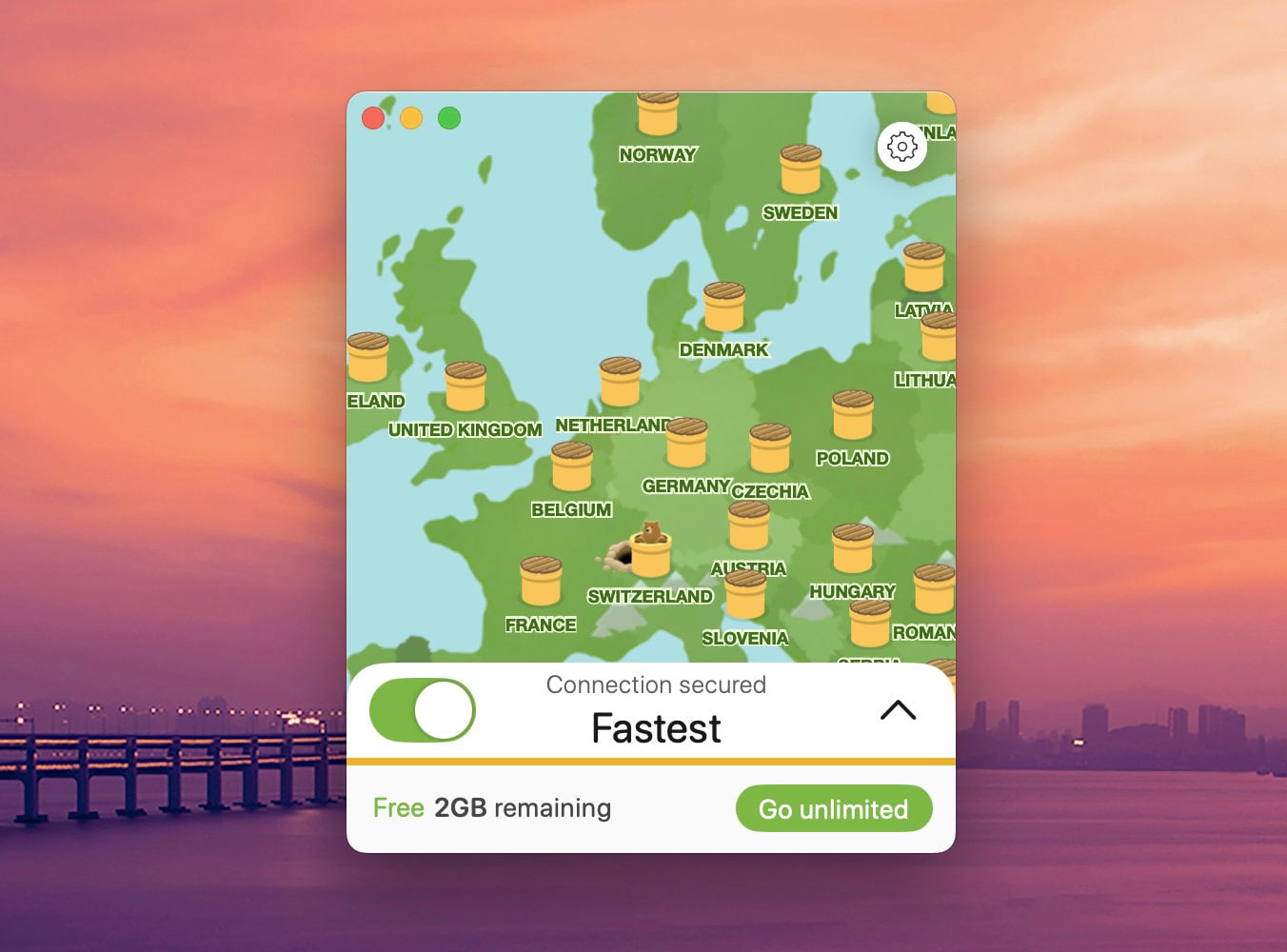
TunnelBear finished last on speed with a 23.9% average loss and a 42.5% drop to Tokyo, and it opened 2 of our 9 platforms: Channel 4 and Netflix US. Everything else detected it. The app is the friendliest of the group, and the audits are genuine, but 47 countries is the smallest network; there’s no Linux client, and support runs by email alone, with a day between replies.
Free use is capped at 2 GB a month, with the server picked for you. Refunds are decided case by case on request, with no guarantee attached. The 3-year plan is $3.33 a month. See our free unlimited VPN data guide for alternatives.
10. Hotspot Shield: A Fallback for Filtered Networks
Pros
- Hydra protocol obfuscation
- Cheap opening year
- Built-in DNS filtering
- Tor routing supported
Cons
- Logs visited domains
- Costly renewal
- Disk-based servers
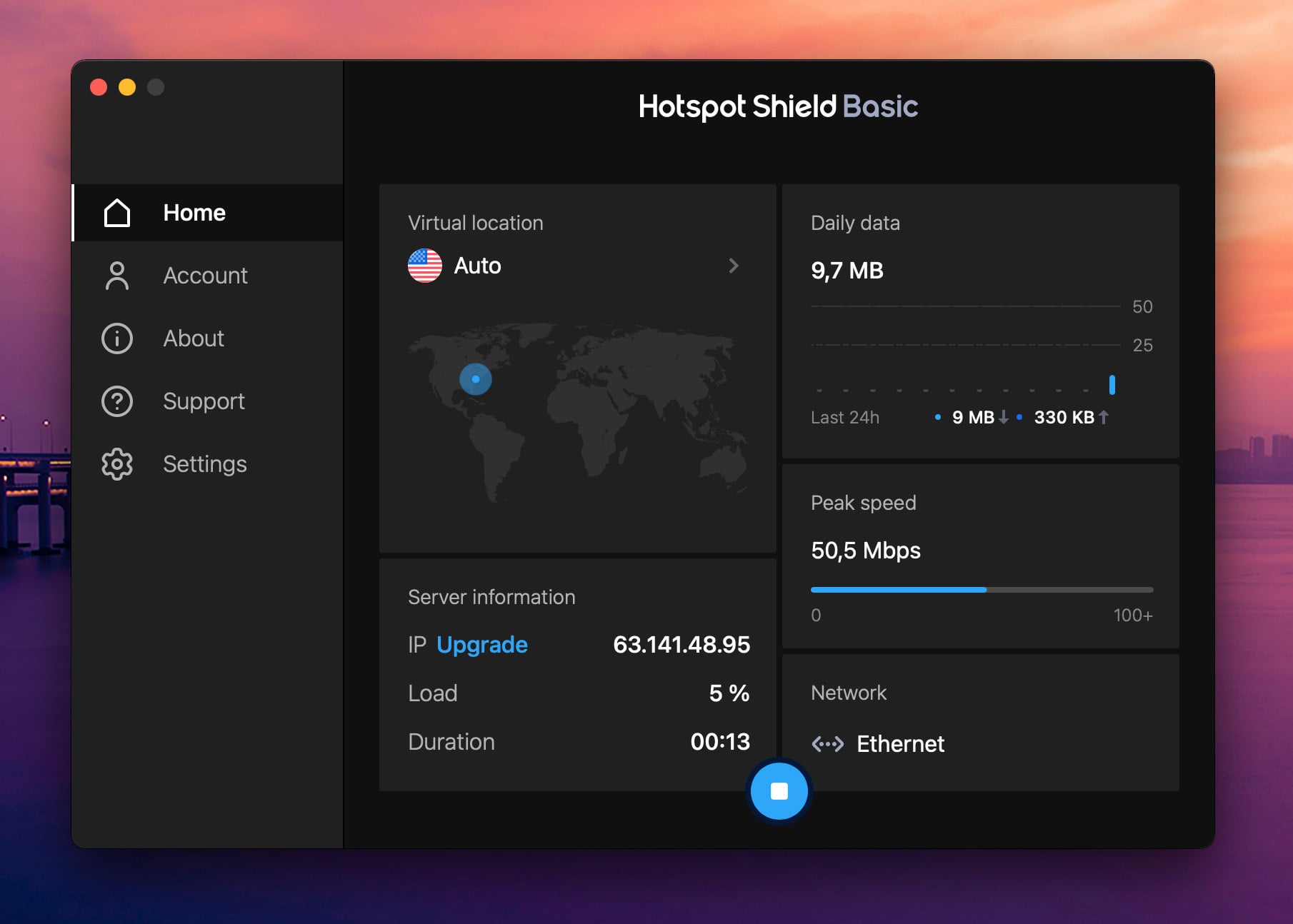
Hotspot Shield’s Hydra protocol is built on OpenVPN TLS and works on lightly filtered networks, and that’s its one clear strength. Speed was near the bottom at a 22.2% average loss, and it opened 5 of 9 platforms, with Prime Video, Netflix Japan, ITV, and HBO Max all blocking it. The privacy notice is where it falls short. It states that the VPN products record the domain names users visit, stripped of full addresses and pooled anonymously.
Session length, bandwidth, and a device ID used for marketing are logged too. Its servers write to encrypted disks, with no RAM-only option. Premium costs $29 for the first year, then $95.99 annually, covering 80 countries and 10 devices with 45 days to claim a refund. It’s a good VPN to use on Linux thanks to its GUI.
How We Tested These VPNs
Every VPN went through the same September 2026 round on the same connection.
| What we tested | How |
|---|---|
| Baseline connection | 190.36 Mbps down, 19.37 Mbps up, 10 ms ping |
| Location and device | Southeastern Europe, Windows 11 desktop |
| Speed tool | Speedtest, 3 runs per server |
| Server locations | UK, US, and Japan |
| Protocol | Fastest one each app offers |
| Streaming platforms | Netflix US, Canada, and Japan, BBC iPlayer, Channel 4, ITV, Pluto TV, Prime Video, HBO Max |
| Browser state | Cookies and cache emptied before each session |
| Also checked | IP and DNS leaks, live chat response time |
ITV and Prime Video blocked or intermittently blocked 7 of the 10 VPNs. BBC iPlayer blocked only one, so Netflix is no longer the hard test in this category. None leaked an IP or DNS request at any point, and a uniform pass tells the ranking nothing, so it plays no part in the final order. Every live chat opens with an AI chatbot. PIA VPN, NordVPN, ExpressVPN, and Surfshark passed us to a human within 20 seconds.
Proton VPN took about a minute. Rankings change when a new round says they should. Prices and networks move faster than we can retest, so we recheck both against each company’s own pages before every update. See which is the fastest VPN of the group in our separate ranking.
Browser Extensions Beat the Apps on Streaming
One result surprised us enough to repeat it. Where a desktop app was detected, the browser extension often wasn’t. The NordVPN, Surfshark, and ExpressVPN extensions, with location spoofing switched on, opened every platform we tried. That includes the ones with their own desktop apps that couldn’t. This also helps with unblocking a blocked site and using a VPN at school, where the restriction comes from the network instead of the platform or website itself.
Why We Avoid Free VPNs
Free plans limit data, run slower, and cut the feature list down. Some log traffic, which defeats the point. Hola VPN and Urban VPN are examples worth staying away from. There are exceptions, and they come with conditions. Proton VPN’s free tier gives unlimited data but assigns the server for you, so it can’t target a country. Hide.me’s blocks P2P and streaming, and TunnelBear’s monthly allowance runs out quickly. Our guide comparing free VPN services covers what each one allows.
Which VPN Should You Get
NordVPN takes the top spot on its US speed, a clean sweep of our streaming tests and 6 audits behind its no-logs claim. The 60 ms UK ping is the one thing we’d change about it. Proton VPN suits a privacy-first setup with Swiss jurisdiction and open-source apps if slow support is acceptable. ExpressVPN matched NordVPN’s average and beat every other VPN to Japan. PIA costs the least to get, Surfshark removes the device limit, and CyberGhost gets a VPN onto a TV without an app.
Positions 7 through 10 answer specific needs, and the top 6 cover everything else. Refunds last 30 days, apart from IPVanish on a monthly plan, and CyberGhost allows 45. If the choice is open, take the two that tied. NordVPN and ExpressVPN lost the least speed and opened on every platform. NordVPN was quicker to US servers and ExpressVPN to Japanese ones, so the destination decides it.
Frequently Asked Questions
Are VPNs legal?
Yes, across most of the world, including the US, Europe, and Australia. Oman, Iraq, North Korea, Turkmenistan, and Belarus restrict or ban them.
Do I really need a VPN?
No, not for every situation. A VPN pays off on public Wi-Fi, for keeping an ISP out of browsing history, and for services that check location.
How do you set up and use a VPN?
Subscribe, install the app on the device, sign in, then pick a country and connect. Setup takes a few minutes, and connecting afterwards is a single click.
How much does the best VPN cost?
Long-term plans from the leading services cost between $2 and $4 a month, paid up front. Monthly billing costs roughly 4four times that.
What is the most secure VPN?
Proton VPN and NordVPN lead among the most secure VPN options, with Swiss and Panamanian jurisdiction, audited no-logs policies, and multi-hop routing. NordVPN adds ID theft protection.
What is the best VPN server to connect to?
The nearest one, for gaming, torrenting, and general browsing, since latency climbs with distance. Streaming is the exception and requires a server in the country that owns the distribution rights.
Which VPN has a dedicated IP address?
NordVPN, CyberGhost, ExpressVPN, and Surfshark sell a dedicated IP address as a paid add-on. Surfshark also includes a static IP address at no extra cost.