A second encrypted hop is meant to cost a quarter of your download speed. NordVPN’s Double VPN cost 2.9%: 179.43 Mbps on the British server, against 184.73 Mbps on the direct connection, with 4 ms added to the ping. OpenVPN produced the second surprise of this NordVPN review, finishing 1.9% behind NordLynx across three server locations. NordWhisper is where the bill arrives.
It returned 161.13 Mbps, and the ping climbed from 42 ms at idle to 180 ms while downloading and 808 ms while uploading. Three more results shape the verdict. Threat Protection Pro blocked 103 of 135 domains on d3ward’s test, or 76%. The kill switch passed both failure modes. On several days, the Windows app wouldn’t connect, which I had to fix by resetting the app.
NordVPN
NordVPN loses the least speed of any VPN we've measured on American servers, and its Double VPN costs under 3%, which no rival comes close to matching. Six independent no-log audits back the privacy claim. The Windows app is unpredictable about connecting, the interface takes a week to learn, and the renewal costs 3.3 times the opening rate.
Pros
- Fastest US servers measured
- Double VPN costs little
- Six no-log audits
- App-level kill switch
- Malware and file scanning
- Widest country coverage
- Every streaming service opened
Cons
- Unpredictable Windows connections
- High renewal price
- No port forwarding
NordVPN Review: Quick Look
| Starting price | $3.49 per month, $94.23 for 27 months (Basic plan) |
| Renewal | $139.08 a year on the Basic plan, so $11.59 per month |
| Money-back guarantee | 30 days, refunded in 10 minutes in our test |
| Protocols | NordLynx, NordWhisper, OpenVPN UDP and TCP, IKEv2 |
| No-log policy | Yes, six independent audits since 2018 |
| Countries | 152, counted in the app |
| Download speed loss | 7.8% averaged across our three server locations |
| Upload speed loss | 5.5% averaged |
| Double VPN | Yes, and it cost 2.9% of download speed |
| Streaming | All 14 streaming services we tested |
| Port forwarding | No |
| Ad and tracker blocking | Threat Protection Pro, 76% on d3ward’s test |
| Simultaneous connections | 10 |
| Supported platforms | Windows, macOS, Linux, iOS, Android, Fire TV, Apple TV, routers, browsers |
| Customer support | 24/7 live chat, email, help center |
NordVPN Speed Test Results
For this review, we measured on a 190.36 Mbps connection on Windows 11 from Europe, via Ethernet, using Speedtest. Each location was checked at three times of day across three days. The protocol was NordLynx, which the app selects on its own. The American figure is the standout of this NordVPN review.
| Server | Download | Upload | Ping | Download loss |
| No VPN | 190.36 Mbps | 19.37 Mbps | 10 ms | n/a |
| UK | 184.73 Mbps | 18.69 Mbps | 60 ms | 3.0% |
| US | 181.50 Mbps | 18.66 Mbps | 118 ms | 4.7% |
| Japan | 160.47 Mbps | 17.57 Mbps | 251 ms | 15.7% |
| Average | 175.57 Mbps | 18.31 Mbps | n/a | 7.8% |
At 181.50 Mbps across the Atlantic, NordVPN lost 4.7%. No VPN we have measured did better on that server location. Japan is the expensive one, though 160.47 Mbps still covers 4K on several screens. The 60 ms ping to the UK was higher than I honestly expected. Several rival apps return a lower ping from America. On a European server this close, 60 ms should be lower. Streaming and browsing don’t notice; competitive gamers may.
NordLynx, Double VPN and NordWhisper Compared
For this review, we measured each protocol on the same British server, in the same session. We also timed each one from a cold launch.
| Protocol | Download | Upload | Ping | Connection time |
| NordLynx | 184.73 Mbps | 18.69 Mbps | 60 ms | 2 seconds |
| Double VPN | 179.43 Mbps | 15.93 Mbps | 64 ms | 3 seconds |
| NordWhisper | 161.13 Mbps | 16.07 Mbps | 42 ms | 4 seconds |
| OpenVPN | 183.25 Mbps | 18.61 Mbps | 54 ms | 3 seconds |
Double VPN is the surprise. Two servers in different countries cost 2.9% of the download speed and 4 ms of ping. That makes the feature usable every day. Upload took the larger hit, dropping to 15.93 Mbps. NordWhisper reverses that picture. The idle ping of 42 ms looks excellent, and it hides what happens under load. While the line was saturated, ping climbed to 180 ms on download and 808 ms on upload.
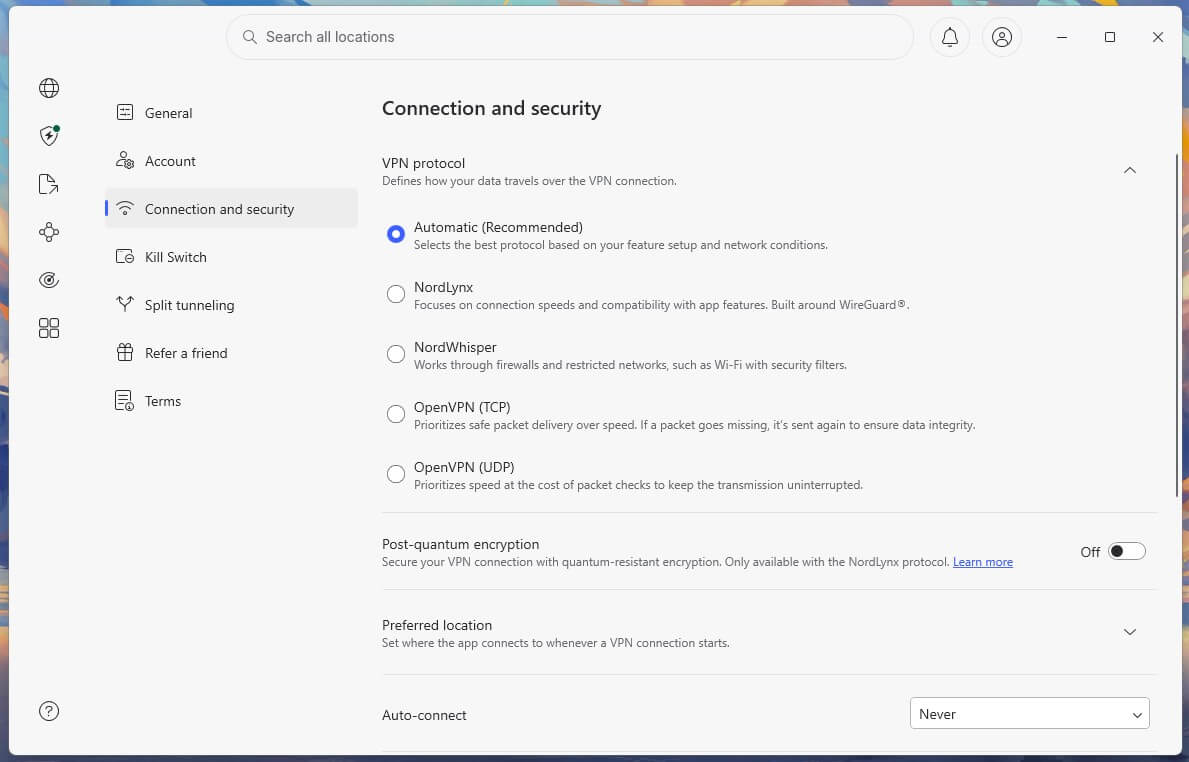
A video call or a game on NordWhisper will stutter whenever something else on the network starts moving data. Therefore, it belongs on a network that blocks NordLynx, and nowhere else. OpenVPN is the other surprise. Across the same three server locations, it averaged 172.31 Mbps and 18.06 Mbps upload, a 9.5% download loss. That puts it 1.9% behind NordLynx, where the older protocol trails by far more. Its 54 ms UK ping also beat NordLynx’s 60 ms.
NordVPN Price and Plans
Three tiers share the same VPN, and this review tested the Prime plan. The differences are security tools, not connection quality. The 2-year terms arrive with three extra months, so the first term covers 27 months.
- The Basic plan: $3.49 a month, $94.23 for 27 months, then $139.08 a year. Covers 10 devices and includes the VPN alone, with no ad blocking and no malware protection.
- The Complete plan: $4.49 a month, $121.23 for 27 months, then $219.48 a year. Adds Threat Protection Pro, the ad and tracker blocker, bank transaction monitoring, NordPass, and 1 TB of NordLocker storage.
- The Prime plan: $7.49 a month, $202.23 for 27 months, then $296.28 a year. Adds Coveron identity protection, with monitoring, alerts, and insurance coverage.
Annual plans cost $5.49, $6.49, and $9.49 a month, and renew at the same yearly figures as the 2-year terms. Monthly plans are $14.99, $19.99, and $29.99. A dedicated IP address is an add-on for $3.69 a month on the 2-year terms. The upgrade worth making is Basic to Complete, since one dollar a month buys Threat Protection Pro. The Basic plan has no ad blocking.
NordVPN coupons move the entry rate through the year. For the price against a freemium rival, see our NordVPN vs Windscribe comparison. The renewal is the weak point. At $139.08 a year, the Basic plan costs 3.3 times its opening rate once the first term ends. The same multiple applies further up the range, and the PureVPN review covers the budget end of the market.
Refunds, the Free Trial and Payment
Every plan includes a 30-day money-back guarantee. For this review, we requested a refund on a secondary account through live chat, paid by PayPal. The money was back in 10 minutes. The agent asked for a reason from a dropdown and processed it without a retention pitch.
There is no free plan. The NordVPN free trial on Android is 3 days through the Play Store, which we confirmed on the phone. iPhone users are neglected; they can’t claim NordVPN’s free trial. It requires a card, so cancel before it ends. Payment methods are card, Google Pay, PayPal, and cryptocurrency through CoinGate.
NordVPN Security Review: The Features Tested
The security set is the broadest in this category. Two parts of it are worth the price on their own.
The Kill Switch Works at App Level
Most VPNs offer one kill switch: the tunnel drops, the internet stops. NordVPN adds an app-level version, where you name specific applications and only those lose their connection when the tunnel fails. A torrent client can be cut while the browser keeps working. We tested the standard switch on Windows 11.
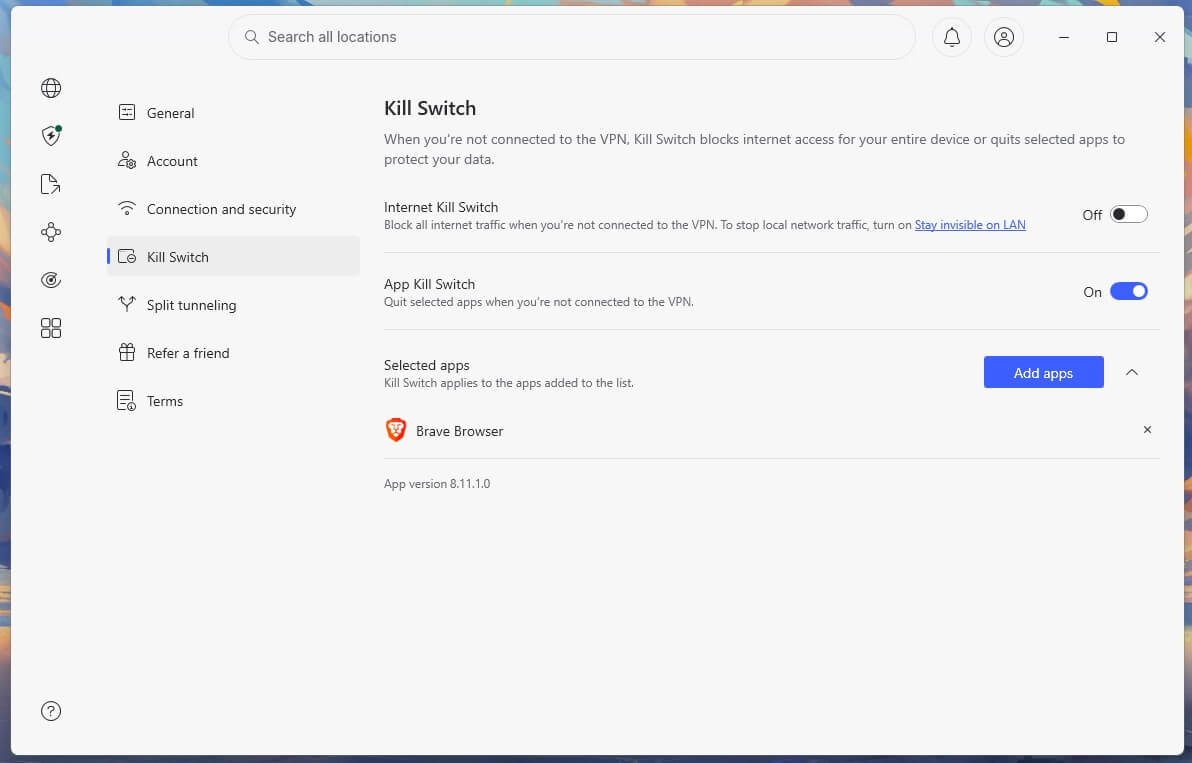
First, the Ethernet cable was pulled mid-session. Second, the app process was killed from Task Manager, with a continuous ping active. No packets escaped in either test. The kill switch guide explains what each version protects.
Threat Protection Pro Scored 76% in Our Review
Threat Protection Pro is three tools under one switch, and it works with the tunnel disconnected, since malware doesn’t wait for a VPN.
- Anti-malware: scans downloaded files and quarantines them, plus a vulnerability scanner for installed apps. It is not a replacement for dedicated malware removal software.
- Advanced browsing protection: malicious site blocking, scam alerts, hijacked session warnings, search result safety flags, email link scanning, and a crypto wallet address checker.
- Ad and tracker blocker: ad blocking, tracker blocking, a cookie banner hider, and a URL cleaner that strips tracking parameters from links.
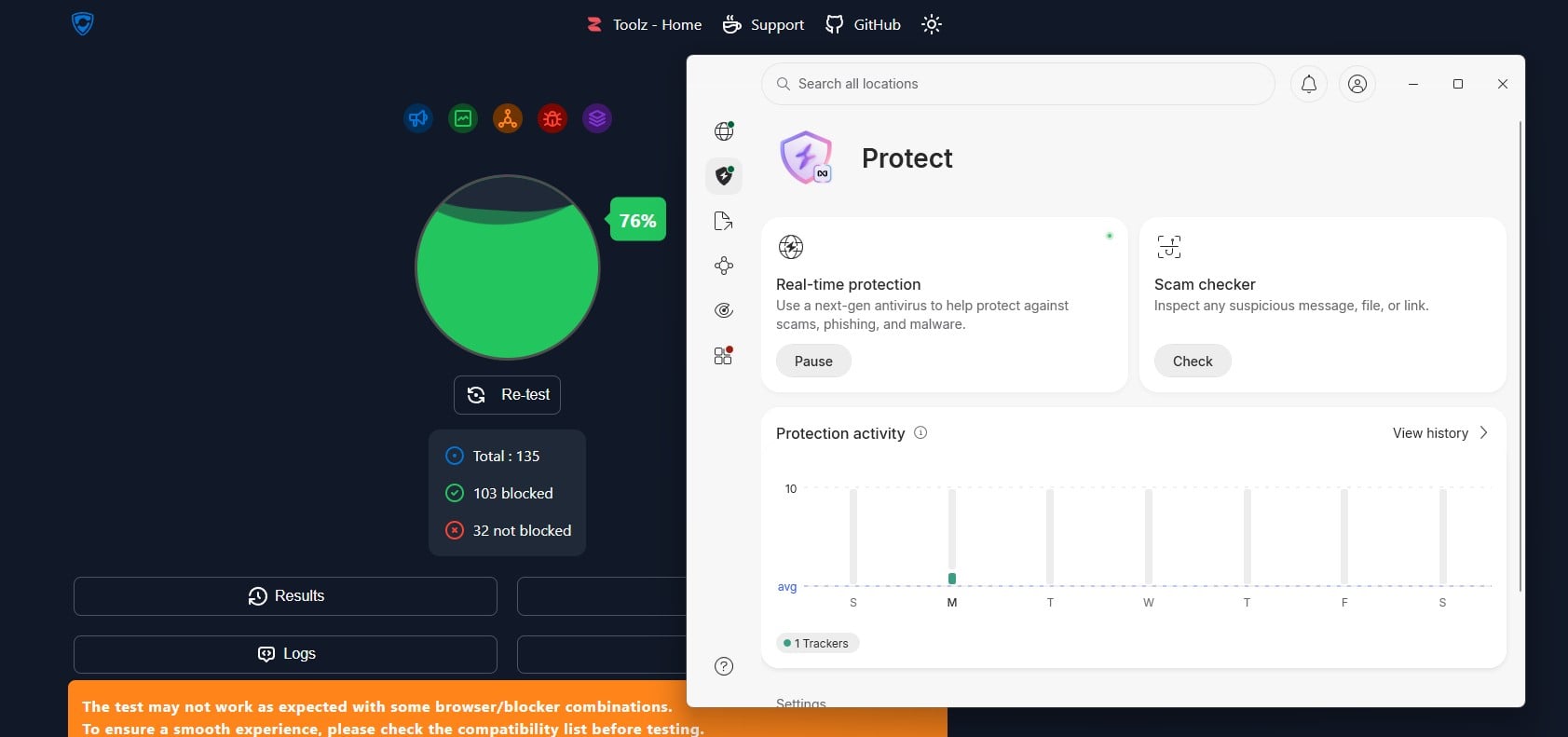
On d3ward’s blocklist test, it stopped 103 of 135 domains, or 76%. Here is that figure beside the other ad blockers we have measured on the same test:
| Blocker | Domains blocked |
| PIA MACE | 96% |
| Proton VPN NetShield | 93% |
| NordVPN Threat Protection Pro | 76% |
| ExpressVPN Advanced Protection | 71% |
Only the third group shows up in a domain test, so 76% measures a fraction of the feature. Even so, 32 domains getting through is enough to notice on an ad-heavy news site. The Basic plan includes none of it.
Specialty Servers
- Double VPN: two encrypted hops through different countries, at a measured cost of 2.9% download speed.
- Obfuscated servers: OpenVPN TCP disguised as ordinary HTTPS traffic, for networks that block VPN connections.
- Onion over VPN: a Tor hop after the tunnel, in the Netherlands, Sweden, and Switzerland. Slow, as Tor always is, and a way to open the dark web without a separate browser.
- Dedicated IP: an add-on address assigned to one subscriber, which cuts CAPTCHAs and bank login blocks.
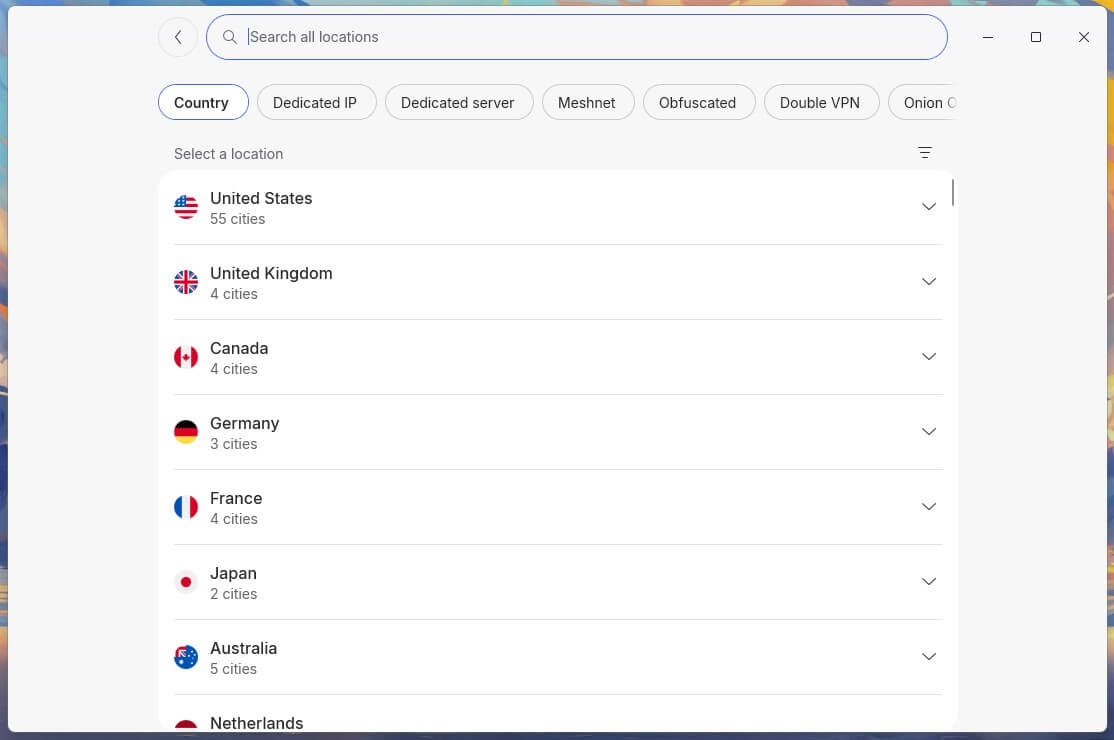
NordVPN removed its dedicated P2P servers. Every server now accepts P2P traffic instead, so the change costs torrent users nothing.
Meshnet Is Still Here
Meshnet links up to 60 devices over encrypted tunnels for file transfers, remote access, and LAN gaming. NordVPN announced its removal for 1 December 2025. Then it reversed the decision in late September, after subscribers objected, and committed to keeping and open-sourcing the feature.
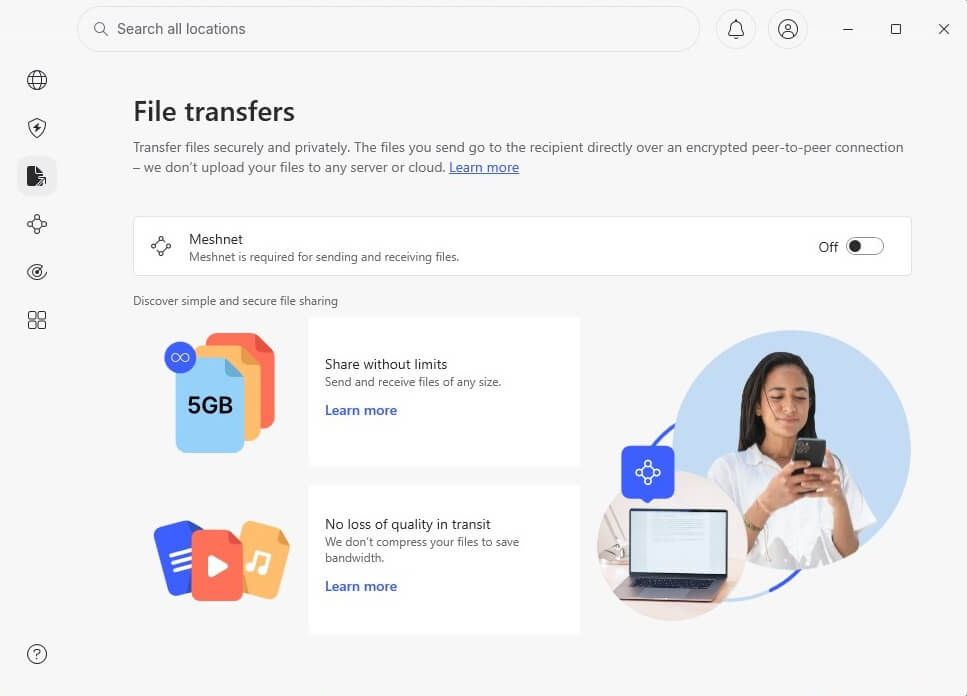
The product director put usage at 1% of subscribers. That explains the shutdown plan, and why most subscribers have never opened it.
NordLynx and Post-Quantum Encryption
NordLynx is built on WireGuard, with a double-NAT layer on top. That layer strips the static IP address WireGuard normally assigns inside the tunnel. The result is WireGuard speed without the record it leaves behind. Encryption is AES-256-GCM, with ML-KEM post-quantum protection across the NordLynx platforms. NordWhisper is the newer protocol, built to pass through networks that filter VPN traffic.
NordVPN Review: IP and DNS Leak Test Results
For this review, we checked ipleak.net and browserleaks.com on the British, American, and Japanese servers. Windows 11 throughout, with the browser cache deleted between sessions. No IP address leaks, no DNS leaks, and no WebRTC exposure. NordVPN replaced our IP address cleanly on every server, and our own appeared nowhere, including the IPv6 test.
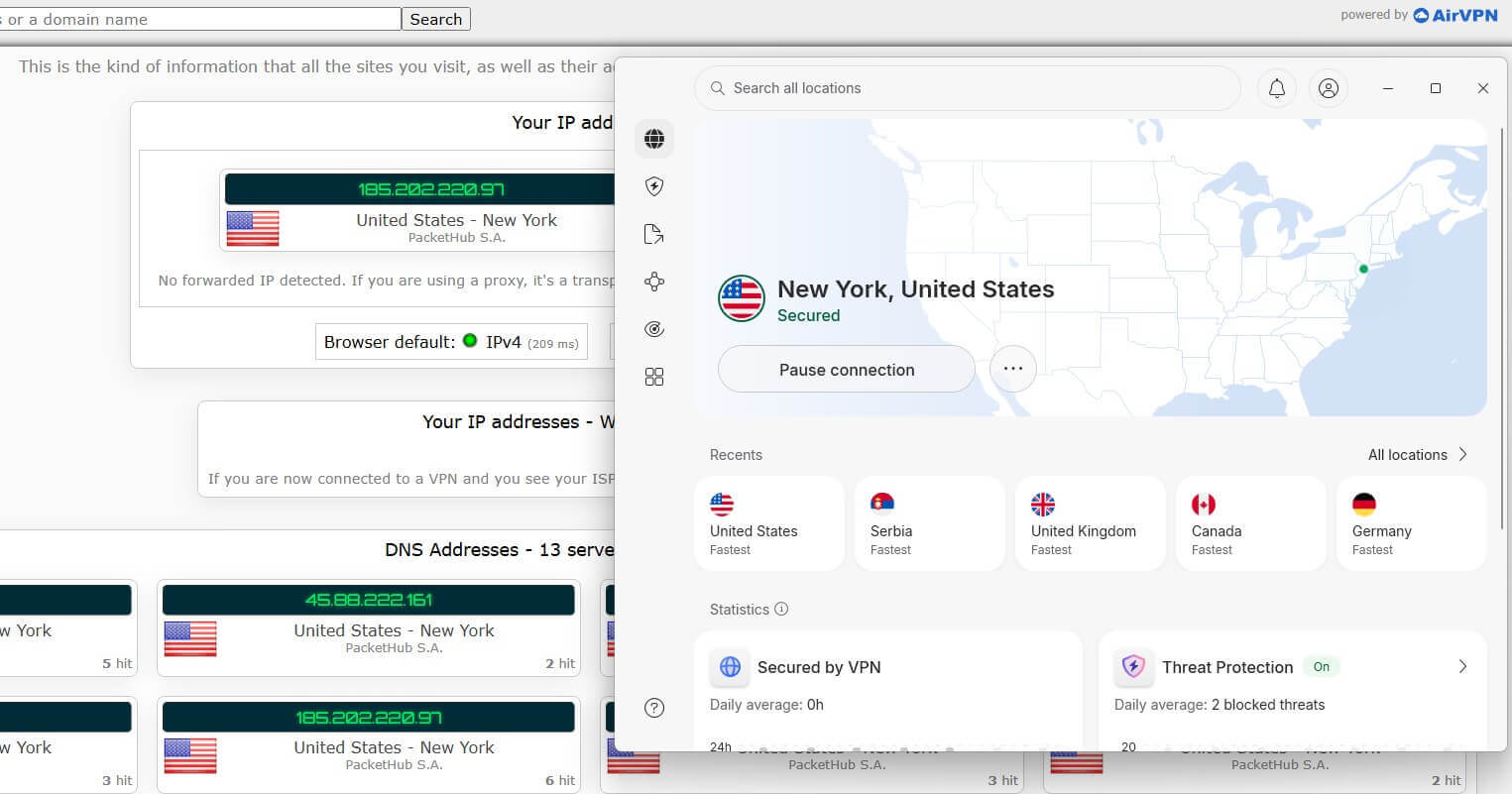
NordVPN operates its own DNS resolvers instead of passing queries to a third party. The same no-log policy covers them. We confirmed the active resolver in a packet capture: queries went to NordVPN’s address range, not our ISP’s.
NordVPN Privacy Review: Does It Keep Logs?
No. NordVPN is headquartered in Panama. The country has no mandatory data retention law and belongs to none of the intelligence-sharing alliances. Jurisdiction decides what a government can compel, and Panama compels very little. We read the privacy policy in full. Every VPN keeps something to make the service work, so the question is what falls on each side of the line.
| Not stored | Stored |
| IP addresses | Email address and payment details |
| DNS requests | Last-session metadata, to enforce the 10-device limit |
| Browsing history | A flag showing whether the account connected in the past 30 days |
| Bandwidth used | Server load and diagnostics, anonymized at source |
| Traffic logs |
The left column matches the no-log standard a privacy VPN should meet. Nothing in the right column identifies a subscriber or ties one to a session. Threat Protection Pro has its own section in the policy, since scanning URLs and files processes more than the tunnel does.
NordVPN states the scanning happens locally where possible, with anonymized backend checks where not. That carve-out is worth reading before switching the feature on. Alternatives with different trade-offs appear in our NordVPN vs PureVPN and NordVPN vs Mullvad comparisons.
Six Independent Audits
The policy is one thing and the verification another. NordVPN has completed six no-log assurance engagements since 2018. PwC completed the first two, in 2018 and 2020. Deloitte has done the last four, in 2022, 2023, 2024 and 2025. The most recent covered 10 November to 12 December 2025. Deloitte issued the report on the closing date, under the ISAE 3000 (Revised) standard.
The inspection covered the standard servers plus the Double VPN, Onion Over VPN, and obfuscated ones. Auditors also interviewed staff and reviewed configuration files. The report is available to account holders through the Nord Account panel. Read the standard as well as the headline. ISAE 3000 assurance describes how systems are configured during the window inspected.
It says nothing about the days outside it. Six consecutive engagements across eight years is the answer to that, and few VPN companies have that record.
NordVPN Review: Streaming and Torrenting
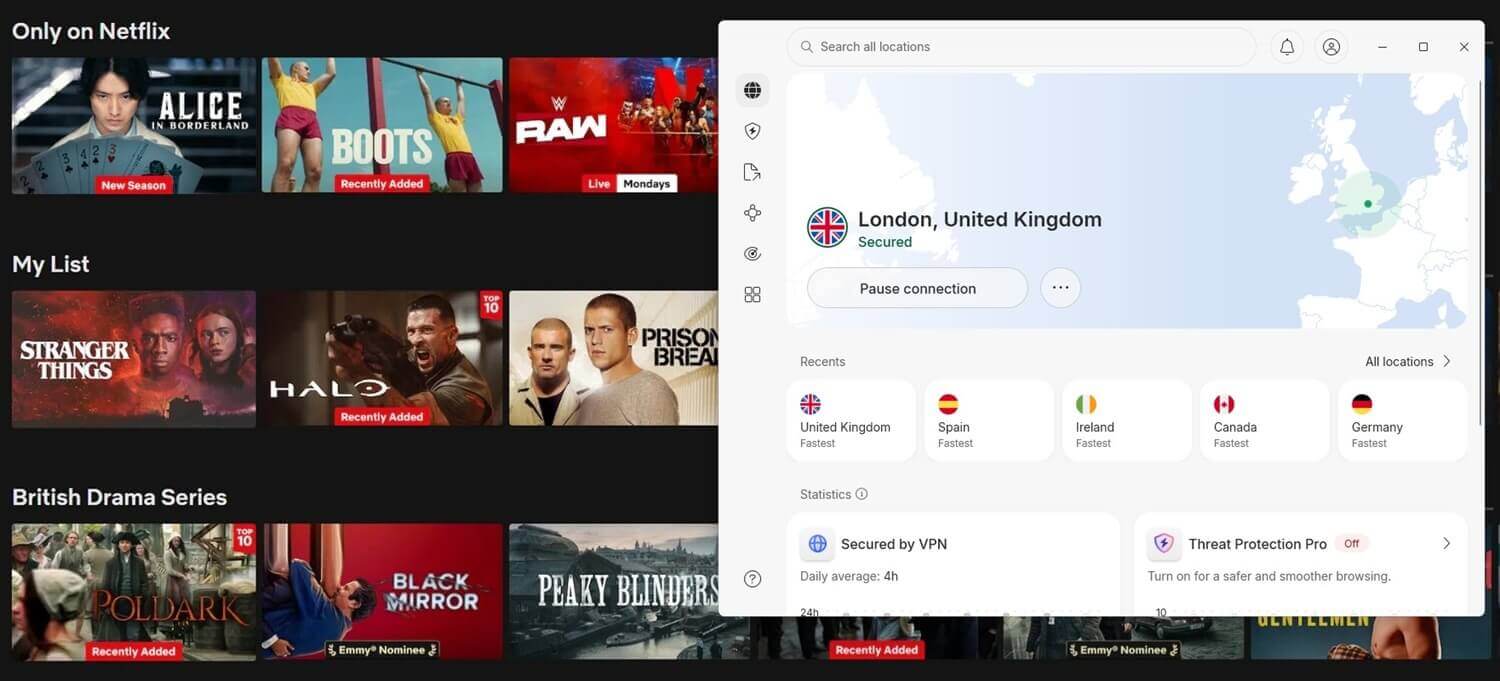
Every one of the 14 streaming services we tested opened, which puts NordVPN in the top group for access. BBC iPlayer streamed at 1080p from the London server, and JioHotstar opened from Mumbai. Two qualifications apply.
| Netflix US | BBC iPlayer | ITVX | Hulu | Prime Video | Disney+ |
| Opened | Opened | Opened | Opened | Opened | Extension only |
Pluto TV and Prime Video detected the connection on a few attempts and wanted a different server in the same country. Disney+ blocked the desktop app, as it does with desktop VPN apps generally, and opened only with location spoofing switched on in the browser extension.
For torrenting, every server accepts P2P and speeds are quick enough that the tunnel is not the limit. The missing piece is port forwarding.
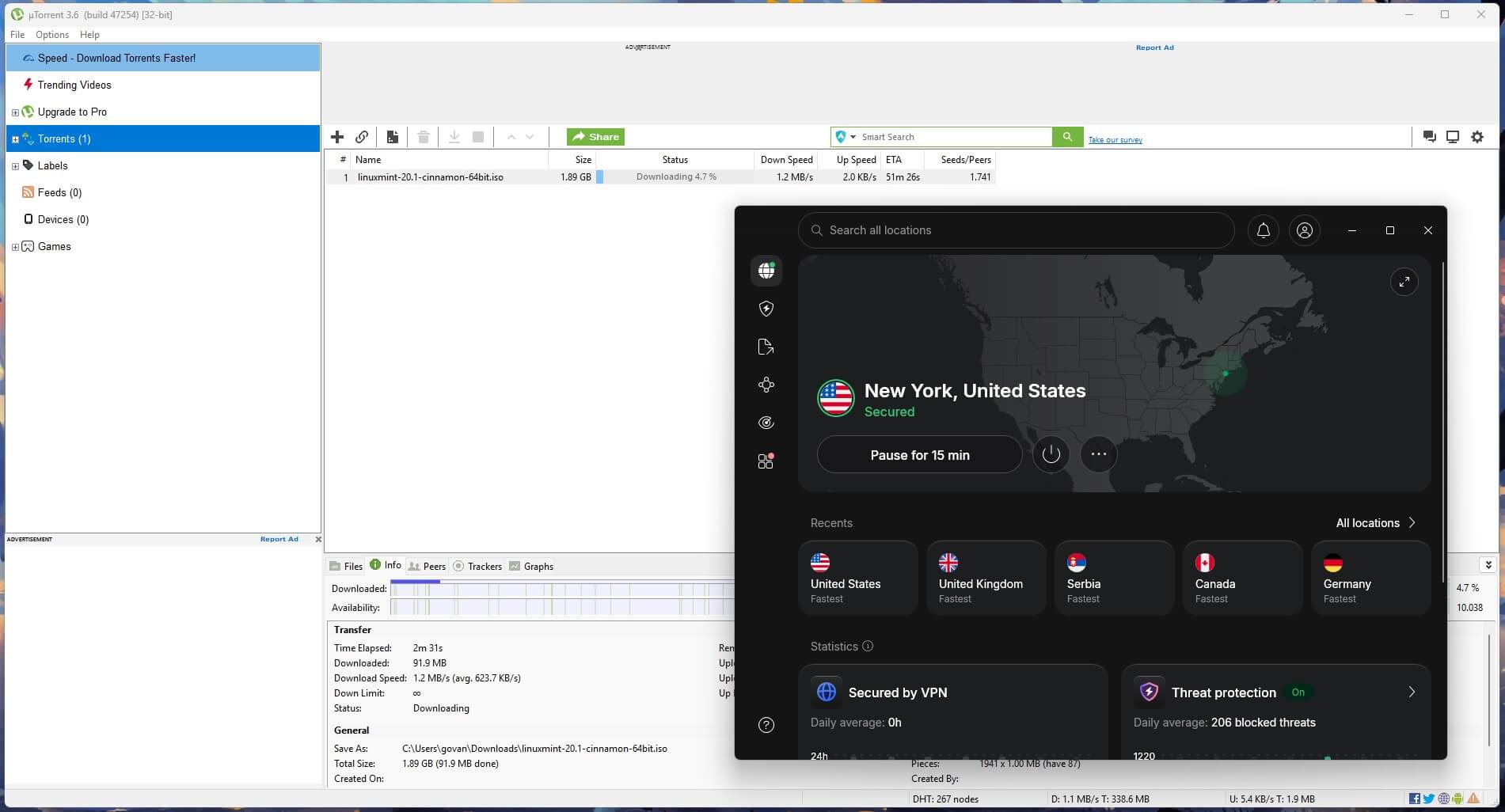
Seeding ratios on private trackers depend on an open port, so that audience is better served by Private Internet Access, which I tested recently. Other torrent users can bind a client to NordVPN’s SOCKS5 proxy instead.
Server Network and Coverage
The app lists 152 countries, the widest country coverage in the category, with city-level entries in the larger markets. The whole network is RAM-only, so every reboot wipes the server. Some locations are virtual, where the IP address belongs to the advertised country while the hosting happens elsewhere. NordVPN labels those in the server list, which it didn’t do two years ago.
Coverage extends to places most VPNs skip, including the UAE, India, and several African countries. Smart DNS covers devices where a VPN app can’t be installed, such as older game consoles and smart televisions from Samsung and LG. It changes the streaming location and encrypts nothing, so treat it as an unblocking tool since it encrypts nothing.
Does NordVPN Work in Censored Countries?
We haven’t tested NordVPN in China. The mechanism is the obfuscated server list, which disguises VPN traffic as ordinary HTTPS, with NordWhisper as the newer alternative. Both require installing the app before arrival, since the website is blocked inside the country. Our NordVPN in China page tracks which servers keep working, and the NordVPN vs Astrill comparison covers the hardest cases.
On networks that filter instead of banning, including a hotel connection that blocked NordLynx, obfuscation opened everything at the speed cost measured further up. Russia is the harder case, since NordVPN withdrew its servers in 2019 and users connect through neighboring countries instead.
NordVPN App Review: Ease of Use
The apps look modern, and the side panel is busy, with icons for features that several plans don’t include. The map view is the default on desktop and looks better than it works: typing a country name into the search box beats scrolling a globe every time. Connections took 2 seconds on NordLynx, 3 on OpenVPN, and 4 on NordWhisper. The mobile app includes almost everything the desktop version does, including Threat Protection.
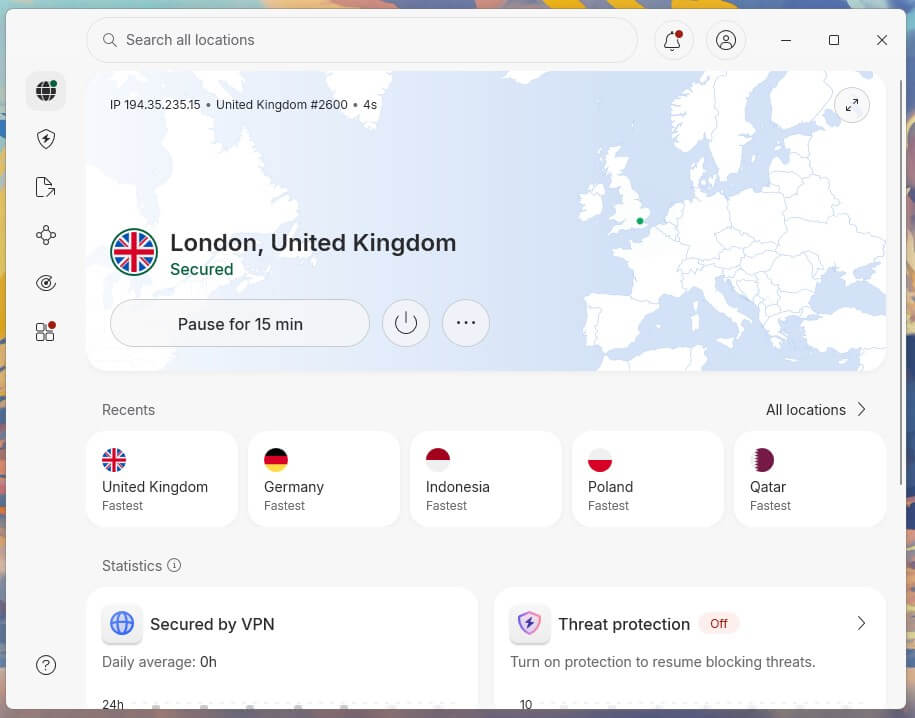
File scanning is absent on iOS, since Apple’s sandbox blocks it. The subscription covers 10 devices. Browser extensions are proxies, not full tunnels. They protect browser traffic, with WebRTC leak protection. Our Chrome extension guide covers those. One fault appeared throughout the test period.

On some days, the Windows app connected in 2 seconds. On others, it wouldn’t connect, and clearing it took NordVPN’s own diagnostics, an app restart and a fresh sign-in. We could find no pattern, and that unpredictability is worse than a fault that reproduces.
Compatibility
- Windows, macOS and Linux computers
- iOS and Android phones and tablets
- Fire TV, Apple TV and Android TV, including Nvidia Shield
- Routers (Asus, pfSense, Tomato, DD-WRT)
- Game consoles through a router or Smart DNS
- Chrome, Firefox, Edge and Brave extensions
NordVPN Customer Support Review
Live chat opens with a bot, and the transfer to a human took under 20 seconds on every attempt. Agents answered product questions properly instead of falling back on a script. The documentation is good enough that we point people to it, including the iPhone setup guide.
Threat Protection Pro also feeds the Dark Web Monitor, which checks a registered email address against breach databases and names the source of each hit. Identity monitoring on the Prime plan comes from Coveron, and our identity theft protection guide covers the standalone alternatives.
NordVPN Review: Conclusion
This review ranks NordVPN as the closest thing this category has to a default. The connection never becomes the thing you think about, the feature set covers every device in a normal household, and the verification behind the no-log claim is the deepest we have checked. The trade is a Windows app that sometimes won’t start a session, with no cause we could trace, and a renewal well above the opening rate.
- Get NordVPN if you want the fastest American servers, you use a second hop often enough to care what it costs, you want malware scanning and ad blocking inside the VPN, or you value an audit record that covers the specialty servers as well.
- Skip NordVPN if you seed on private trackers and require port forwarding, you want an app that never requires troubleshooting, or you want the lowest possible renewal price.
For the wider picture, the fastest VPN ranking covers speed, while NordVPN vs Norton VPN and NordVPN vs Bitdefender weigh the security suites against antivirus brands, and the NordVPN alternatives guide covers everything else.
Frequently Asked Questions
Is NordVPN worth it?
Yes. NordVPN combines the fastest American servers we have measured with malware scanning, a Double VPN that costs almost no speed, and six independent no-log audits.
How much does NordVPN cost?
The Basic plan costs $3.49 a month on the two-year term, $94.23 for 27 months, and renews at $139.08 a year. The Complete plan costs $4.49, and the Prime plan $7.49.
Does NordVPN keep logs?
No. NordVPN operates from Panama, stores no IP addresses, DNS requests, or browsing history, and has passed six independent no-log audits by PwC and Deloitte.
Is Double VPN slow?
No. A second encrypted hop through another country costs 2.9% of download speed and 4 ms of ping, which is low enough to leave it enabled.
Does NordVPN work with Netflix?
Yes. NordVPN opens Netflix libraries in the US, Canada, and Japan, along with BBC iPlayer, ITVX, and Hulu.
Does NordVPN have a free trial?
Yes, on Android. The Play Store offers a 3-day trial, and it requires a card, so cancel before it ends.
Is NordVPN good for torrenting?
Yes. Every server accepts P2P traffic and speeds stay high, though NordVPN offers no port forwarding, which limits seeding on private trackers.
What is NordWhisper?
NordWhisper disguises VPN traffic as ordinary web traffic to pass through networks that block VPNs. It costs more speed than NordLynx and increases ping under load.